

A significant share of marketing leaders have had to revise their outbound strategies in response to tightened GDPR enforcement. The Dutch Data Protection Authority recently demonstrated this shift by imposing a €4.75 million fine on a streaming service whose privacy statements lacked proper transparency—a harbinger of what’s to come.
As the regulatory landscape evolves, the stakes for non-compliance reach beyond organizational penalties to now include personal executive liability for systemic failures. With procedural violation fines increasing 22% since 2023, understanding the shifting gdpr rules outbound sales 2025 framework isn’t merely about compliance—it’s existential. Sales leaders now navigate a complex balance between legitimate interest (which 63% of EU B2B marketers rely on) and explicit consent requirements that vary by sector. For teams conducting international sales campaigns, the regulatory minefield has never been more dangerous—or more consequential.
Contents
- 1 Key Takeaways
- 2 GDPR Enforcement: Escalating Stakes for Sales Teams
- 3 Legal Bases for Outbound Sales: Navigating the Consent Dilemma
- 4 Cross-Border Data Transfers: Stricter Requirements
- 5 Breach Reporting: Tightened Timelines for 2025
- 6 Practical Compliance Strategies for Sales Teams
- 7 Global Impact: Implications for Non-EU Businesses
- 8 FAQ
- 9 Sources
Key Takeaways
- Maximum penalties have increased to €20 million or 4% of global revenue for GDPR violations
- 63% of EU B2B marketers now use legitimate interest as their legal basis for outbound sales
- Critical sectors must report data breaches within 48 hours under 2025 compliance standards
- Non-EU businesses targeting European prospects must appoint a GDPR representative or risk fines
- CRM systems require comprehensive data mapping with clear legal basis labeling for each contact
GDPR Enforcement: Escalating Stakes for Sales Teams
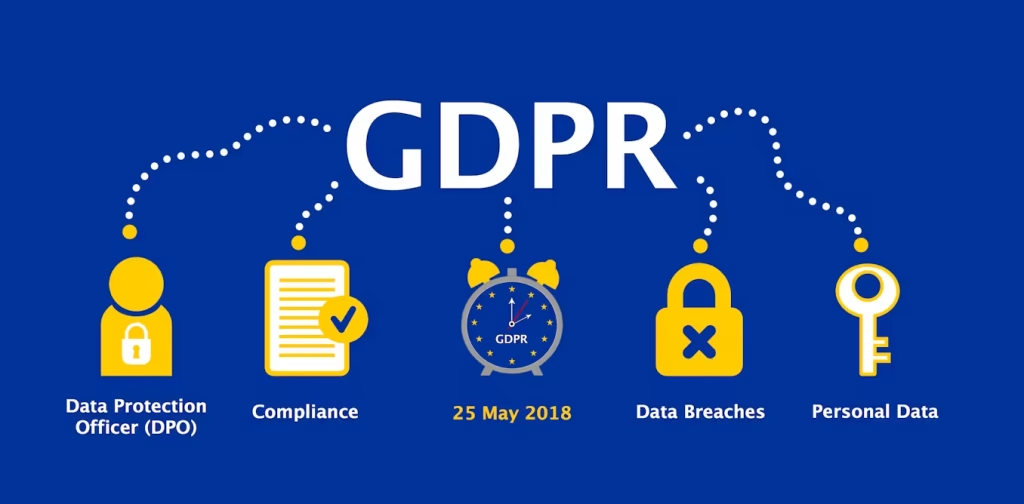
The regulatory environment for outbound sales is transforming fundamentally as we approach 2025. Data protection authorities have shifted from educational approaches to aggressive enforcement, particularly regarding sales and marketing activities. The Dutch Data Protection Authority’s €4.75 million fine against a streaming service in late 2024 exemplifies this trend, highlighting how authorities now scrutinize even procedural violations like incomplete privacy statements.
Financial and Personal Liability
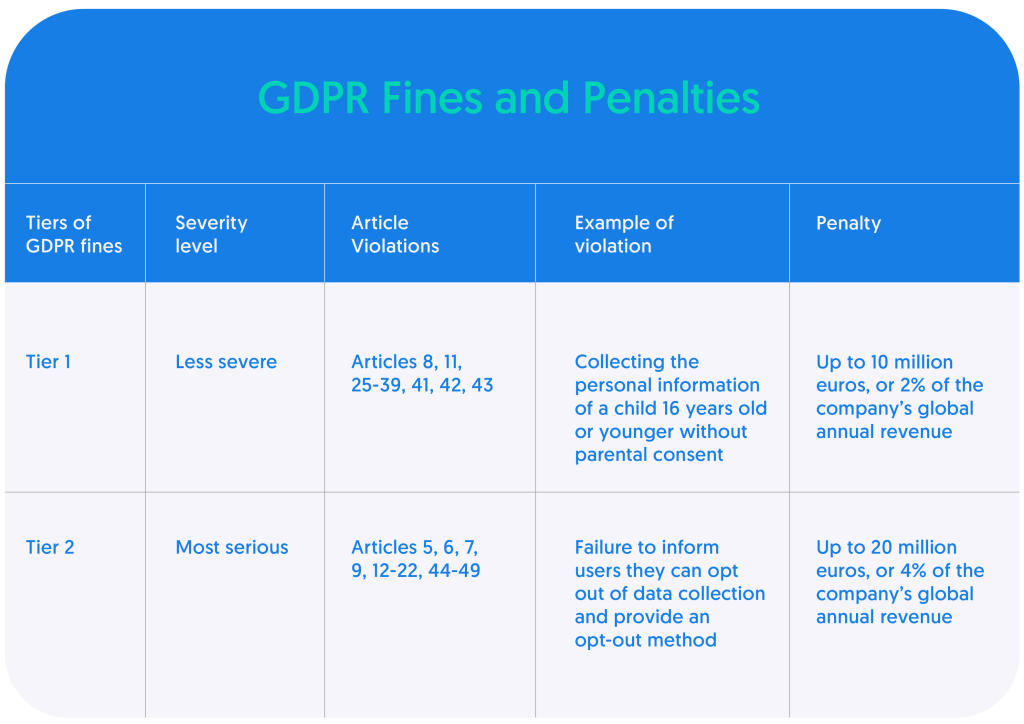
The financial stakes have never been higher. Organizations now face penalties up to €20 million or 4% of global annual revenue, whichever is greater. What’s particularly concerning for sales leadership is the emerging trend of personal executive liability warnings. Regulators increasingly hold C-suite executives personally accountable for systemic compliance failures, especially those involving direct marketing activities.
A key challenge for sales teams engaged in cold outreach campaigns is the 22% increase in fines specifically targeting procedural violations since 2023. These include unclear consent mechanisms and improperly documented legal bases for prospect contact—core elements of outbound sales operations.
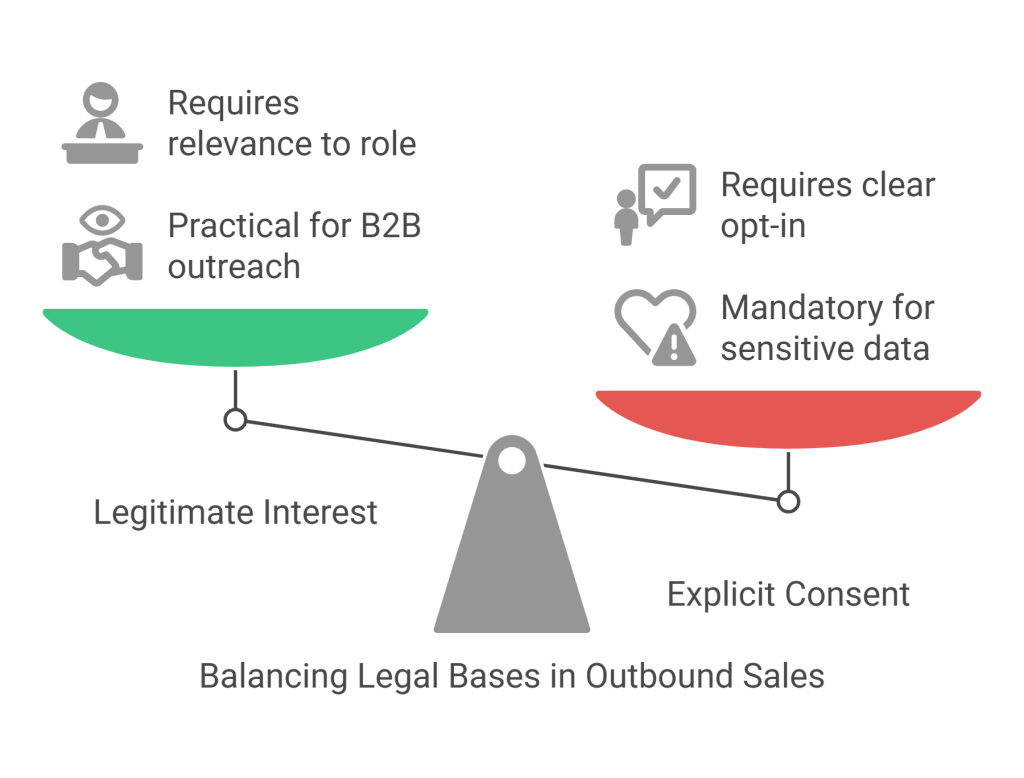
Perhaps the most pressing question for sales teams is determining the proper legal basis for contacting prospects. The 2025 landscape offers two primary pathways: explicit consent or legitimate interest. Each has specific applications and limitations that directly impact outbound strategy.
When Legitimate Interest Applies
For B2B outreach, legitimate interest provides the most practical foundation for initial contact. Data indicates 63% of EU B2B marketers now rely on this basis for cold outreach—a significant increase from 48% in 2023. However, legitimate interest isn’t a blanket permission for all prospecting activities.
Legitimate interest requires demonstrating proportionality between your business goals and the prospect’s reasonable expectations. Contacting a CFO about accounting software aligns with legitimate interest because it relates to their professional role. Conversely, emailing a stay-at-home parent about enterprise CRM tools likely violates GDPR principles as it lacks this professional relevance.
Consent Requirements
The alternative legal basis—explicit consent—requires “freely given, specific, informed, and unambiguous” opt-in. This presents significant practical challenges for initial outreach since you typically need contact to obtain consent in the first place. However, consent becomes mandatory in sectors involving sensitive data, such as healthcare, where the European Data Protection Board mandates explicit opt-ins.
For sales teams using technical systems for cold email, documenting the specific legal basis for each contact becomes essential. This requires sophisticated CRM configurations that can track both the basis and timing of permission to process data.
Cross-Border Data Transfers: Stricter Requirements
International sales teams face additional complexities in 2025, particularly regarding cross-border data flows. The revised Standard Contractual Clauses (SCCs) now mandate “geofencing” to keep metadata and backups within EU borders—creating significant operational challenges for global organizations.
Data Sovereignty Clauses
The 2025 SCCs introduce stronger sovereignty protections, requiring cloud providers and data processors to resist third-country government access to EU data. This directly impacts sales teams using U.S.-based CRM platforms like Salesforce or HubSpot, which must now implement specific technical safeguards.
For example, a German company conducting outbound sales must ensure its U.S.-based CRM includes contractual clauses barring unilateral data access by foreign governments. Compared to previous versions, the 2025 SCCs expand audit rights, requiring biannual compliance reports from vendors—creating additional administrative overhead for sales operations.
Sector-Specific Requirements
Healthcare and financial services face even stricter auditing requirements. Sales teams targeting these sectors must be aware that their prospective clients now conduct quarterly GDPR compliance reviews, with non-compliant vendors risking immediate contract termination. This creates both a compliance burden and a potential competitive advantage for sales organizations that can demonstrate robust data protection practices.
Breach Reporting: Tightened Timelines for 2025
Data breaches represent a significant risk for sales organizations that manage large volumes of prospect and customer information. The 2025 GDPR updates introduce significantly compressed reporting timelines, particularly for critical sectors.
New Tiered Reporting System
The updated regulations establish a two-tier system based on breach severity:
- High-risk breaches require notification to authorities, affected individuals, and public disclosure within 24 hours
- Low-risk breaches require supervisory authority notification within 48 hours
For sales teams in healthcare, energy, and telecommunications, the standard 72-hour breach reporting window has been reduced to 48 hours. This compressed timeline requires organizations to have pre-established incident response protocols specifically tailored to their sales data infrastructure.
The case of a 2024 ransomware attack on a French hospital provides a cautionary tale. The breach exposed 500,000 records and resulted in a €3.2 million fine. Under the 2025 rules, penalties for similar incidents would double due to enhanced documentation requirements that demand specific details about attack vectors and mitigating actions like encryption.
Practical Compliance Strategies for Sales Teams
Implementing practical compliance measures requires a balance between legal requirements and sales effectiveness. For teams concerned with avoiding blacklisting during B2B prospecting, several key strategies can help maintain compliance while preserving outreach capabilities.
Data Mapping and Documentation
Comprehensive data mapping represents the foundation of GDPR compliance. Sales organizations must document all processing activities, including third-party vendors who may access prospect data. This mapping should clearly identify data flows, especially those crossing EU borders, and establish retention periods for different categories of prospect information.
Beyond simple documentation, the 2025 standards require regular auditing of these processes. Sales teams should conduct quarterly reviews of their data maps to ensure they reflect current operations and processing activities.
CRM Hygiene and Contact Management
CRM systems require significant reconfiguration to meet 2025 standards. Each contact must be labeled with its specific legal basis (consent vs. legitimate interest) and associated with clear retention limits. The system should automatically flag records approaching their retention deadline for review or deletion.
A fully compliant CRM must maintain detailed logs documenting:
- Source of each contact record (e.g., purchased lists, website inquiries)
- Dates for periodic consent reviews (typically every 24 months)
- Complete interaction history to support legitimate interest claims
For sales teams utilizing AI-driven outreach, conducting a mandatory Data Protection Impact Assessment (DPIA) becomes essential. This assessment evaluates the specific risks associated with automated profiling or decision-making in your sales process.

Global Impact: Implications for Non-EU Businesses
The territorial scope of GDPR continues to expand in 2025, creating significant implications for non-EU businesses targeting European prospects. Organizations based outside the EU but selling to EU residents must appoint a formal GDPR representative or face fines up to €10 million.
Impact on U.S. Sales Organizations
Data shows that 78% of U.S. companies with EU customers updated their Standard Contractual Clauses in 2024 to meet the 2025 standards. This proactive approach reflects the growing awareness that GDPR compliance is now a prerequisite for accessing European markets.
The regulatory influence extends beyond direct compliance requirements. GDPR principles increasingly shape U.S. state laws, with California’s CPRA mirroring many of the EU’s consent and transparency mandates. This regulatory convergence means that implementing GDPR-compliant sales processes often satisfies multiple jurisdictional requirements simultaneously.
Supply Chain Considerations
Perhaps most critically for B2B sales organizations, 41% of European businesses now audit their vendors’ GDPR adherence quarterly. Non-compliant organizations increasingly find themselves excluded from RFP processes before they even have an opportunity to present their solutions.
This creates both a challenge and an opportunity. Sales teams that can demonstrate robust data protection practices gain a competitive advantage in compliance-sensitive markets. Conversely, those without documented GDPR procedures face growing obstacles in penetrating European markets.
FAQ
Do B2B sales teams need consent for every cold email?
No. B2B teams can rely on legitimate interest for relevant outreach to professional contacts. For example, emailing a CIO about cybersecurity solutions is generally acceptable without prior consent, provided you maintain proper documentation and honor opt-out requests immediately. However, this doesn’t apply to sensitive industries like healthcare.
What retention periods apply to prospect data under GDPR?
GDPR doesn’t specify fixed retention periods, but regulators typically expect prospect data to be deleted after 24-36 months of inactivity. Data from prospects who explicitly declined your offer should be deleted within 12 months, while data from engaged prospects can be retained longer with proper documentation of ongoing legitimate interest.
Can U.S. companies still use their existing CRM for EU prospects?
Yes, but with specific safeguards. U.S.-based CRMs must implement Standard Contractual Clauses with the 2025 data sovereignty provisions, ensuring EU data remains protected from foreign government access. Many major platforms now offer EU-specific data centers and processing options to address these requirements.
What happens if a purchased contact list violates GDPR?
Using non-compliant purchased lists can trigger fines up to €20 million or 4% of global revenue. Organizations remain liable even if they believed the list vendor was compliant. Before using any purchased list, verify the vendor provides documentation of consent or legitimate interest for each contact, including opt-in dates and methods.
Sources
- SmithLaw – GDPR Enforcement is Alive and Well – Key Considerations in 2025
- ComplyDog – GDPR in 2025: Key Changes and Compliance Strategies
- GrowthList – GDPR For Cold Email Sales
- Cognism – GDPR for B2B Marketing
- Evergrowth – GDPR Compliance for Outbound Sales
- CPO Magazine – Transferring Data Under GDPR
- CyberArrow – Key Requirements to Comply with GDPR
- Dabrian Marketing – Changes in Privacy Regulations U.S. Firms Need to Consider in 2025
- Usercentrics – How Does GDPR Affect B2B Sales?
- Usercentrics – Navigating GDPR and Marketing
- activeMind – GDPR-Compliant Use of Call Centre Systems
- ComplianceHub – GDPR 2025 Updates: Cross-Border & Breach Reporting Guide
