

The fractional executive market has surged 57% since 2020, reflecting a fundamental shift in how companies access marketing leadership. The fractional CMO vs full-time CMO debate no longer centers on prestige—it hinges on operational fit, financial pragmatism, and growth stage alignment. This post delivers a decision matrix that maps your company’s current situation to the CMO model that maximizes strategic impact while managing cost and risk.
Contents
- 1 TL;DR
- 2 When Your Business Actually Needs a CMO (and Which Type)
- 3 The Real Cost: Beyond Base Salary
- 4 Matching CMO Model to Your Company Stage
- 5 Speed to Results: How Fast Each Model Delivers
- 6 Making the Decision: Your Specific Situation
- 7 Hybrid Models and Transition Strategies
- 8 FAQ
- 8.1 What does a fractional CMO do?
- 8.2 When should a company hire a fractional CMO?
- 8.3 How much does a fractional CMO cost?
- 8.4 Fractional CMO vs full-time CMO: which is better?
- 8.5 Fractional CMO vs marketing agency: what’s the difference?
- 8.6 When is a full-time CMO worth the investment?
- 8.7 Fractional CMO vs interim CMO: what’s the difference?
- 8.8 How fast can a fractional CMO deliver results?
- 8.9 How does company size affect the CMO decision?
- 8.10 What risks come with hiring a full-time CMO?
- 9 Sources
TL;DR
Choosing between a fractional CMO and a full-time CMO requires aligning leadership model to company stage, financial capacity, and speed-to-impact needs. Fractional arrangements deliver strategic marketing guidance at 40–65% lower cost while enabling rapid deployment. Full-time CMOs provide deep cultural integration and sustained team development for mature organizations.
- Fractional models save $270,000–$330,000 annually compared to full-time hires with total compensation packages.
- First-time CMOs succeed only 34% of the time, making fractional arrangements lower-risk alternatives for testing leadership fit.
- Full-time CMOs require 90–120 days to reach productivity, while fractional leaders demonstrate value within 30–90 days.
When Your Business Actually Needs a CMO (and Which Type)
The marketing leadership landscape has transformed dramatically over the past five years. Companies now rethink senior marketing positions not simply to cut costs but to match executive marketing support to operational complexity and growth velocity. Strategic marketing expertise once reserved for enterprises with eight-figure revenues now flows through fractional marketplaces accessible to startups and mid-market firms.
Fractional leadership adoption has accelerated across growth-stage companies. Pre-Series A startups and mid-market teams can now engage VP-level expertise for market entry and buyer persona development without committing to six-figure permanent salaries.
→ More information: Fractional CMO – definition, responsibilites & cost.
The Short Tenure Problem
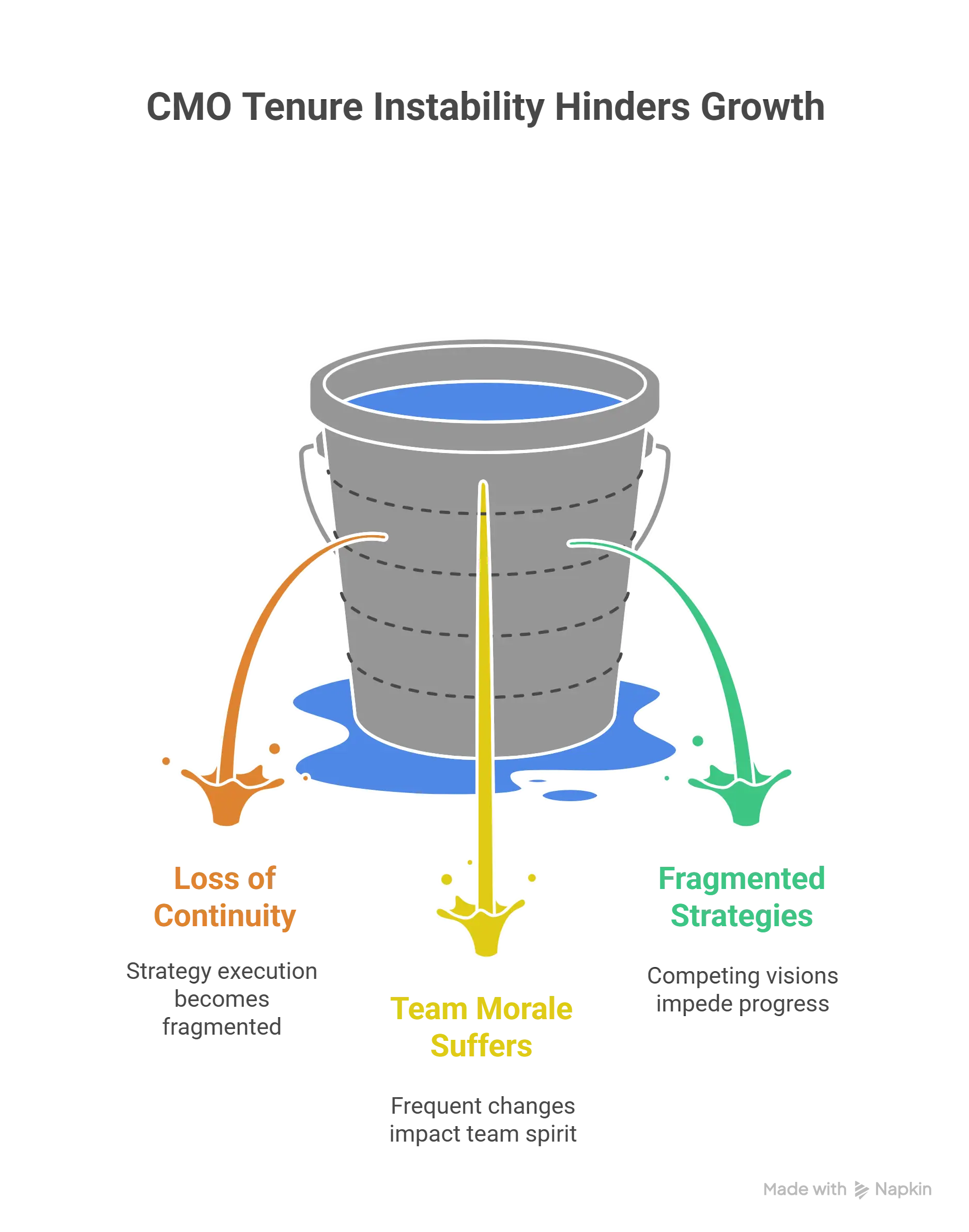
Average CMO tenure sits at just 42 months, dropping to 28 months in technology companies and 18–24 months at startups. This instability creates cascading risk for companies investing in full-time hires. When leadership transitions occur every 18 months, organizations lose strategic continuity, team morale suffers, and business growth strategies fragment across competing visions.
A fractional CMO can serve as a bridge during these transitions, maintaining momentum during the six-month executive search cycles that typically follow departures. Mid-market companies preparing for Series B funding often engage fractional CMOs for 6–12 months to access specialized product-launch expertise without permanent commitment. This arrangement preserves flexibility while delivering executive-level strategic guidance during critical growth phases.
Recognizing Your Leadership Gap
The first step in choosing between CMO roles involves diagnosing your specific leadership gap. Companies with solid execution resources—capable agencies, strong marketing coordinators, functional campaign management—but lacking strategic direction thrive with fractional arrangements. The fractional CMO directs strategy through existing resources, optimizing what already works while filling the vision void.
Organizations lacking execution capacity entirely struggle with fractional models. If you have no marketing team, no established agency relationships, and limited internal infrastructure, a fractional CMO becomes an expensive advisor without hands to execute recommendations. These situations demand either a full-time CMO who will build the team from scratch or a comprehensive marketing agency partnership before introducing fractional leadership.
The Real Cost: Beyond Base Salary
Full-time CMO base salaries ranging from $200,000 to $350,000 for small and mid-sized companies represent only 60–70% of true compensation. When you factor bonuses typically spanning 25–50% of base salary, equity compensation of 20–100% of base, benefits packages of $25,000–$75,000 annually, recruitment fees averaging $50,000–$75,000, and standard severance provisions covering 6–12 months, first-year cost for a mid-market CMO — including all components — significantly exceeds the base salary figure alone.
Hidden Hiring Costs That Compound
Recruitment timelines average 44 days nationally, during which companies operate without marketing leadership. These indirect costs rarely appear in hiring a CMO budget discussions but materially impact organizational performance and competitive positioning.
The total cost of hiring often reaches three to four times the position’s base salary when all factors receive proper accounting. Companies fixated solely on base compensation miss the comprehensive financial picture that determines whether executive investment delivers acceptable return.
Fractional Economics: Inclusive Pricing
Fractional CMO monthly retainers ranging from $5,000–$15,000 translate to $60,000–$180,000 annually. These fees are inclusive—fractional CMOs cover their own taxes, benefits, and equipment while companies avoid National Insurance contributions, pension payments, and benefits administration entirely.
For a company with a $300,000 full-time CMO budget plus estimated overhead of 30–50%, total cost approaches $450,000 annually. A fractional arrangement at $120,000–$180,000 annually generates potential savings of $270,000–$330,000, representing roughly 60–73% cost reduction. This cost-effective marketing approach preserves capital for direct revenue-generating activities.
Comparing Total Cost of Ownership
The table below breaks down the comprehensive financial comparison between fractional and full-time CMO arrangements, accounting for all major cost components over a typical annual engagement.
| Cost Component | Full-Time CMO | Fractional CMO | Savings |
|---|---|---|---|
| Base Compensation | $300.000 | $120.000–$180.000 | $120.000–$180.000 |
| Bonuses & Equity | $75.000–$150.000 | $0 | $75.000–$150.000 |
| Benefits & Taxes | $45.000–$75.000 | $0 | $45.000–$75.000 |
| Recruitment Fees | $60.000–$90.000 | $0 | $60.000–$90.000 |
| Total First-Year Cost | $480.000–$615.000 | $120.000–$180.000 | $300.000–$435.000 |
This comparison demonstrates that fractional models deliver 40–65% cost savings while maintaining access to experienced executives. The financial advantage extends beyond direct savings—fractional arrangements typically operate on renewable quarterly or six-month contracts, allowing companies to discontinue engagements with minimal financial liability if partnerships underperform.
Scaling Investment to Business Cycles
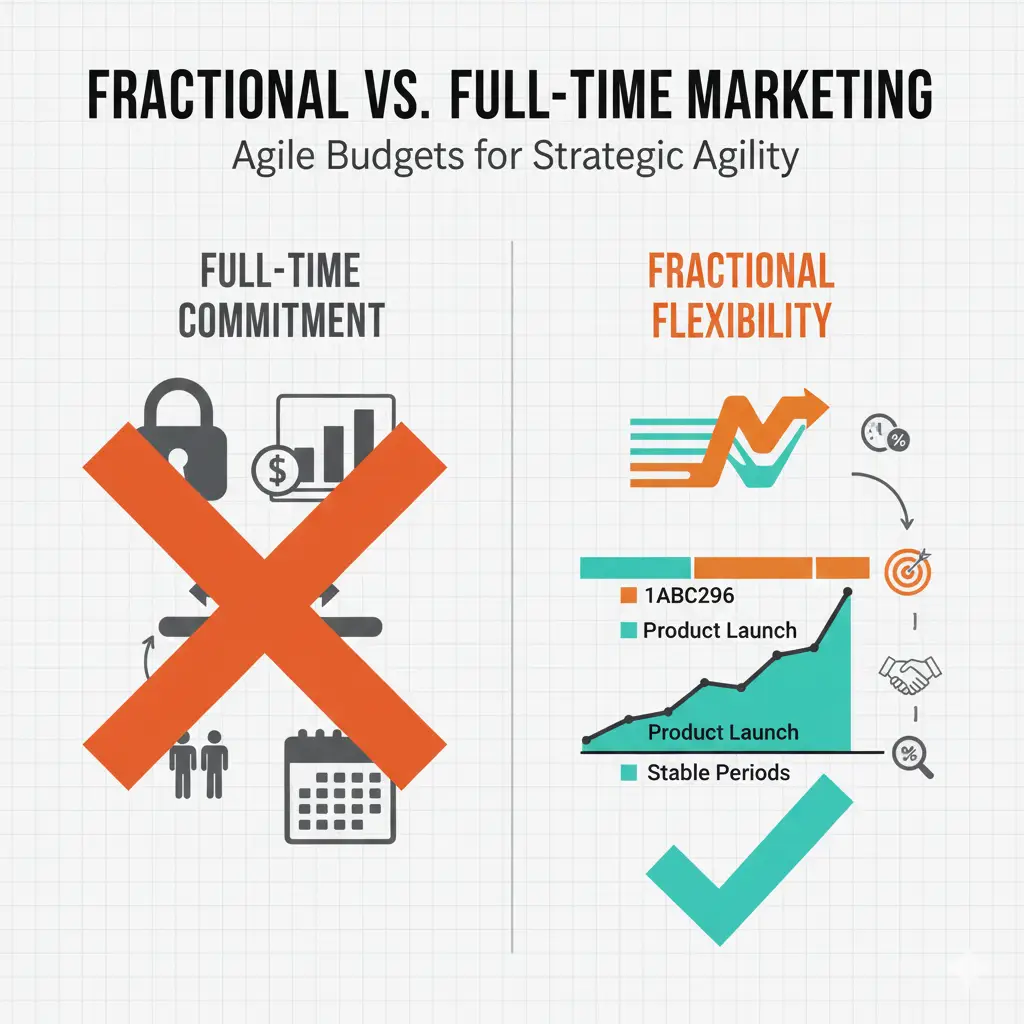
The marketing budget flexibility inherent in fractional arrangements provides strategic agility impossible with traditional full-time hiring. Companies can scale engagement hours from 10 monthly during stable periods to full-time interim coverage during product launches, then back down once the initiative completes. This elasticity matches financial commitment to actual strategic need rather than locking in fixed executive overhead regardless of business conditions.
Matching CMO Model to Your Company Stage
Company stage dramatically influences which marketing leadership structure delivers optimal value. Early-stage startups, growth-phase companies, and mature enterprises face fundamentally different challenges requiring distinct executive marketing support models.
Pre-Series A: Strategic Direction Without Permanent Commitment
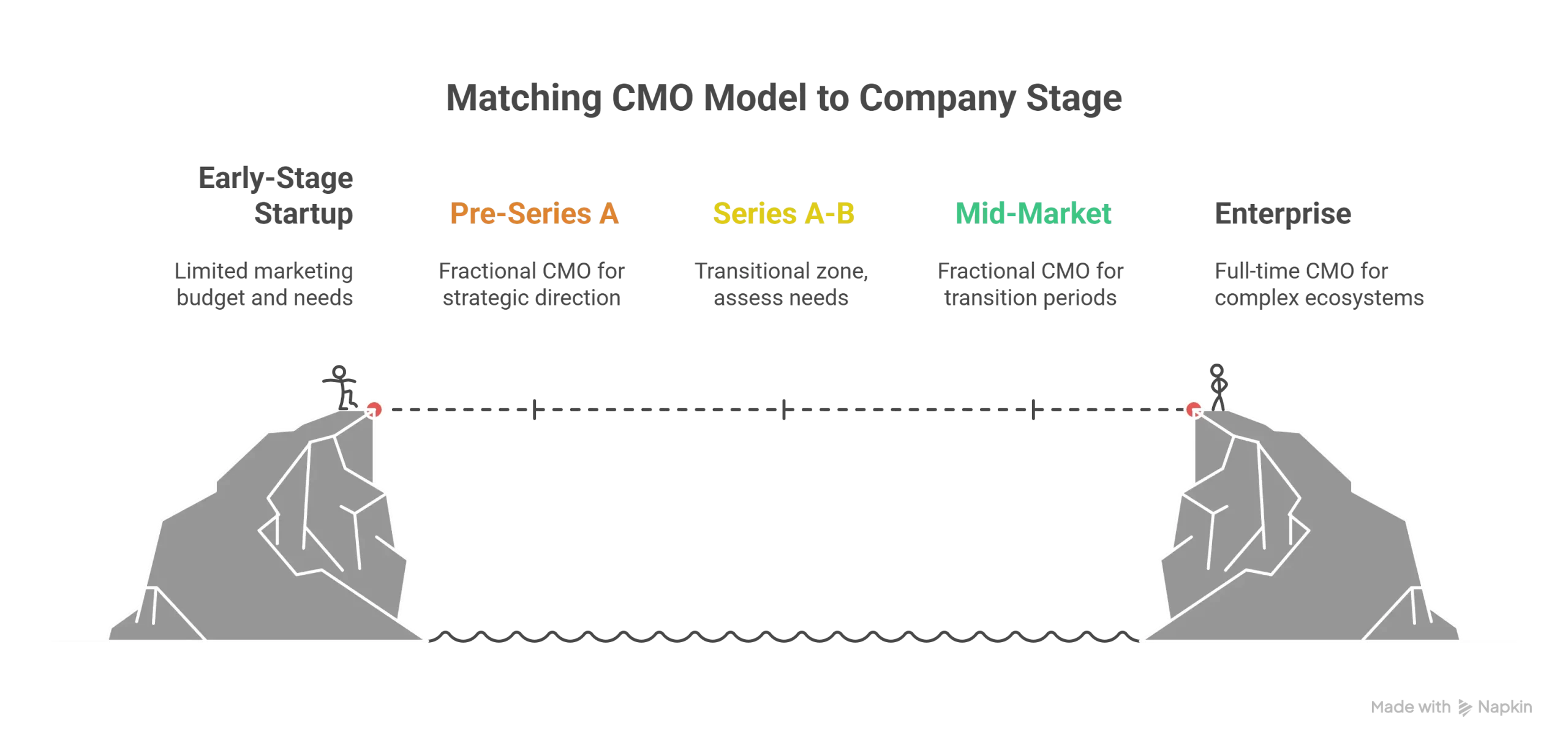
Startups in the $1–10 million revenue range benefit most from fractional arrangements. At this stage, companies need strategic direction on market entry, buyer persona validation, and foundational go-to-market strategy without the operational complexity or marketing budget that justify six-figure executive compensation.
An $8 million ARR startup can engage a fractional CMO to validate product-market fit and establish foundational measurement frameworks before scaling. This approach preserves runway while accessing expertise that would otherwise remain financially inaccessible. The fractional CMO builds the strategic infrastructure that enables more effective full-time hiring when revenue and complexity warrant permanent leadership.
Series A–B: The Transitional Zone
Companies in the $10–20 million ARR range represent a transitional zone where either model can work. The determining factor becomes whether primary needs center on rapid strategy execution or deep team integration. A fractional CMO excels at quickly diagnosing growth bottlenecks, implementing high-impact demand generation initiatives, and establishing marketing measurement within 60–90 days.
A $25 million ARR Series B company might bring in a fractional CMO for a nine-month market expansion initiative while maintaining an existing marketing director. This arrangement provides specialized expertise for the expansion without disrupting established team dynamics. Once expansion completes and operations stabilize, the company reassesses whether permanent CMO leadership makes sense or whether the director can manage ongoing execution.
Mid-Market: Transition Expertise and Specialized Guidance
Companies in the $20–50 million ARR range increasingly use fractional arrangements during specific transition periods—funding rounds, product launches, market entries, or rebranding initiatives. These episodic needs spanning 6–12 months suit fractional engagement perfectly. Organizations with mature marketing teams, multiple leaders requiring daily guidance, and complex matrix structures, however, typically require permanent CMO leadership.
The complexity test proves useful here: if strategic marketing decisions require navigating intricate internal politics, managing cross-functional dependencies across five departments, and participating in weekly executive team meetings, full-time presence becomes necessary. If strategic marketing needs center on expert guidance, external perspective, and periodic course correction, fractional arrangements deliver equivalent value at substantially lower cost.
→ More about the fractional CMO model in Germany.
Enterprise: Full-Time as Default, Fractional for Specialization
Large enterprises and publicly traded companies typically require full-time CMOs. These organizations operate complex marketing ecosystems with substantial budgets, multiple internal teams, vendor relationships, and board-level reporting requirements demanding continuous executive presence. The average Fortune 500 CMO tenure of 4,2 years reflects the long-term strategic positioning and cultural integration required at scale.
Even large organizations, however, increasingly employ fractional specialists alongside full-time CMO leadership—fractional digital transformation leaders, fractional marketing technology officers, or fractional category-specific brand leaders operating within the full-time CMO’s strategic framework. This hybrid model combines the stability of permanent leadership with specialized expertise for bounded initiatives.
Speed to Results: How Fast Each Model Delivers
Timeline expectations differ fundamentally between fractional and full-time arrangements. Fractional CMOs operate under explicit three to six-month assessment periods, requiring them to demonstrate value rapidly—typically within 30–90 days of engagement.
Fractional: Built for Rapid Impact
Clear impact timelines characterize effective fractional engagements. Strategic deliverables including comprehensive marketing strategy and team structure clarification typically emerge within 4–8 weeks. Foundational improvements spanning infrastructure establishment and process documentation appear within 2–3 months. Initial performance improvements including lead generation optimization and conversion rate enhancement materialize within 2–4 months.
A fractional CMO can launch optimized paid campaigns, establish analytics dashboards, and improve lead conversion within the first 60 days while simultaneously developing a 12-month strategic roadmap. This dual focus on immediate tactical wins and long-term strategic foundation proves remarkably effective for companies requiring rapid course correction.
Many fractional leaders with growth marketing backgrounds bring cross-industry experience and proven playbooks enabling hands-on execution alongside strategic guidance. They write landing page copy, launch campaigns, establish analytics systems, and run lifecycle marketing programs—functioning as both strategists and executors. This versatility accelerates impact when companies possess execution gaps alongside strategic needs.
Full-Time: Strategic Foundation Before Execution
Full-time CMOs require 90–120 days to reach full productivity. The first 30 days involve listening and diagnostic work—interviewing stakeholders, auditing existing programs, and understanding organizational dynamics. The second 30 days focus on strategic alignment and planning, securing executive team buy-in for recommended direction. The third 30 days concentrate on pilot validation, testing key initiatives before broader rollout.
This phased approach enables thorough organizational integration but delays revenue impact. A full-time CMO spending the first 90 days building cross-functional alignment before launching new initiatives follows industry best practice but requires organizational patience during the ramp-up period.
Full-time CMOs focus energy on strategic positioning, team leadership, and cross-functional alignment rather than hands-on tactical execution. They develop strategy, manage teams, oversee vendors, and embed marketing into corporate decision-making. This model delivers superior results when execution capability requires ongoing internal team development or when brand stewardship demands consistent cultural integration.
The Momentum Factor
Research indicates that 70% of transformation initiatives fail largely due to lack of early momentum and stakeholder buy-in. Fractional arrangements are specifically designed to deliver early wins and build internal momentum before undertaking longer-term transformation. Quick wins—high-impact, low-effort initiatives executable within 30–90 days—generate organizational confidence while laying infrastructure for sustained growth.
For companies facing competitive pressure, declining pipeline health, or stagnant revenue growth, the speed advantage of fractional arrangements can prove decisive. The ability to diagnose problems, implement corrections, and generate measurable improvement within a single quarter often matters more than the deeper integration a full-time CMO would eventually provide.
Making the Decision: Your Specific Situation
The fractional versus full-time decision ultimately hinges on several organizational factors beyond simple cost calculation. Team integration requirements, risk tolerance, decision authority frameworks, and cultural dynamics all influence which model fits your current context.
Team Integration and Cultural Embedding
Full-time CMOs become deeply embedded in organizational culture—attending all-hands meetings, participating in offsite experiences, developing relationships with peer leaders, and modeling organizational values. This immersion enables mentorship, cohesive internal culture, and long-term succession planning. Extended tenure full-time CMOs invest substantially in team development and training.
Fractional CMOs necessarily operate with more limited organizational integration given time constraints. High-performing fractional leaders overcome this limitation through intentional relationship-building—inclusion in strategic planning sessions, board meetings, quarterly business reviews, and key organizational moments. Rather than functioning as external advisors providing periodic input, top fractional CMOs integrate as embedded executive team members for the hours they engage.
The integration question becomes: does your marketing organization require daily presence and cultural embedding, or can strategic direction and periodic oversight deliver equivalent value? If your team includes multiple managers needing continuous mentorship and your company culture highly values face-time and relationship depth, full-time arrangements suit better. If your team operates autonomously with periodic strategic guidance and your culture values outcome-based contributions regardless of physical presence, fractional models work well.

Decision Authority and Organizational Autonomy
Full-time CMOs require significant autonomy to establish marketing strategy, build teams, manage budgets, and make key decisions. CEOs must be willing to delegate meaningful authority and grant CMOs latitude to set strategic marketing direction and organizational key results. This autonomy enables cohesive execution but risks misalignment if the CMO’s strategic vision diverges from CEO expectations.
Fractional CMOs operate within more clearly delineated decision authority. Engagements typically specify decision rights, approval processes, and escalation paths upfront. A fractional CMO might possess full authority to launch campaigns, hire vendors, and reorganize processes within their domain, while investments exceeding specific budget thresholds or strategic pivots require CEO approval.
This clarity prevents authority ambiguity that paralyzes fractional engagements while maintaining CEO visibility into key decisions. The decision to hire a fractional CMO works most effectively when decision authority is clearly documented and communicated to internal teams. When teams question whether the fractional CMO actually has authority to make decisions, execution stalls.
Risk Management and Hiring Success Rates
Full-time CMO hiring represents one of the most expensive and highest-stakes decisions companies make. First-time CMOs have approximately 34% success rates, meaning roughly two-thirds either fail to achieve objectives or transition out within their initial contract period. This elevated failure rate reflects the difficulty of predicting executive performance in specific organizational contexts.
Fractional arrangements offer substantially lower risk through multiple mechanisms. Shorter contract periods—typically quarterly or semi-annual renewable agreements—allow companies to discontinue engagements with minimal financial liability if partnerships underperform. The lower absolute investment means failed fractional engagements represent far smaller financial losses than failed full-time CMO hires.
Companies can test fractional CMO partnerships before making full-time commitment decisions, using the fractional period as extended evaluation. If the partnership delivers exceptional value and organizational fit proves strong, many companies convert successful fractional relationships into permanent senior marketing positions. This pathway significantly reduces hiring risk by replacing theoretical interview assessments with actual performance evidence.
When to Choose Fractional
Select fractional arrangements when you’re a pre-Series A company with $1–10 million revenue needing strategic direction without permanent commitment; preparing for a major initiative spanning 6–12 months requiring specialized expertise; between full-time CMOs and need continuity during executive search; testing marketing leadership before full-time commitment; have solid execution resources but lack strategic direction; require rapid results within 90 days; or operate with limited marketing budget.
Fractional models particularly suit companies valuing flexibility and speed over deep cultural integration. If your growth trajectory remains uncertain, if you’re approaching a funding round requiring demonstrable marketing traction, or if you’re testing new markets before committing resources, fractional arrangements preserve optionality while delivering executive-level guidance.
When to Choose Full-Time
Select full-time arrangements when you’ve reached $20 million-plus revenue with mature marketing organization needing daily team oversight; have multiple internal team leaders requiring continuous guidance; operate complex matrix structures demanding embedded leadership; prioritize brand stewardship requiring deep cultural integration; need board-level reporting and corporate strategy participation; focus on long-term capability building and succession planning; value cultural embedding more than rapid tactical wins; or can support a substantial full-year executive investment including onboarding, benefits, and severance exposure.
Full-time CMOs suit organizations that have moved beyond entrepreneurial chaos into operational maturity. If you run established processes, manage large vendor relationships, oversee substantial marketing budgets, and participate in strategic corporate decisions requiring daily executive availability, permanent leadership becomes necessary. The deeper organizational knowledge and sustained presence full-time CMOs provide justify the higher investment at this stage.
Hybrid Models and Transition Strategies
The fractional versus full-time choice need not be permanent or binary. Many companies successfully employ hybrid approaches or plan deliberate transitions between models as organizational needs evolve.
Fractional to Full-Time Conversion
Companies frequently begin with fractional engagements, then convert successful partnerships into full-time employment. This pathway provides extended evaluation periods where both parties assess fit before making permanent commitments. The fractional CMO demonstrates capability and cultural alignment while the company proves it can provide the resources, authority, and organizational support the CMO needs to succeed.
This approach dramatically reduces the hiring risk associated with traditional recruitment. Rather than making permanent offers based on interviews and references, companies extend offers based on months of actual performance evidence. The conversion typically includes adjustments to compensation structure, equity participation, and expanded scope reflecting the shift from part-time to permanent arrangement.

Full-Time with Fractional Specialists
Large organizations increasingly employ full-time CMOs for core marketing leadership while bringing in fractional specialists for bounded initiatives. A company might maintain a full-time CMO overseeing brand, demand generation, and product marketing while engaging a fractional marketing technology leader for a nine-month MarTech stack consolidation project.
This hybrid model combines the stability and cultural integration of permanent leadership with specialized expertise for specific challenges. The full-time CMO maintains strategic continuity while fractional specialists provide deep functional expertise the organization needs episodically rather than continuously. The model particularly suits business growth strategies requiring specialized skills—AI marketing implementation, account-based marketing buildout, or marketing operations transformation—where permanent hires would be underutilized once projects complete.
Interim Leadership During Transitions
The distinction between fractional and interim CMOs matters during leadership transitions. Interim CMOs temporarily fill full-time roles during executive transitions or recruitment gaps, acting as bridge leaders. Fractional CMOs provide long-term part-time leadership on an ongoing, flexible basis without permanent employment commitments.
During unexpected departures or planned transitions, companies can engage fractional CMOs as interim leaders, providing full-time coverage during the recruitment cycle, then transitioning to ongoing fractional engagement once a permanent CMO joins. This flexible arrangement prevents the momentum loss and competitive disadvantage that often follow leadership departures.
FAQ
What does a fractional CMO do?
A fractional CMO provides part-time executive-level marketing leadership to companies that need strategic guidance without hiring a full-time chief marketing officer. They typically plan marketing strategy, oversee campaigns, and align teams for growth while working on a flexible schedule or project-based arrangement, reducing long-term financial risk.
When should a company hire a fractional CMO?
A company should hire a fractional CMO when it needs marketing leadership but lacks resources or organizational complexity to justify a full-time executive. Typical situations include early-stage startups, firms approaching funding rounds, or businesses undergoing transitions that require strategic marketing direction for a defined period.
How much does a fractional CMO cost?
Fractional CMOs generally cost between $5.000 and $15.000 per month, depending on engagement level and scope. This translates to $60.000–$180.000 annually, often 40–65% less than a full-time CMO. Each engagement usually covers strategy, oversight, and advisory services without benefits or equity commitments.
Fractional CMO vs full-time CMO: which is better?
Neither model is universally better; it depends on company stage and objectives. Fractional CMOs offer flexibility, quick strategic wins, and cost efficiency. Full-time CMOs suit mature organizations requiring ongoing leadership, cultural integration, and team development. The right choice balances cost, impact, and strategic continuity.
Fractional CMO vs marketing agency: what’s the difference?
A fractional CMO focuses on strategic leadership—defining vision, positioning, and long-term marketing direction—while agencies primarily handle execution tasks like campaigns or creative production. Many businesses hire both: a fractional CMO to set strategy, and an agency to deliver tactical outcomes aligned with the strategic roadmap.
When is a full-time CMO worth the investment?
A full-time CMO becomes valuable when a company has mature marketing teams, large budgets, and complex operations needing daily oversight. Businesses beyond $20–50 million revenue often require continuous leadership, deeper cultural integration, and direct accountability for strategic growth initiatives that part-time executives cannot provide.
Fractional CMO vs interim CMO: what’s the difference?
A fractional CMO provides long-term part-time leadership on an ongoing, flexible basis. An interim CMO temporarily fills a full-time role during executive transitions or recruitment gaps. Interim CMOs often act as bridge leaders, while fractional CMOs deliver continual expertise without permanent employment commitments.
How fast can a fractional CMO deliver results?
Fractional CMOs typically generate measurable results within 30–90 days. They focus on quick wins—improving lead generation, clarifying strategy, or optimizing execution processes. Their structured engagements emphasize rapid assessment, immediate tactical improvements, and building long-term marketing foundations that sustain growth after the initial engagement period.
How does company size affect the CMO decision?
Smaller or early-stage companies often gain more value from fractional arrangements for flexibility and affordability. Mid-sized firms may use fractional leaders during transitions or scaling phases. Large enterprises, with complex structures and multi-channel operations, generally require dedicated full-time CMOs for stability and full organizational integration.
What risks come with hiring a full-time CMO?
A full-time CMO hire involves high financial and organizational risk if misaligned. Costs include large compensation packages, severance liabilities, and long recruitment cycles. Misfit executives can create cultural disruption or strategic drift. These risks make fractional alternatives appealing for testing leadership alignment before committing permanently.
Sources
- Clean Cut Growth – Why Startups Are Choosing Fractional CMOs Over Full-Time Hires
- VantEdge Search – What’s Driving the Demand for Non-Traditional C-Suite Roles in Private Equity
- Fractional CMO Partners – The ROI of a Fractional CMO: Measuring Impact on Growth
- YOR CMO – Why Quick Wins Are the Secret Strategies of Fractional CMOs
- Spencer Stuart – CMO Tenure Study 2024
- Activated Scale – Benefits of Hiring a Fractional CMO