
CMO tenure at Fortune 500 companies has plummeted from 4.1 years in 2024 to just 3.9 years in 2025, with only 58% of these companies now employing marketing executives who report directly to the CEO or leadership team—down from 63% previously. This dramatic shift occurs as 51% of B2B CMOs anticipate a recession and 35% of startup failures stem from lack of market need, highlighting a critical gap in product-market fit expertise. Meanwhile, 310% growth in interim C-level placements since 2020 signals a fundamental change in how companies approach leadership.
Enter the fractional CMO product market fit specialist—a strategic solution that’s reshaping B2B tech growth. With 35% of U.S. companies expected to have at least one fractional executive by 2025, these seasoned professionals are bridging the gap between traditional marketing leadership failures and the specialized expertise required for achieving true product-market fit in today’s competitive B2B tech landscape.
Contents
- 1 Key Takeaways
- 2 Why Full-Time CMOs Are Failing to Drive Product-Market Fit Success
- 3 The Financial Case: How Fractional CMOs Deliver 50-75% Cost Savings While Accelerating Results
- 4 Defining and Measuring Product-Market Fit in B2B Tech: Beyond the 40% Rule
- 5 Strategic Frameworks: How Fractional CMOs Architect Accelerated PMF
- 6 Proven Results: Case Studies and Performance Benchmarks
- 7 Implementation Timeline and Best Practices
- 8 Cost-Effectiveness and Financial Benefits
- 9 Industry Trends and Future Outlook
- 10 FAQ
- 10.1 What’s the typical engagement length for fractional CMOs focused on product-market fit?
- 10.2 How do fractional CMOs differ from marketing consultants or agencies?
- 10.3 What stage companies benefit most from fractional CMO product-market fit expertise?
- 10.4 Can fractional CMOs effectively manage internal marketing teams?
- 11 Sources
Key Takeaways
- CMO tenure at Fortune 500 companies has dropped significantly, creating opportunities for fractional leadership models that offer more stability and specialized expertise
- Fractional CMOs deliver 50-75% cost savings compared to full-time hires while accelerating time-to-market by 48%
- Product-market fit in B2B tech requires specialized metrics beyond the traditional 40% rule, including customer retention rates of 90%+ and churn rates under 5% monthly
- Case studies demonstrate 1,000% organic traffic increases and 500% revenue growth within 90 days of fractional CMO engagement
- Remote work and economic uncertainty are driving the shift toward flexible leadership models, with fractional executives becoming the preferred solution for agile B2B tech companies
Why Full-Time CMOs Are Failing to Drive Product-Market Fit Success
The Leadership Crisis in B2B Marketing
The traditional CMO model is cracking under pressure. Adweek reports that marketing leadership instability has reached crisis levels, with companies struggling to maintain consistent B2B marketing leadership during critical growth phases. This instability creates a vicious cycle: shorter tenures mean less time to achieve meaningful product-market fit, leading to poor performance and even shorter future tenures.
Economic uncertainty compounds these challenges. More than half of B2B CMOs expect a recession, forcing companies to seek more agile leadership solutions that can adapt quickly to changing market conditions. Traditional full-time CMOs, locked into rigid organizational structures and long-term commitments, often can’t pivot fast enough to address evolving customer needs or market dynamics.
→ More information: Fractional CMO – definition, responsibilites & cost.
The Cost of Marketing Leadership Failure
The statistics paint a stark picture of why companies are abandoning traditional CMO models. With 35% of startup failures directly attributed to lack of market need—essentially poor product-market fit—the stakes couldn’t be higher. Companies that persist with underperforming marketing leadership face not just wasted salary expenses, but missed market opportunities that can be fatal in competitive B2B tech sectors.
The 310% growth in interim C-level placements since 2020 reflects a market correction. Companies have recognized that fractional executive hiring trends offer a more sustainable path to marketing success, especially when navigating the complex challenge of achieving product-market fit in B2B environments.

The Financial Case: How Fractional CMOs Deliver 50-75% Cost Savings While Accelerating Results
Breaking Down the True Cost Advantage
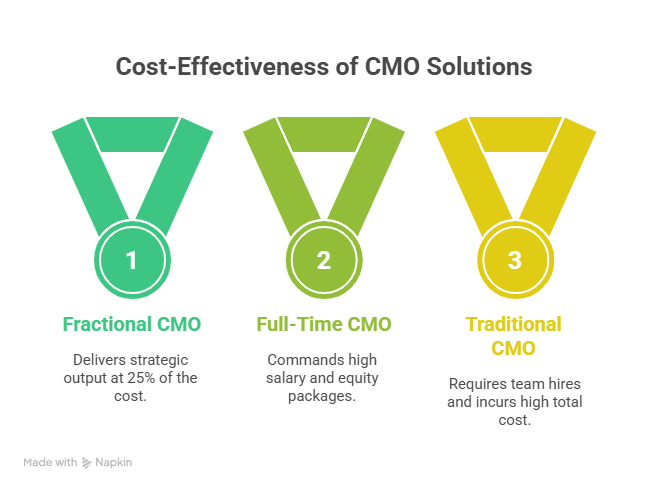
The financial benefits of fractional CMO product market fit specialists extend far beyond simple salary comparisons. While full-time CMOs command $200,000-$350,000 annually in base salary, fractional professionals typically cost $5,000-$15,000 monthly. But the real savings emerge when considering total cost of ownership.
Full-time CMO expenses balloon to over $500,000 annually when factoring in equity packages, health insurance, bonuses, and the inevitable team hires they require. A fractional CMO working two days per week at $250,000 annual equivalent delivers the same strategic output as a traditional CMO working one day per week—at just 25% of the cost.
ROI Performance Metrics
The cost advantage means nothing without results, but fractional CMOs consistently deliver superior performance metrics. Companies typically see qualified leads increase by 30-50% within the first 3-6 months of engagement. Case studies reveal even more dramatic improvements: 360% increases in initial client meetings and 500% jumps in closed revenue within 90 days.
These results stem from focused expertise rather than divided attention. Fractional CMOs bring specialized product-market fit experience from multiple companies, applying proven frameworks immediately instead of learning on the job like many full-time hires.
Defining and Measuring Product-Market Fit in B2B Tech: Beyond the 40% Rule
Why Traditional PMF Metrics Fall Short in B2B
The famous 40% rule—if 40% of surveyed customers would be very disappointed if your product disappeared, you’ve achieved PMF—oversimplifies B2B complexity. B2B tech companies face longer sales cycles, multiple decision makers, and enterprise-level implementation challenges that consumer-focused metrics can’t capture effectively.
Fractional CMO product market fit specialists understand that B2B SaaS benchmarks require different measurement approaches. Customer retention rates must exceed 90% annually for SMB SaaS, while churn rates should stay below 5% monthly for early-stage companies and under 2% for scale-ups. These metrics reflect the reality of B2B relationships where switching costs are high and vendor relationships are strategic.
Advanced PMF Validation Methods
Beyond retention and churn, sophisticated B2B companies track DAU/MAU stickiness ratios above 20% and maintain MRR growth of at least 10% month-over-month during early stages. Net Promoter Scores above 40 indicate strong B2B SaaS performance, but must be weighted against customer lifetime value and expansion revenue potential.
The global B2B SaaS market’s projected 19.28% growth rate, with AI-powered solutions achieving 30% CAGR, means companies without proper PMF measurement frameworks will miss massive opportunities. Average customer acquisition costs ranging from $300 to $15,000 demand precise tracking to ensure sustainable unit economics.
Strategic Frameworks: How Fractional CMOs Architect Accelerated PMF
Go-to-Market Strategy Development
Fractional CMOs serve as architects of comprehensive go-to-market plans that bridge the critical gap between customers and companies. Unlike full-time executives who may lack diverse industry experience, fractional professionals bring proven GTM strategy frameworks from multiple successful B2B tech implementations.
Their approach focuses on aligning product development with actual market demand through systematic customer discovery and validation processes. This includes implementing robust marketing automation systems, CRM optimization, and customer-facing process automation that many full-time CMOs take months to establish.
Specific PMF Acceleration Methods
The tactical execution separates effective fractional CMOs from traditional hires. They deploy A/B testing frameworks for viral marketing campaigns while developing user-generated content strategies that systematically lower customer acquisition costs. Account-based marketing alignment with sales teams creates seamless handoffs that improve conversion rates across the entire funnel.
Lifecycle campaign optimization ensures that once customers are acquired, they progress through onboarding and expansion phases efficiently. Sales enablement programs developed by experienced fractional CMOs typically generate higher close rates because they’re built on proven frameworks rather than theoretical approaches.
Proven Results: Case Studies and Performance Benchmarks
Slack and Zoom: Positioning Strategy Success
Strategic marketing initiatives overseen by fractional marketing leadership helped position Slack as the modern, efficient collaborative tool through emphasis on user-friendly features and simplified workplace communication messaging. The user-centric positioning didn’t happen by accident—it emerged from systematic market research and iterative messaging refinement.
Similarly, strategic marketing leadership helped establish Zoom as a household name for video conferencing through consistent emphasis on user-centric design and ease-of-use positioning. The reliable and user-friendly platform reputation was built through coordinated messaging campaigns that emphasized reliability and simplicity over technical specifications.
Performio: Measurable Growth Transformation
The most compelling case study comes from Performio, where fractional marketing leadership delivered extraordinary results. Organic traffic increased by 1,000% while LinkedIn followers grew by 3,000%. The company dominated search engine results for high-intent keywords like “sales commission software” and achieved 110% year-over-year growth by 2021.
These results weren’t achieved through luck or market timing alone. The systematic approach included comprehensive keyword research, content marketing strategy, and social media optimization that leveraged message-market fit principles. The company secured $75M in funding, demonstrating how proper marketing leadership creates measurable business value that extends far beyond typical marketing metrics.
Implementation Timeline and Best Practices
Optimal Timing for Fractional CMO Engagement
Companies should consider fractional CMO product market fit specialists when clear warning signs emerge. These include operating without a coherent marketing strategy, experiencing growth stagnation after achieving initial product-market fit, facing budget constraints that prevent full-time CMO hiring, or watching marketing and sales teams operate in destructive silos.
→ More about the fractional CMO model in Germany.
The beauty of fractional engagements lies in their rapid deployment capability. Results typically begin appearing within weeks of engagement, compared to months required for full-time CMO onboarding, team building, and strategy development. This 48% faster time-to-market advantage can be decisive in competitive B2B tech sectors.

Three-Phase Implementation Framework
Successful fractional CMO implementations follow predictable phases. Early-stage companies benefit from foundational marketing plan development that establishes proper tracking, messaging, and customer acquisition processes. This phase typically lasts 3-6 months and focuses on building sustainable marketing infrastructure.
Scaling phase engagement occurs during post-Series A growth when companies need to systematize and accelerate proven customer acquisition methods. Pre-exit preparation represents the third phase, where fractional CMOs help companies optimize metrics and positioning for acquisition, IPO, or significant market expansion. Each phase requires different expertise levels that experienced fractional professionals can provide without the learning curve of new full-time hires.
Cost-Effectiveness and Financial Benefits
Comprehensive Cost Analysis
Smart B2B tech companies recognize that fractional CMO investments create opportunities for strategic budget reallocation. The savings from avoiding full-time CMO hiring—typically $91,000 to $120,000 annually after considering all costs—can be redirected into high-impact growth initiatives like paid acquisition, content production, or marketing technology stack optimization.
Monthly retainer structures ranging from $7,500 to $20,000 provide predictable expenses without the hidden costs of full-time employment. Companies avoid healthcare premiums, equity dilution, bonus structures, and the risk of extended severance packages when performance doesn’t meet expectations. This financial flexibility proves especially valuable during economic uncertainty when budget optimization becomes critical.
Return on Investment Measurement
The most successful fractional CMO engagements establish clear ROI measurement frameworks from day one. Qualified lead increases of 30-50% within six months translate to measurable revenue pipeline improvements that justify the investment multiple times over. Companies that previously spent only 1% of revenue on marketing often increase to the more appropriate 3.2% industry benchmark, but with dramatically improved efficiency.
A revenue engine approach ensures that marketing investments generate predictable returns rather than hoping for organic growth. The 25% revenue growth achieved in documented case studies represents sustainable improvement rather than temporary spikes that often accompany new marketing leadership.

Industry Trends and Future Outlook
Remote Work Impact on Fractional Leadership
Remote work adoption has fundamentally expanded the talent pool for fractional executive positions, creating global access to specialized expertise that was previously limited by geographic constraints. This transformation means B2B tech companies can now access world-class marketing talent regardless of location, significantly improving the quality of available fractional CMO options.
The gig economy’s continued expansion, with 27.7 million full-time independents in the U.S. freelance economy, signals a permanent shift in professional preferences. Top marketing executives increasingly prefer fractional arrangements that offer variety, higher hourly compensation, and the ability to work with multiple innovative companies simultaneously.
Economic Drivers Accelerating Adoption
Economic uncertainty drives companies to prioritize agility and expense optimization, making fractional leadership models increasingly attractive. The risk of maintaining bloated headcounts during market downturns creates strong incentives for flexible staffing models that can scale with business needs.
Technology companies particularly favor fractional talent because it allows them to remain agile while addressing specific challenges without long-term commitments. This trend aligns with broader market demands for nimbleness during uncertain economic conditions, suggesting that fractional executive hiring will continue expanding beyond the current 35% of companies expected to employ fractional executives by 2025.
FAQ
What’s the typical engagement length for fractional CMOs focused on product-market fit?
Most fractional CMO product market fit engagements last 6-18 months, allowing sufficient time to implement strategy, measure results, and optimize performance. Companies typically see initial improvements within weeks, with substantial progress evident by month three of the engagement period.
How do fractional CMOs differ from marketing consultants or agencies?
Fractional CMOs function as executive team members with strategic decision-making authority, unlike consultants who provide recommendations or agencies that execute tactics. They take ownership of marketing outcomes and integrate directly with leadership teams to drive product-market fit improvements.
What stage companies benefit most from fractional CMO product-market fit expertise?
Pre-Series A through post-Series A companies gain the most value, particularly those that have achieved initial traction but need to scale systematically. Early-stage companies building foundational strategies and scaling companies preparing for major growth phases see the strongest ROI.
Can fractional CMOs effectively manage internal marketing teams?
Experienced fractional CMOs excel at leading internal teams while leveraging their established networks of agencies and vendors for tactical execution. They provide strategic direction and accountability while building internal capabilities that persist beyond their engagement period for sustainable growth.
Sources
- ThinkCap Advisors – The Evolving Role of a CMO in B2B SaaS
- 7 Fits Framework – Fractional CMO for Startup Growth Marketing
- CMOx – How a Business Benefits from a B2B SaaS Fractional CMO
- Crunch Marketing – How To Achieve SaaS Product-Market Fit
- Geisheker – The Impact of a SaaS Fractional CMO
- Ace Talent Curators – How Fractional Talent Finds Product-Market Fit Fast
- Zavala Civitas