
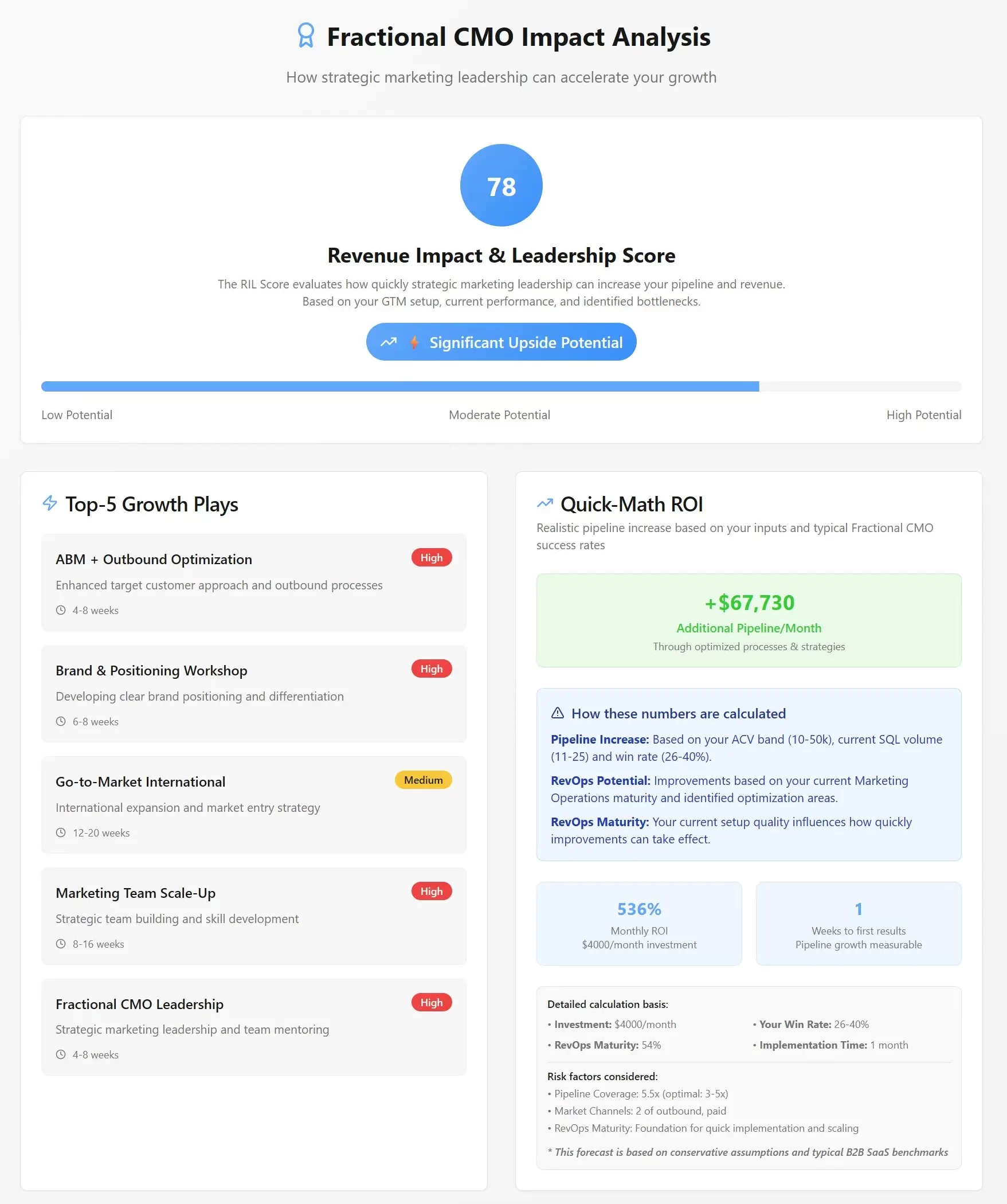
Many companies face the same challenge today: revenue targets keep rising, marketing is becoming more complex, and budgets and resources remain limited. Founders, CEOs, and sales leaders know that “more marketing” is needed. But where should they start? And is investing in a senior marketing leader really worth it?
That’s exactly where our ROI Calculator for Fractional CMO engagements comes in – a tool that makes your growth potential, marketing ROI, and RevOps maturity visible in minutes.
Contents
- 1 Why an ROI Calculator?
- 2 The Dimensions at a Glance
- 3 What the Calculator Delivers
- 4 A Real-Life Example
- 5 Vibe Coding – the Gamechanger Behind It
- 6 Why a Fractional CMO is Worth It
- 7 Conclusion: Your Personal Growth Check
- 8 Frequently Asked Questions
- 8.1 What is a Fractional CMO and how does it differ from hiring a full-time Chief Marketing Officer?
- 8.2 How can an ROI calculator help improve marketing performance?
- 8.3 What are the eight core dimensions measured in a Fractional CMO ROI calculator?
- 8.4 Why should companies track RevOps maturity instead of just marketing metrics like clicks and impressions?
- 8.5 What specific results can a company expect after working with a Fractional CMO?
- 8.6 How does data quality and CRM infrastructure impact marketing ROI?
- 8.7 What role does marketing and sales alignment (SLAs) play in revenue growth?
- 8.8 How can marketing automation and lead scoring improve conversion rates?
- 8.9 What is Vibe Coding and how does it improve tool development speed?
- 8.10 How should companies prioritize improvements after receiving their RevOps maturity score?
Why an ROI Calculator?
Marketing teams measure a lot of things, but not always what truly matters: the direct impact on revenue growth, lead generation, and customer retention. Many decisions are based on gut feeling or vanity metrics like clicks and impressions.
An ROI calculator brings structure to this uncertainty. In just a few steps, it shows how mature your Revenue Operations (RevOps) really are and what kind of impact a Fractional Chief Marketing Officer (CMO) could have. The result: clarity on where you stand today, where the biggest levers are, and how you could dramatically improve marketing efficiency and return on investment.
→ More information: Fractional CMO – definition, responsibilites & cost.
The Dimensions at a Glance
The calculator walks you through eight core areas every B2B leader should understand:
- Strategy & Market Positioning
A clear marketing strategy, strong value proposition, and well-defined target audiences. - Demand & Growth
Effective lead generation, stable pipeline conversion rates, and plans for scaling into new markets. - Data & Infrastructure
Clean CRM data, a single source of truth across teams, and an integrated, GDPR-compliant tech stack. - Attribution & Reporting
ROI tracking per channel, multi-touch attribution, and KPI frameworks covering CAC, LTV, CLV. - Processes & Alignment
SLAs between marketing and sales, a shared sales funnel with forecasting, and real collaboration. - Automation & Enablement
Marketing automation, lead scoring, nurturing sequences, and sales enablement playbooks. - Content Generation
A consistent content engine, clear content strategy, performance measurement, and distribution. - Customer Lifecycle & Retention
Structured onboarding, churn tracking and reduction, plus systematic cross-sell and upsell.
At the end, you get a comprehensive score that highlights whether your organization is just getting started, on solid ground, or already operating at a best-in-class level.
What the Calculator Delivers
- Clarity: A fact-based snapshot instead of endless discussions.
- Prioritization: Clear visibility into which areas have the biggest ROI potential.
- Actionability: Within 5–10 minutes, you get a practical roadmap a Fractional CMO could execute.
Many CEOs say afterwards: “Now I finally understand where we really stand – and what’s holding us back.”
A Real-Life Example
A SaaS company with about 50 employees used the calculator. The result: 48% overall RevOps maturity.
- CRM data: clean
- Attribution & reporting: missing
- Content strategy: underdeveloped
- Pipeline conversion: weak
The calculator clearly revealed the gaps. Based on this, a Fractional CMO designed a 90-day roadmap. Six months later, the company saw +35% more qualified leads, +22% higher conversion rates, and -18% churn.
Vibe Coding – the Gamechanger Behind It
Here’s another interesting part: the ROI calculator itself was built with Vibe Coding.
Instead of traditional coding, Vibe Coding makes it possible to build apps visually and interactively. You get into flow quickly, experiment, and create in hours what would normally take weeks.
For us, it was the key to getting a functional, user-friendly tool live in no time – one that immediately delivers value. Put simply: without Vibe Coding, this ROI calculator wouldn’t exist in its current form.
Why a Fractional CMO is Worth It
This calculator is more than a nice-to-have tool. It shows the tangible impact a Fractional CMO can bring:
- Growth: More leads, better conversion, stronger pipeline.
- Efficiency: Less friction, more automation, cleaner data.
- Transparency: A single source of truth instead of siloed metrics.
- Strategic clarity: A clear market position that convinces customers and outpaces competitors.
For startups and mid-sized companies that aren’t ready to hire a full-time CMO, a Fractional CMO is often the perfect solution.
Conclusion: Your Personal Growth Check
If you’ve felt for a while that marketing and sales should work more seamlessly together, this calculator is for you.
In just a few minutes, you’ll see:
- Where you stand today
- Where you’re leaving growth potential on the table
- How a Fractional CMO could unlock that potential
Try the calculator here: https://www.jollymarketer.com/en/roi-rechner-for-fractional-cmo-engagements/
Frequently Asked Questions
What is a Fractional CMO and how does it differ from hiring a full-time Chief Marketing Officer?
A Fractional CMO is a senior marketing leader who works part-time or on a project basis, typically 10-20 hours weekly. Unlike full-time CMOs, fractional arrangements offer flexibility and lower costs, making them ideal for startups and mid-sized companies that need strategic marketing expertise without the overhead of a permanent salary.
How can an ROI calculator help improve marketing performance?
An ROI calculator provides data-driven clarity on your RevOps maturity across eight critical dimensions: strategy, demand generation, data infrastructure, attribution, processes, automation, content, and customer retention. It identifies specific gaps and prioritizes high-impact areas, eliminating guesswork and enabling focused improvement efforts.
What are the eight core dimensions measured in a Fractional CMO ROI calculator?
The calculator evaluates: Strategy & Market Positioning, Demand & Growth, Data & Infrastructure, Attribution & Reporting, Processes & Alignment, Automation & Enablement, Content Generation, and Customer Lifecycle & Retention. Each dimension reveals operational maturity and revenue growth potential within your organization.
Why should companies track RevOps maturity instead of just marketing metrics like clicks and impressions?
Revenue Operations (RevOps) maturity directly links marketing activities to business outcomes—qualified leads, conversion rates, and customer retention. Vanity metrics like clicks don’t reveal revenue impact. RevOps tracking ensures marketing spend directly influences pipeline growth, customer acquisition cost, and lifetime value.
→ More about the fractional CMO model in Germany.
What specific results can a company expect after working with a Fractional CMO?
Based on real case studies, companies typically see 25-35% increases in qualified leads, 20-22% higher conversion rates, and 15-18% churn reduction within six months. Results depend on implementation of the strategist’s roadmap and organizational alignment on priorities identified during the ROI assessment.
How does data quality and CRM infrastructure impact marketing ROI?
Clean CRM data and integrated tech stacks enable accurate attribution tracking, multi-touch reporting, and predictive analytics. Poor data infrastructure creates silos, limits accountability, and wastes ad spend on ineffective channels. Strong data foundations allow precise CAC, LTV, and CLV calculations for informed budget allocation.
What role does marketing and sales alignment (SLAs) play in revenue growth?
Service Level Agreements between marketing and sales establish clear expectations for lead quality, follow-up timing, and pipeline forecasting. Alignment eliminates friction, accelerates deal velocity, and ensures both teams optimize for shared revenue outcomes rather than conflicting department metrics.
How can marketing automation and lead scoring improve conversion rates?
Marketing automation nurtures prospects through personalized, timely touchpoints while lead scoring identifies sales-ready opportunities. Combined, they prioritize high-intent prospects, reduce manual handoffs, and shorten sales cycles—directly improving conversion rates and pipeline velocity.
What is Vibe Coding and how does it improve tool development speed?
Vibe Coding enables visual, no-code app development that significantly reduces build time from weeks to hours. It accelerates user testing, iteration, and deployment of functional tools. This approach allows companies to rapidly create business-critical applications like ROI calculators without extensive engineering resources.
How should companies prioritize improvements after receiving their RevOps maturity score?
Focus first on high-impact, low-effort improvements—typically in data infrastructure, attribution tracking, and sales-marketing alignment. These foundational areas unlock clarity on other gaps. Then tackle content strategy and automation, which compound benefits. A Fractional CMO typically designs 90-day roadmaps addressing these priorities sequentially.