

The sales landscape is witnessing an unprecedented transformation as companies rush to implement AI sales agents for automation. What was once a futuristic concept has rapidly become a competitive necessity, with the market for these intelligent tools projected to skyrocket from $5.1 billion in 2024 to a staggering $47.1 billion by 2030—expanding at a breathtaking 44.8% CAGR. This isn’t just another tech trend; it’s a fundamental shift in how companies approach their sales processes.
While traditional sales reps spend up to three hours daily on manual data entry, their AI counterparts work tirelessly 24/7, processing 8x more leads at 40-60% lower operational costs. The impact extends beyond efficiency metrics to the bottom line, with personalized AI-driven recommendations now generating 35% of Amazon’s massive $143.1 billion quarterly revenue. As sales funnel optimization becomes increasingly sophisticated through machine learning, businesses face a stark choice: adapt to this new paradigm or risk falling dramatically behind competitors who are already leveraging these powerful tools.
Contents
- 1 Key Takeaways
- 2 The Economic Impact of AI Sales Automation
- 3 How AI Transforms the Sales Funnel
- 4 Strategic Applications Across the Sales Cycle
- 5 Leading Tools Reshaping Sales Automation
- 6 Implementation Challenges and Solutions
- 7 Future Directions in AI Sales Automation
- 8 Real-World AI Sales Success: Case Studies That Prove the Power of Automation
- 9 FAQ
- 10 Sources
Key Takeaways
- Market explosion projected to reach $47.1 billion by 2030, with 44.8% CAGR from 2024
- AI sales agents slash cost per converted lead from $1,708 to $68.50 while handling 8x more leads
- Companies using AI for lead scoring experience 50% higher conversions and 30% revenue growth
- 57% of businesses see ROI within 3 months of implementing AI sales automation
- Predictive analytics deliver 25% higher conversion rates through intelligent lead prioritization
The Economic Impact of AI Sales Automation
The financial implications of AI agents in business extend far beyond simple cost savings. These intelligent systems are projected to contribute an astonishing $15.7 trillion to the global GDP, according to Bank of America’s 2024 analysis. This economic transformation is happening at a pace that vastly outstrips traditional sales technologies—with AI sales tools growing nearly four times faster than conventional CRM software.
Regional Adoption Patterns
North America currently leads this revolution with over 24,000 public mentions of AI sales implementation in 2024 alone. European and Asia-Pacific regions follow closely behind, though with distinct adoption patterns. Healthcare organizations are particularly quick adopters, with 90% expected to implement AI sales solutions by 2025. Similarly, retail businesses leveraging AI-driven personalization report 69% revenue growth compared to competitors using traditional methods.
Industry-Specific Growth Metrics
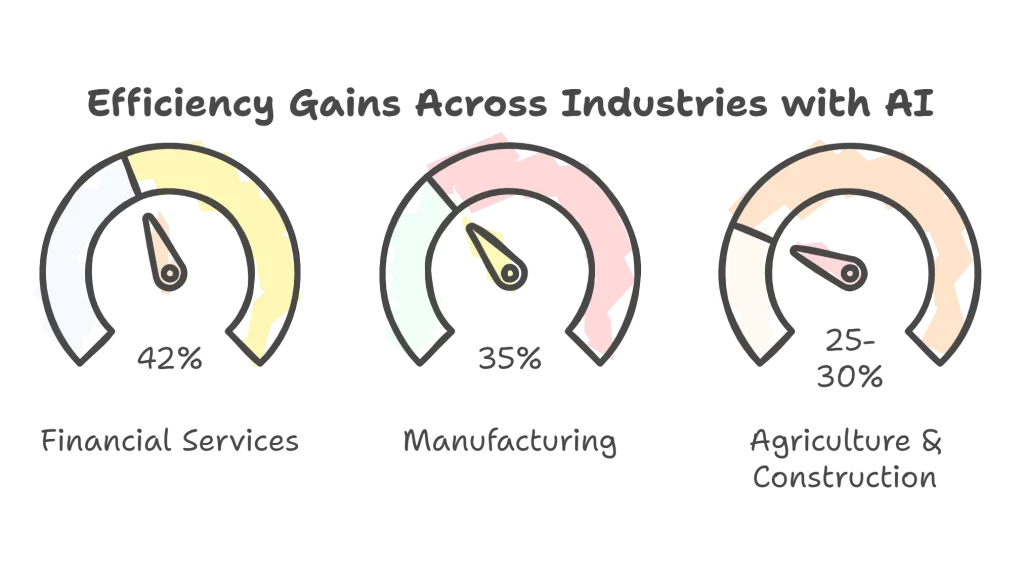
The impact varies dramatically across sectors. Financial services companies report 42% efficiency gains in client onboarding processes. Manufacturing firms reduce sales cycle duration by 35% through automated qualification and follow-up. Even traditionally technology-resistant industries like agriculture and construction are seeing 25-30% improvements in dealer network management and parts supply through AI-powered sales systems.
How AI Transforms the Sales Funnel
The integration of artificial intelligence into sales processes has fundamentally altered how companies move prospects through their B2B sales funnel strategy. The impact stretches from initial contact to post-sale relationship management, creating efficiencies at every touchpoint.
Automated Lead Generation and Qualification
The most dramatic cost benefits appear in lead conversion metrics. Tendril’s 2024 case study revealed that AI systems reduced the cost per converted lead from $1,708 to just $68.50—a 96% reduction. This efficiency isn’t merely financial; these systems process eight times more leads than human teams while maintaining quality.
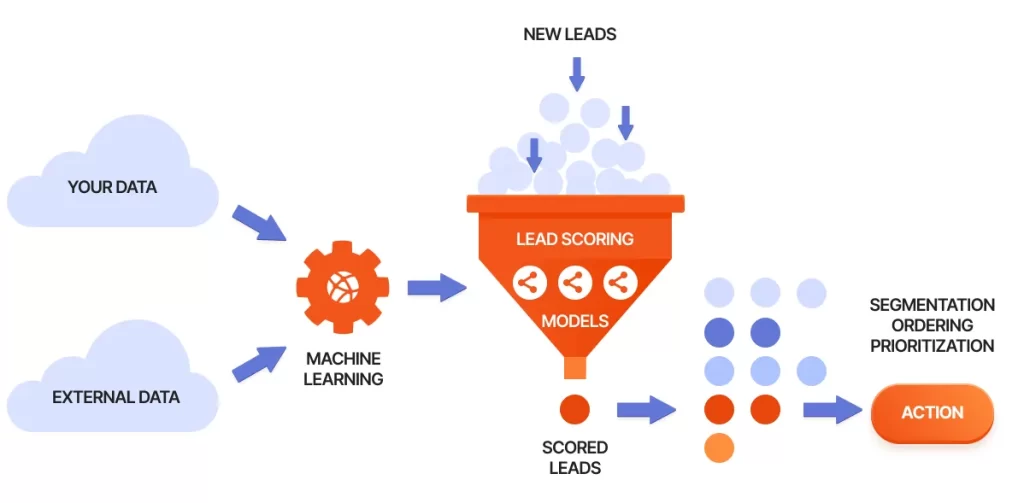
The contrast between manual and automated lead scoring is stark. Sales representatives typically spend 8-10 hours weekly on lead prioritization, with inconsistent results. Meanwhile, platforms like Salesforce Einstein analyze over 200 data points in real-time, delivering 25% higher conversion rates through objective, data-driven lead scoring.
Hyper-Personalized Customer Interactions
Modern AI sales tools track over 100 distinct behavioral metrics—from cursor movements to page dwell time—creating deeply personalized engagement strategies. This granular approach drives significant results, as evidenced by Amazon’s 35% revenue attribution to AI-powered product recommendations (totaling $143.1 billion in Q3 2023).
AI sequences that combine multiple communication channels show particularly impressive performance. Apollo.io’s integrated approach merges LinkedIn outreach, email sequences, and automated call scheduling, resulting in 20% higher reply rates compared to single-channel approaches.

Operational Efficiency Gains
The time-saving aspects of AI sales agents can’t be overstated. HSO’s 2024 report found that 75% of resume screening and 40% of repair cost calculations are now fully automated. This automation eliminates approximately three hours of manual data entry per day for each sales representative—time that can be redirected to high-value customer interactions.
The financial return timeline is equally compelling, with 57% of businesses reporting ROI within just three months of implementation. This rapid payback period makes AI sales tools increasingly accessible even to smaller organizations with limited technology budgets.
Strategic Applications Across the Sales Cycle
The versatility of AI sales agents allows them to address specific challenges throughout the customer journey, from prospecting to closing deals and beyond.
Predictive Lead Scoring and Prioritization
A tech company featured in Emplibot’s 2024 case study implemented AI-based lead scoring and saw conversions increase by 50% while revenue grew by 30%. These results exemplify how intelligent prioritization allows sales teams to focus their energy where it matters most.
This trend is particularly pronounced in B2B environments, where Leadfeeder reports that 80% of enterprise organizations now prioritize AI for account-based marketing initiatives. Tools like HubSpot leverage natural language processing to analyze email sentiment and communication patterns, flagging high-intent leads that might otherwise be overlooked.
Around-the-Clock Customer Engagement
The ability to provide seamless 24/7 support represents another significant advantage. Rising-Tide.ai’s 2024 analysis found chatbot implementations drive 20% higher conversions and 40% better engagement metrics compared to traditional office-hours-only support models.
Healthcare organizations demonstrate the transformative potential here—90% of hospitals now use AI agents for patient triage according to Salesforce. Similarly, retail chatbots like those from Tidio can simultaneously handle over 1,000 customer interactions in multiple languages, eliminating wait times entirely.
Dynamic Sales Pipeline Management
Pipeline visibility and forecasting accuracy dramatically improve with AI integration. Synthesia’s 2025 projections indicate that real-time analytics reduce deal slippage by 15% through early identification of stalled opportunities.
The contrast in forecasting precision is equally notable. Traditional spreadsheet-based models typically carry error rates up to 25%, while Salesforce Einstein delivers 95% precision in revenue predictions. This forecasting accuracy allows for more confident resource allocation and strategic planning.
Leading Tools Reshaping Sales Automation
The market offers numerous platforms for implementing agentic CRM capabilities, each with distinct advantages for different business models and team structures.
Enterprise-Grade Solutions
Salesforce Sales Cloud remains the dominant enterprise platform, offering Einstein Copilot for email generation and conversation intelligence. Its predictive forecasting capabilities justify the premium pricing ($25–$500 per user monthly) for organizations seeking comprehensive integration.
HubSpot Sales Hub presents another robust option, with AI-powered deal management and automated quote generation. Its widespread adoption by over 150,000 businesses reflects its balance of sophisticated features and usability.
Specialized Functionality Tools
For organizations seeking more targeted solutions, Apollo.io offers access to over 210 million B2B contacts with AI sequences across multiple communication channels. Users report 20% higher lead acceptance rates compared to manual outreach methods.
Fireflies.ai focuses specifically on conversation intelligence, with meeting transcription and trend analysis that boasts 98% speech recognition accuracy according to G2’s 2024 assessment. This specialization strategy allows for deeper functionality within a narrower scope.
Accessible Options for Small and Medium Businesses
Smaller organizations can still access powerful AI sales capabilities through platforms like Pipedrive, which offers tiered pricing from $15 to $99 per user monthly. These more accessible entry points provide essential AI sales functions without requiring enterprise-level investment.
Tidio’s multilingual chatbots deliver another affordable entry point, handling over 1,000 concurrent queries with minimal setup requirements. This scalable approach makes AI sales automation achievable regardless of company size.
Implementation Challenges and Solutions
Despite the compelling benefits, organizations face several obstacles when adopting AI sales agents.
Data Privacy and Trust Concerns
ResearchAndMarkets.com reports that 43% of consumers express distrust regarding AI handling their sensitive data. This hesitation creates friction in otherwise promising customer relationships.
Leading solutions address this through robust security measures. Zendesk and similar platforms implement end-to-end encryption and transparent data usage policies that satisfy both regulatory requirements and customer concerns.
Cost Barriers and ROI Timelines
Initial implementation costs remain a significant hurdle, with Quytech noting that 65% of small and medium businesses cite financial constraints as their primary adoption barrier.
Vendors are responding with more flexible models, including subscription-based pricing, limited-feature entry points, and phased implementation approaches that allow for gradual investment aligned with proven returns.
Integration with Existing Systems
Technical compatibility issues can complicate deployment, particularly for organizations with legacy CRM systems or custom sales workflows.
Modern solutions increasingly offer API-based integration capabilities and pre-built connectors for popular platforms. This interoperability focus ensures that AI sales tools enhance rather than replace existing technology investments.
Future Directions in AI Sales Automation
As the technology matures, several emerging trends will shape the next generation of AI sales agents.
Conversational AI Advancements
Gartner projects that 50% of B2B interactions will involve chatbots by 2026, driven by rapid improvements in natural language processing. These systems will move beyond scripted responses to truly adaptive conversations that match human sales professionals in persuasiveness and relationship building.
Advanced Machine Learning Integration
The integration of more sophisticated models like GPT-5 will enable more naturalistic cold emails and sales communications. Salesforge predicts these advancements will finally overcome the “uncanny valley” effect that currently makes some AI communications feel slightly off to recipients.
Ethical AI Frameworks
As adoption accelerates, ethical considerations move center stage. Forbes reports 78% of enterprises will prioritize transparency in AI decisions by 2025. This focus on responsible implementation will include clear disclosure of AI usage, bias mitigation strategies, and human oversight mechanisms for sensitive decisions.
Real-World AI Sales Success: Case Studies That Prove the Power of Automation
The AI sales revolution isn’t just happening in labs or boardrooms—it’s playing out in the real world, delivering measurable results for companies across industries. Here are some standout examples that illustrate just how transformative these systems can be.
🏢 Property Developer Closes $2M Deals on Sundays
A property developer implemented an AI voice agent to instantly answer and qualify leads—even outside business hours. This eliminated missed opportunities from off-hour inquiries, turning previously lost Sunday evening calls into $2 million contracts. The AI doesn’t just talk—it books meetings, updates the CRM, and follows up automatically.
💄 Cosmetic Clinics Generate $100K in 3 Days
One agency built a hybrid AI chatbot and voice agent system for cosmetic clinics that segments leads by intent. Instead of spending money on ads or discounts, the AI re-engages their existing database, nurturing warm leads and presenting time-sensitive offers to hot prospects. The result? Over $100,000 in revenue generated in less than 72 hours—without a single paid ad.
🏠 Realtors Respond in Under 60 Seconds
Speed to lead matters. A real estate automation solution sends an SMS within one minute of form submission, followed by an AI-driven conversation that gathers buyer preferences, books showings, and follows up automatically. This system increased conversions by 391%, leveraging the fact that 78% of buyers go with the first company that responds.
🎯 AI Agents That Sell While You Sleep
Whether it’s avatars qualifying leads on landing pages, SDR agents scraping profiles and engaging on Instagram, or smart assistants reactivating cold databases, these systems are redefining what’s possible in sales. And the best part? They’re doing it at scale, around the clock, without burning out.
FAQ
What ROI can companies expect from implementing AI sales agents?
Most organizations see returns within 3-6 months of implementation. The average ROI metrics include 40-60% lower operational costs, 25% higher conversion rates, and time savings of approximately 3 hours per rep daily. For specific businesses, this typically translates to 20-30% revenue growth within the first year.
How do AI sales agents differ from traditional automation tools?
Unlike rule-based automation, AI sales agents continuously learn from interactions and adapt their approach. They can analyze unstructured data (emails, calls, social media), recognize patterns humans might miss, and make predictive recommendations rather than simply following predetermined workflows. This learning capability creates compounding value over time.
Are AI sales agents suitable for small businesses with limited budgets?
Yes, with several vendors now offering tiered pricing starting at $15-25 per user monthly. Many platforms provide free trials or limited-feature versions that still deliver significant value. Small businesses often see faster relative ROI due to the dramatic efficiency gains when moving from completely manual processes to AI-assisted workflows.
How do customers respond to interactions with AI sales agents?
Customer response has improved dramatically with recent advances. When properly implemented with transparency about AI usage, customer satisfaction scores typically match or exceed those of human-only interactions. The key factors are response speed (instant vs. hours/days), 24/7 availability, and consistency in information provided.
Sources
- allaboutai.com: AI Agents Statistics
- amplemarket.com: 15 of the Most Useful Sales Funnel Metrics
- salesforce.com: AI Sales Tools
- tendril.us: The Role of AI SDRs in Modern Outbound Sales Teams
- quytech.com: AI Agents in Sales
- leadfeeder.com: What is Account Based Marketing
- globenewswire.com: AI Agents Research Report 2024-2029
- perspective.co: Marketing Funnel Metrics
- cognism.com: AI Sales Tools
- tidio.com: AI Sales Assistant Software
- synthesia.io: AI Sales Enablement
- salesforge.ai: Best AI Sales Tools
- skaled.com: AI Sales Tools

