
Last year, I watched a six-figure enterprise software deal collapse after nine months of negotiations when a previously unknown stakeholder—the company’s new CFO—vetoed the purchase during final approval. This scenario plays out daily across B2B sales floors, where B2B buying committee roles have expanded from an average of six decision-makers to 10-13 stakeholders, fundamentally transforming how complex sales succeed or fail.
I’ll show you exactly how to map these expanded committees, identify where real power lies, and overcome the objections that kill 58% of B2B deals before they close.
Contents
- 1 Key Takeaways
- 2 The New Reality: 10-13 Decision Makers Control Your Deal
- 3 Essential Roles Every Sales Team Must Navigate
- 4 Where Power Really Lives: Executive Authority Meets Committee Consensus
- 5 The 12-Month Marathon: Understanding Extended Buying Cycles
- 6 Critical Objections That Kill Deals (And How to Prevent Them)
- 7 Winning Strategies for Complex Committee Engagement
- 8 FAQ
- 9 Sources
Key Takeaways
- Modern committees average 10-13 decision-makers, with deals over $250,000 requiring up to 19 stakeholders
- Executive authority concentrates with C-suite (22%) and CFOs (20%) despite broader committee involvement
- Buying cycles stretch 11.5-12 months from initial budgeting through vendor selection
- Multi-threading strategies increase conversion rates by 3.4-4.4x compared to single-contact approaches
- 81% dissatisfaction rates post-purchase highlight the complexity of achieving true committee consensus
The New Reality: 10-13 Decision Makers Control Your Deal
The traditional assumption that B2B purchases involve roughly six stakeholders no longer reflects market reality. My analysis of recent procurement data shows buying committees have grown 43% larger, with 89% of purchases now spanning two or more departments. This expansion creates unprecedented complexity for sales teams accustomed to single-threaded deals.
Understanding Committee Size by Deal Type
Software purchases typically involve 6-10 committee members, while enterprise solutions require significantly more participants. Deals exceeding $250,000 demand an average of 19 external stakeholders for successful closure. The buying center expands proportionally with investment size and organizational risk, as companies distribute accountability across multiple departments to mitigate potential failure.
I’ve observed that 92% of B2B buying decisions now involve groups of two or more people, completely eliminating the single decision-maker model for all but the smallest purchases. This shift toward collective evaluation reflects both increased solution complexity and heightened scrutiny around technology investments. The decision-making unit has evolved from a small executive team to a cross-functional assembly spanning IT, finance, operations, legal, and end-user departments.
Cross-Functional Complexity Drives Committee Growth
Modern business solutions touch multiple operational areas simultaneously, forcing organizations to include stakeholders from each affected department. When implementing a CRM system, for instance, sales, marketing, customer service, IT, and finance all require representation in the evaluation process. This interconnectedness means that stakeholder mapping must account for both direct users and indirect beneficiaries of any proposed solution.
The procurement process itself has become more formalized, with dedicated procurement teams joining technical and business stakeholders. These professional buyers introduce additional layers of evaluation criteria, focusing on vendor risk assessment, contract terms, and compliance requirements that extend beyond functional requirements.

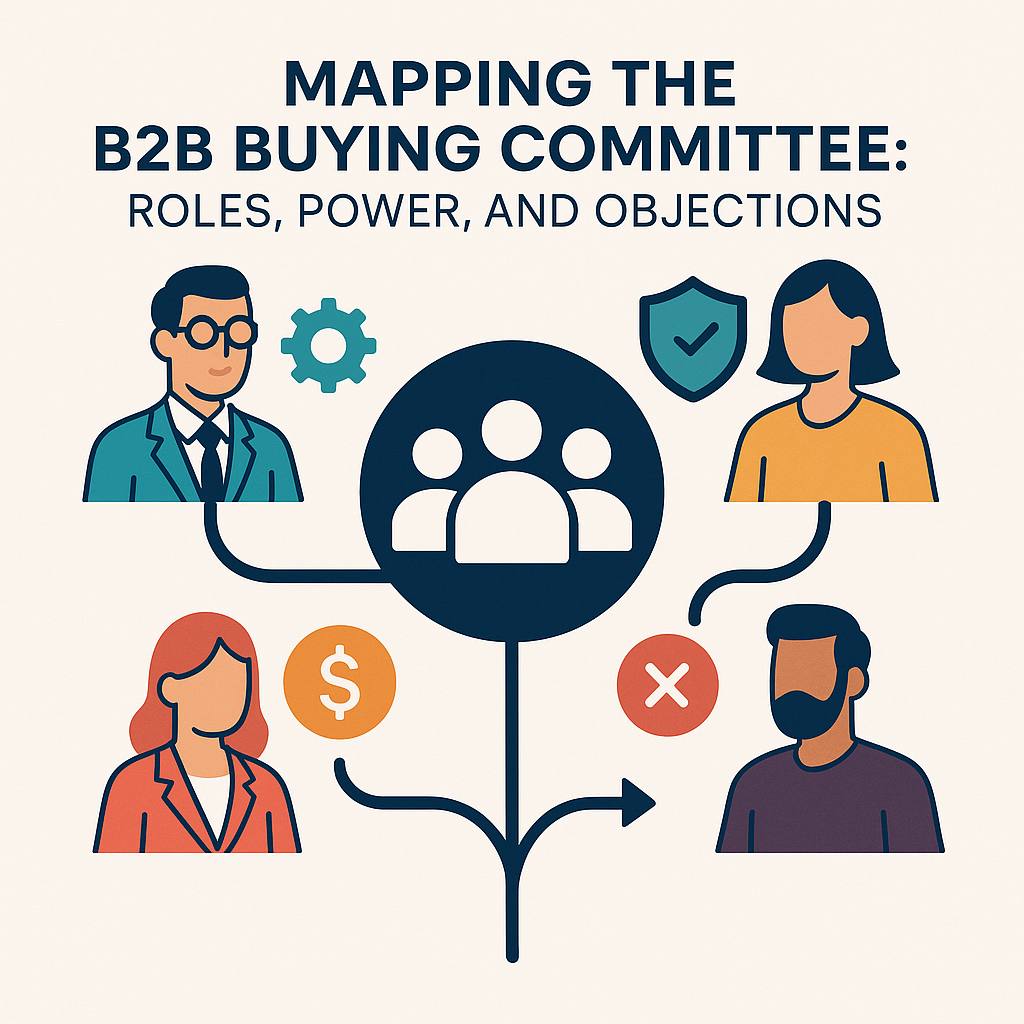
Each member of the buying committee brings distinct perspectives, concerns, and evaluation criteria to the purchase decision. I’ve identified nine archetypal roles that consistently appear across B2B purchases, though individuals often occupy multiple positions simultaneously depending on organizational structure and purchase type.
Primary Decision-Making Roles
The Initiator identifies organizational problems and triggers the procurement process, often emerging from operational teams experiencing daily pain points. Champions serve as internal advocates, promoting solutions across departments and building coalition support. These enthusiastic supporters differ from Influencers, who provide technical buyer expertise that shapes committee opinions through domain knowledge and credibility.
Decision-Makers hold formal approval authority, with 22% being C-suite executives and 20% CFOs maintaining final veto power. The economic buyer controls financial resources and evaluates cost-benefit ratios, frequently overlapping with CFO responsibilities in smaller organizations. 79% of purchases now require CFO approval regardless of initial budget ownership.
Supporting and Blocking Roles
End-Users represent the daily operators who will interact with purchased solutions, providing practical feedback about usability and workflow integration. The gatekeeper controls information flow and access to other stakeholders, often administrative assistants or procurement professionals who screen vendor communications. Blockers raise objections based on risk perception, competing priorities, or political motivations, while Coordinators manage the vendor evaluation timeline and documentation.
Understanding that 42% of buyers identify C-suite or CFO as ultimately responsible for decisions helps prioritize engagement efforts. Yet I’ve learned that neglecting lower-level stakeholders proves fatal, as their resistance can derail deals despite executive support. The same individual might champion one aspect while blocking another, requiring nuanced relationship management throughout the budget authority hierarchy.

Where Power Really Lives: Executive Authority Meets Committee Consensus
Purchase authority has consolidated dramatically at executive levels, with 38% of buying committees now involving CEOs directly. Post-pandemic economic pressures dropped CFO spending thresholds from $500,000 to just $50,000, inserting financial executives into previously autonomous departmental purchases. This authority concentration creates tension between democratic participation and hierarchical control.
The Consensus Paradox
Despite formal executive authority, 82% of purchases require committee consensus for successful implementation. Single decision-makers maintain an 81% likelihood of making purchases, while committees of 5.4 members drop to just 43% decision probability. This mathematical reality forces vendors to balance executive engagement with broader stakeholder alignment.
I’ve tracked how 77% of CFOs introduced cost-cutting measures in 2022, elevating their influence over previously approved budgets. The decision-making unit must now satisfy both technical requirements and increasingly stringent financial criteria. Two-thirds of the buying process completes through internal group dynamics before any vendor evaluation begins, limiting seller influence over critical early discussions.
Managing Committee Conflict
Group conflict among stakeholders peaks at 37% throughout the purchase journey, particularly when departmental priorities clash. Marketing might prioritize features while IT focuses on security, creating deadlocks that stall progress. The expanded budget authority structure means multiple executives can veto purchases, even when lower-level consensus exists.
Power dynamics shift based on purchase type and organizational culture. Technical purchases elevate IT influence, while customer-facing solutions empower revenue leaders. Understanding these contextual power variations helps sellers identify true decision drivers beyond formal titles.
The 12-Month Marathon: Understanding Extended Buying Cycles
B2B purchase timelines have stretched dramatically, with 80% of buyers taking up to six months for vendor selection and 76% requiring another six months for budgeting approval. Complete buying journeys from initial problem identification through contract signing now average 11.5-12 months, transforming sales forecasting and pipeline management requirements.
Research Phase Dominance
Modern buyers complete 69% of their purchase journey before contacting sales teams, consuming an average of 27 pieces of content across the buying group. This self-directed research phase reflects both information accessibility and risk aversion, as committees seek consensus before exposing themselves to vendor influence. Stakeholder mapping must account for this invisible evaluation period where opinions crystallize without seller input.
I’ve noticed 58% of buyers spend more time researching than previously, with 53% relying more heavily on peer recommendations. The procurement process incorporates extensive internal discussions, third-party reviews, and competitive analysis before formal vendor engagement begins. Additionally, 95% of buyers anticipate using generative AI to support decision processes within the next year, potentially accelerating research while adding new evaluation complexity.
Stall Points and Deal Mortality
Pipeline stagnation has become endemic, with 86% of purchases stalling at some point and 58% resulting in no decision. More than 80% of sellers report deals lost due to key stakeholder departures, highlighting the fragility of extended sales cycles. The prolonged vendor evaluation period increases exposure to organizational changes, budget shifts, and competing priorities that derail momentum.
Extended timelines particularly impact innovative solutions requiring behavioral change or process transformation. Enthusiasm wanes as implementation complexity becomes apparent, while competing initiatives emerge to challenge resource allocation. Each additional month increases the probability of committee composition changes that reset evaluation criteria.

Critical Objections That Kill Deals (And How to Prevent Them)
My experience shows that understanding objection patterns enables proactive mitigation strategies that prevent deal collapse. Budget and price concerns lead stall reasons across all committee sizes, but deeper analysis reveals complex objection ecosystems that vary by stakeholder role and organizational context.
Financial and Authority Objections
Cost objections extend beyond sticker price to encompass ROI timelines, with 57% of buyers expecting returns within three months. This compressed expectation conflicts with implementation realities for complex solutions. Objection handling must address both immediate cost concerns and long-term value creation, particularly when 34% of purchases were initially unbudgeted.
Authority-related stalls rank third among delay causes, as committees struggle with unclear approval hierarchies. The procurement process often reveals competing budget priorities and conflicting departmental mandates that individual stakeholders cannot resolve. I recommend mapping authority structures early to identify potential approval bottlenecks before they manifest.
Technical and Risk Concerns
Integration challenges create substantial resistance, particularly given that 52% of current commerce technology stacks will be unsupported within two years. Technical objections often mask deeper organizational fears about change management and implementation failure. The shift from “fear of missing out” to “fear of messing up” reflects heightened accountability for purchase decisions.
Post-purchase dissatisfaction rates reveal objection validity, with 81% of buyers expressing regret about chosen providers. This rises to 91% among younger decision-makers, suggesting that traditional vendor evaluation criteria fail to predict implementation success. Addressing unstated concerns about organizational readiness and change capacity proves as important as feature demonstrations.
Winning Strategies for Complex Committee Engagement
Multi-threaded engagement strategies dramatically outperform traditional single-contact approaches, with companies talking to 11+ stakeholders achieving 3.4-4.4x higher conversion rates. Delivering verified buying groups to sales teams results in 20-50% conversion improvements, fundamentally changing pipeline velocity and predictability.
Proven Multi-Threading Tactics
Palo Alto Networks’ buying center strategy demonstrates achievable results: doubling close rates, improving MQL-to-opportunity conversion by 20%, and accelerating deal velocity by 30+ days. Their approach maps entire committees before first contact, enabling simultaneous engagement across all stakeholder types. This comprehensive stakeholder mapping reduces vulnerability to individual departures while building broader organizational support.
Creating committee-specific content that addresses collective concerns outperforms personalized individual messaging, which actually decreases group decision likelihood. I’ve found that 65% of buyers credit winning vendor content as significantly impacting their decision, particularly when it demonstrates industry expertise and contextual understanding.

Building Committee Consensus
Successful vendors focus on consensus facilitation rather than individual persuasion. This requires understanding inter-stakeholder relationships and power dynamics that influence group decisions. The decision-making unit responds better to materials that help them align internally than to aggressive selling tactics.
Industry and domain expertise rank among top selection criteria, as committees seek vendors who understand their specific challenges. Demonstrating this understanding through relevant case studies, industry-specific ROI models, and peer references accelerates consensus building. Sales and marketing alignment becomes critical for delivering consistent messages across all committee touchpoints throughout the extended buying cycle.
The most effective strategies acknowledge that 82% of purchases require consensus despite executive authority. Rather than bypassing committee members to reach executives, winning vendors equip champions with materials that address each stakeholder’s specific concerns while supporting collective decision-making. This approach to objection handling transforms potential blockers into advocates by demonstrating understanding of their unique perspectives.
FAQ
How do I identify all members of a B2B buying committee?
Start by asking your champion to map all stakeholders involved in evaluation, approval, and implementation. Use LinkedIn to identify department heads and team members connected to your primary contact. Request introductions to technical evaluators, budget holders, and end users early in the process. Most importantly, explicitly ask about approval requirements and who holds veto power over the purchase decision.
What’s the difference between an economic buyer and a decision-maker?
The economic buyer controls budget allocation and evaluates financial return, while the decision-maker holds final approval authority. These roles often overlap in smaller organizations but separate in enterprises. Economic buyers focus on ROI and cost justification, whereas decision-makers consider strategic alignment and organizational impact. Understanding this distinction helps target appropriate messaging to each stakeholder type.
Why do so many B2B deals end in no decision?
Deals stall when committees cannot achieve consensus, priorities shift, or key stakeholders leave. The 58% no-decision rate reflects risk aversion, extended timelines that lose momentum, and inability to justify change. Competition from status quo and internal initiatives often proves stronger than vendor differentiation. Preventing no-decision outcomes requires maintaining urgency while supporting internal consensus building.
How can I accelerate a 12-month buying cycle?
Focus on helping buyers complete their internal processes rather than pushing your sales agenda. Provide business case templates, ROI calculators, and implementation roadmaps that committees can use independently. Identify and address objections before they surface formally. Most importantly, maintain multi-threaded relationships to prevent single points of failure when stakeholders change roles or leave the organization.
Sources
- LeanData – 25 Powerful Statistics on Buying Groups & Opportunity Motions
- Forrester – The State Of Business Buying, 2024
- Martal – Key Factors Influencing the B2B Buying Process in 2025
- Forrester – The State Of Business Buying: Companies Still Struggle To Meet Buyer Expectations
- G2 – 2024 Buyer Behavior Report


