
Leading B2B companies in Germany spend between €5,000 and €15,000 monthly on fractional CMOs, yet 67% report cost savings compared to full-time executives while achieving 29% average revenue growth—a stark contrast to the 19% growth rate for companies without fractional leadership. The challenge isn’t finding talent anymore; it’s selecting the right engagement model among fractional cmo pricing models germany retainers sprints that aligns with your growth stage and budget constraints.
I’ll break down exactly how each pricing structure works, when to deploy them, and provide the financial framework to make an informed choice that maximizes ROI while minimizing risk.
Contents
- 1 TL;DR
- 2 Understanding the Core Fractional CMO Pricing Models
- 3 Financial Analysis: Calculating True Fractional CMO Cost
- 4 Selecting the Right Model for Your Business Stage
- 5 Implementation Roadmap for SME Marketing Budget Planning
- 6 FAQ
- 6.1 What is the typical monthly retainer pricing for a fractional CMO in Germany?
- 6.2 How do marketing sprints differ from traditional project-based engagements?
- 6.3 When should companies consider success fee marketing models?
- 6.4 How much can companies save with fractional versus full-time CMO hiring?
- 7 Sources
TL;DR
Fractional CMO engagement models offer distinct advantages depending on your business stage and objectives. Monthly retainers provide predictable costs and ongoing strategic leadership, while sprint-based engagements deliver focused execution for specific initiatives. Performance-based models align compensation with measurable outcomes, creating shared accountability between CMO and company.
- Monthly retainers average €12,000 with 67% cost savings versus full-time hires
- Sprint engagements run 6-8 weeks at €10,000-€50,000 for 25% faster time-to-market
- Performance models combine base fees with KPI bonuses, driving 29% revenue growth on average
Understanding the Core Fractional CMO Pricing Models
Monthly Retainer: The Foundation of Strategic Partnership
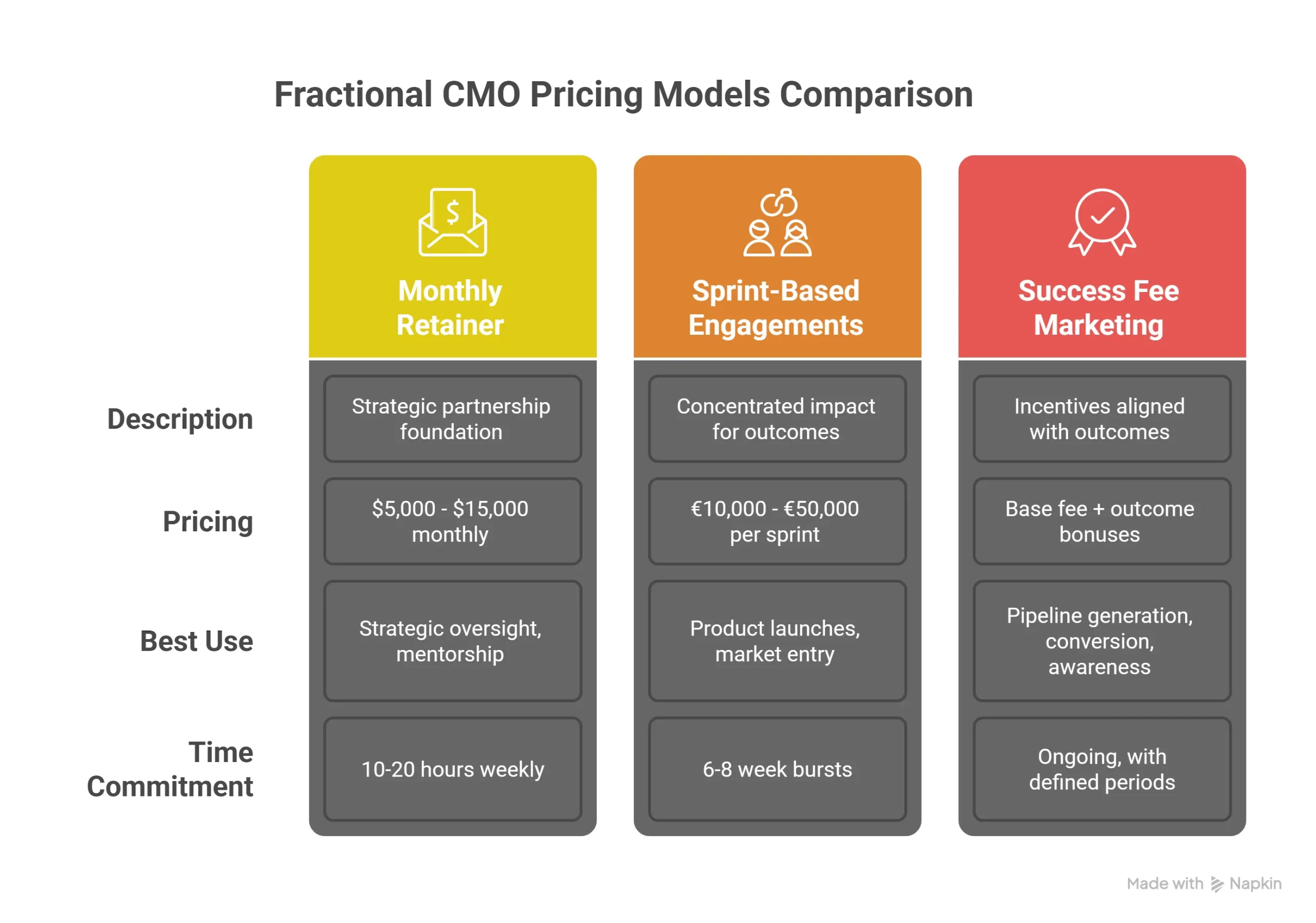
Monthly retainer pricing represents the backbone of most fractional CMO Germany engagements. I’ve seen countless mid-market companies struggle with the decision between hiring a full-time executive at €250,000+ annually versus engaging a fractional leader. The numbers tell a compelling story: monthly retainers range from $5,000 to $15,000, with most settling around €12,000 for comprehensive strategic oversight.
→ More information: Fractional CMO – definition, responsibilites & cost.
What makes retainers particularly attractive for SME marketing budget planning is the predictability. You know exactly what you’ll spend each month, can budget accordingly, and receive consistent strategic input. A B2B software company I worked with switched from project-based engagements to a €10,000 monthly retainer and saw their pipeline velocity increase by 40% within six months—not because of any single campaign, but because of sustained strategic alignment across all marketing activities.
The sweet spot for retainer engagements typically falls between 10-20 hours weekly. This provides enough time for deep strategic work, team mentorship, board reporting, and cross-functional collaboration without the overhead of a full-time position. Consider that fractional CMO cost efficiency extends beyond pure salary savings—you’re also avoiding benefits, equity dilution, and the 3-6 month ramp-up period typical of new executive hires.
Sprint-Based Engagements: Concentrated Impact for Defined Outcomes
Marketing sprints have revolutionized how companies approach time-bound initiatives. Rather than spreading efforts thin over months, sprint-based engagements concentrate expertise into 6-8 week bursts with multivariate testing cycles that rapidly validate strategies.
I recently observed an e-commerce company execute a B2B go-to-market strategy Germany sprint for €25,000. Over six weeks, they validated their ideal customer profile, refined messaging across three segments, and identified the two most effective acquisition channels from an initial test of seven. The concentrated effort delivered what would typically take six months of internal work, compressed into six weeks of focused execution.
Sprint pricing typically ranges from €10,000 to €50,000 depending on scope and deliverables. The key advantage isn’t just speed—it’s the ability to maintain current operations while simultaneously testing new approaches. This parallel processing capability makes sprints ideal for product launches, market entry strategies, or major repositioning efforts where time-to-market directly impacts competitive advantage.
Success Fee Marketing: Aligning Incentives with Outcomes
Performance-based pricing B2B models represent the most sophisticated approach to fractional engagement. Rather than paying purely for time or deliverables, companies tie compensation directly to measurable outcomes. A typical structure might include an €8,000 monthly base fee plus €1,000 for every 10% improvement in customer acquisition cost beyond baseline.
The critical distinction in success fee marketing lies in defining realistic, CMO-controllable metrics. While revenue seems like the obvious target, experienced fractional CMOs understand they don’t control sales execution or product quality. Instead, focus shifts to marketing-specific KPIs: qualified pipeline generation, conversion rate optimization, or brand awareness metrics in defined segments.
One manufacturing client implemented a hybrid model combining €7,500 monthly retainer with quarterly bonuses tied to lead generation for Mittelstand companies. They achieved 3x pipeline growth within nine months while maintaining predictable base costs. The key was establishing clear attribution models upfront and agreeing on which metrics the CMO could genuinely influence.
Financial Analysis: Calculating True Fractional CMO Cost
Breaking Down the Investment Requirements
Understanding fractional CMO cost requires looking beyond headline rates. A comprehensive analysis reveals that companies report 67% cost savings compared to full-time hires when accounting for total compensation packages.
Let’s examine a typical scenario: A €5M ARR company considering a full-time CMO at €300,000 annual cost (including benefits and equity) versus a fractional engagement at €10,000 monthly. The fractional option costs €120,000 annually—a €180,000 difference that can fund substantial campaign execution, marketing technology, or additional team members. But the financial advantage extends further when considering opportunity costs and flexibility.
The hidden costs of full-time executives often surprise first-time buyers. Recruitment fees alone can reach 25% of first-year salary (€75,000 in our example). Add severance packages if things don’t work out—and remember that average CMO tenure has dropped to just 4.3 years—and the risk-adjusted cost of full-time hiring becomes even more pronounced.
ROI Metrics That Matter
Measuring return on fractional CMO investment requires tracking both hard and soft metrics. Organizations employing fractional CMOs achieved 29% average revenue growth versus 19% for those without fractional leadership. But revenue alone doesn’t tell the complete story.
I track five core metrics when evaluating fractional CMO impact:
– Pipeline velocity (time from lead to opportunity)
– Marketing qualified lead cost reduction
– Customer acquisition cost optimization
– Marketing-sourced pipeline percentage
– Team productivity improvements
A portfolio company that replaced three consecutive full-time CMOs with a two-year fractional engagement saw 25% faster product launch cycles while maintaining strategic continuity. The stability factor—often overlooked in ROI calculations—proved invaluable during a critical growth phase.
Selecting the Right Model for Your Business Stage
Early-Stage: Flexibility First
Pre-product-market-fit companies need maximum flexibility with minimal commitment. Hourly engagements at €200-€500 per hour allow testing hypotheses without locking into long-term contracts. A startup I advised began with five hours monthly at €300/hour (€1,500/month) for messaging validation, then scaled to an €8,000 monthly retainer post-launch.
The transition point typically occurs when companies need consistent strategic oversight rather than sporadic consultation. Watch for signals: weekly marketing decisions requiring senior input, board requests for marketing metrics, or team members seeking mentorship beyond tactical execution.
Growth-Stage: Retainer vs Project Pricing
Growth-stage companies face the classic retainer vs project pricing dilemma. Retainers provide ongoing strategic leadership essential for scaling, while project-based engagements suit specific initiatives with clear endpoints. The decision often comes down to internal capability assessment.
Companies with strong execution teams but lacking strategic direction benefit most from retainer models. Those with solid strategy but needing specialized expertise for specific initiatives—like entering new markets or launching new products—find project-based engagements more valuable. Many companies combine both: maintaining a base retainer for ongoing strategy while adding project fees for major initiatives.
Scale-Stage: Hybrid Models and Performance Alignment
Mature companies often deploy hybrid arrangements combining predictable retainers with performance incentives. A fintech preparing for Series A paid €5,000 for two days of intensive pitch deck refinement, then engaged monthly at €15,000 post-funding. This phased approach matched investment to available resources while maintaining momentum.
→ More about the fractional CMO model in Germany.
Day rates (€1,200-€2,500) work well for board meetings, strategic planning sessions, or investor presentations where concentrated expertise delivers immediate value. Combined with monthly retainers for ongoing oversight, this creates a flexible framework that scales with business needs.
See also this post:
Implementation Roadmap for SME Marketing Budget Planning
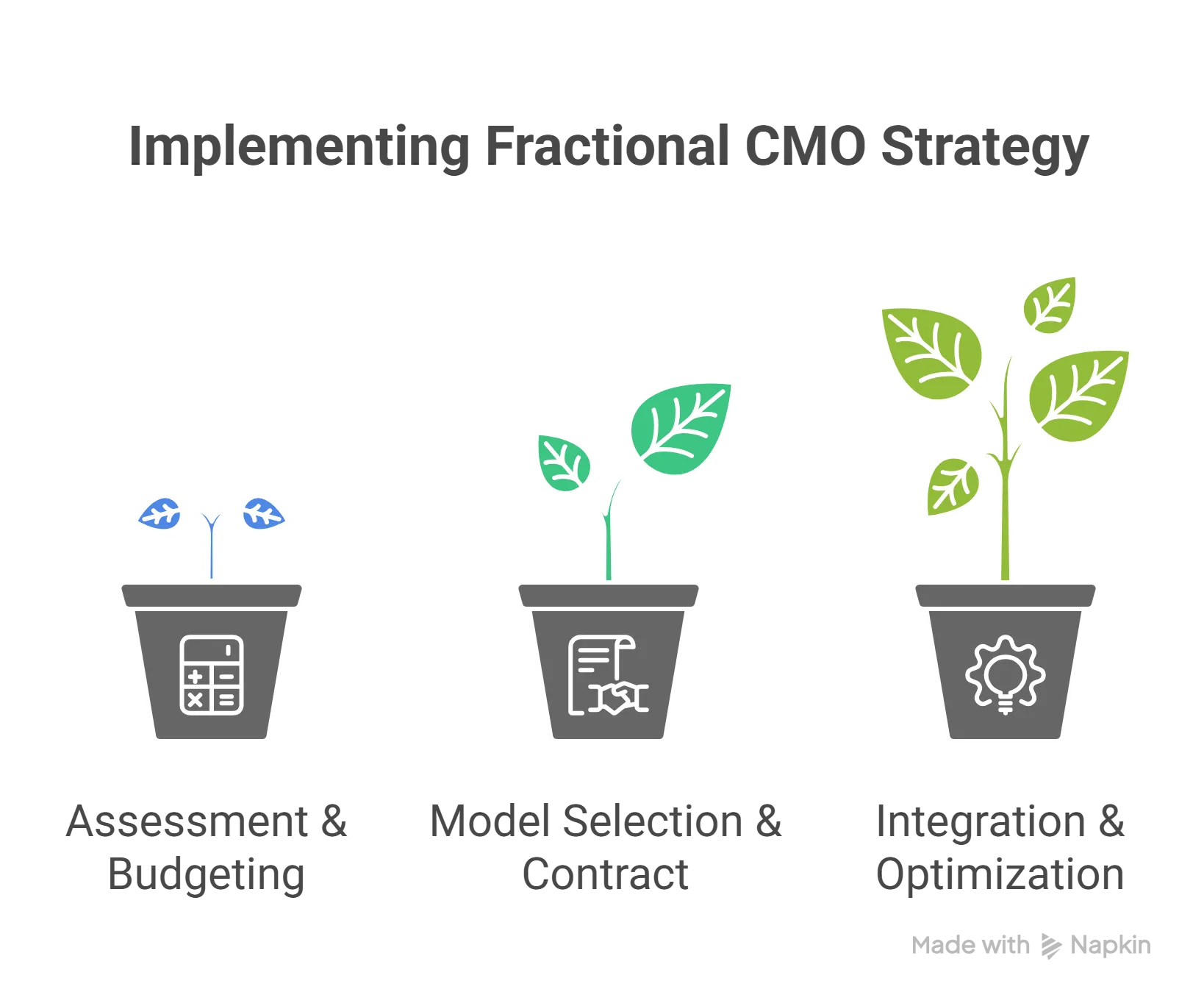
Phase 1: Assessment and Budgeting
Start by calculating the true cost of your current marketing leadership situation. Include not just salaries but also opportunity costs of vacant positions, underperformance, or strategic misalignment. Many SMEs discover they’re already spending fractional CMO equivalent amounts on agencies and consultants without receiving strategic oversight.
Document your specific needs across three dimensions: strategic planning requirements, execution oversight needs, and team development goals. Companies requiring all three typically need 15-20 hours weekly, pointing toward monthly retainer models. Those needing only strategic input might succeed with quarterly planning sessions plus monthly check-ins.
Phase 2: Model Selection and Contract Structure
Match your engagement model to business stage and objectives. If pursuing B2B go-to-market strategy Germany expansion, a 6-8 week sprint might validate market fit before committing to longer-term engagement. For sustained growth acceleration, monthly retainers provide the consistency needed for meaningful transformation.
Structure contracts with clear success metrics, termination clauses, and intellectual property provisions. Include specific deliverables for the first 90 days to ensure alignment and build trust. Many successful engagements begin with a 90-day trial period before committing to longer terms.
Phase 3: Integration and Optimization
Successful fractional CMO integration requires deliberate onboarding. Provide access to historical data, introduce key stakeholders, and establish communication rhythms early. The first month should focus on assessment and quick wins that demonstrate value while building longer-term strategic plans.
Monitor engagement effectiveness monthly using predetermined KPIs. Adjust scope as needed—successful fractional relationships evolve with business needs. What begins as strategic planning might shift toward team development or execution oversight as capabilities mature.
FAQ
What is the typical monthly retainer pricing for a fractional CMO in Germany?
Monthly retainer pricing for fractional CMOs in Germany typically ranges from €5,000 to €15,000, averaging around €12,000. The exact cost depends on factors including company size, industry complexity, required time commitment, and specific deliverables. Most mid-market B2B companies find the €8,000-€12,000 range provides optimal value.
How do marketing sprints differ from traditional project-based engagements?
Marketing sprints compress strategic work into 6-8 week intensive periods with defined outcomes and rapid iteration cycles. Unlike traditional projects that might stretch over months, sprints focus on quick validation through multivariate testing and concentrated effort. This approach typically costs €10,000-€50,000 and delivers faster time-to-market.
When should companies consider success fee marketing models?
Success fee marketing works best for companies with clear, measurable objectives and sufficient data to establish baselines. Consider this model when you can define specific KPIs the CMO can directly influence, such as lead generation quality or conversion rates. Avoid tying fees to revenue unless the CMO controls the entire customer journey.
How much can companies save with fractional versus full-time CMO hiring?
Companies typically save 67% on total costs when choosing fractional over full-time CMOs. A full-time CMO costing €300,000 annually (including benefits and equity) compares to €120,000 for fractional engagement. Additional savings come from avoiding recruitment fees, faster time-to-value, and reduced risk of mis-hires.