
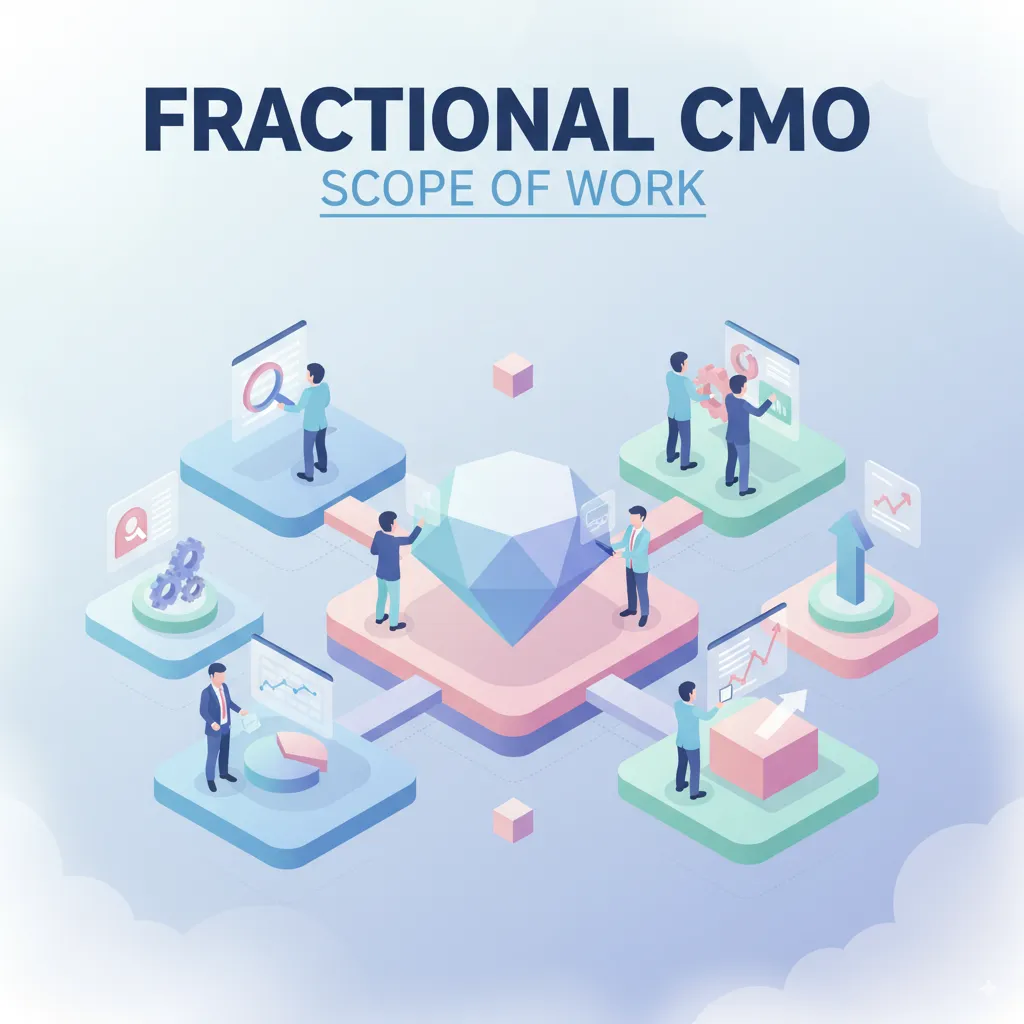
Last year alone, 73% of growing B2B companies struggled to define clear marketing leadership responsibilities, leading to missed revenue targets and wasted budgets exceeding $2.3 million per organization. The fractional cmo scope of work provides a structured solution that delivers executive-level marketing expertise at a fraction of traditional costs while maintaining full accountability for results.
I’ll show you exactly how these strategic leaders transform marketing operations through specific roles, responsibilities, and measurable deliverables that drive 29% average revenue growth.
TL;DR
A fractional CMO delivers strategic marketing leadership on a flexible basis, typically working 5-25 hours weekly while providing the same executive expertise as full-time CMOs at 60-80% lower costs. These leaders focus on high-impact initiatives including strategic planning, brand positioning, digital marketing oversight, and team development while following structured 30-60-90 day frameworks with measurable deliverables.
- Companies experience 29% revenue growth with fractional CMO leadership versus 19% without
- Implementation follows a 30-60-90 day framework with specific deliverables at each phase
- Cost savings range from 60-80% compared to full-time executive compensation packages
Core Functions and Strategic Impact of Fractional CMO Services
Executive Leadership on Flexible Terms
A fractional CMO operates as a senior-level marketing executive providing strategic leadership on a flexible, part-time CMO basis, typically working between 5-25 hours weekly. Unlike traditional consultants who merely advise from the sidelines, fractional CMOs integrate directly into leadership teams and take full ownership of marketing outcomes. Their involvement spans five primary responsibility categories that transform marketing from a cost center into a revenue driver.
→ More information: Fractional CMO – definition, responsibilites & cost.
The fractional CMO market reached $1.27 billion in 2024, driven by significant C-suite volatility where Fortune 500 CMOs average just 4.3 years tenure versus 4.9 years for other executives. This outsourced CMO model addresses the increasing complexity of modern marketing while providing budget flexibility for companies in the $2-30 million revenue range who need executive-level guidance without full-time overhead costs.
Strategic Planning and Market Positioning
Strategic leadership through fractional CMO services involves conducting thorough market research, competitor analysis, and customer behavior studies to inform B2B marketing strategy decisions. I’ve seen fractional CMOs uncover critical insights where 70% of marketing budget allocation produces only 30% of qualified leads, then systematically reallocate resources to higher-performing channels. This data-driven approach ensures every marketing dollar generates maximum impact.
Brand management extends beyond logo design and messaging consistency. Fractional CMOs develop positioning strategies that differentiate companies from competitors while ensuring unified brand expression across all customer touchpoints. They oversee comprehensive digital marketing initiatives including social media campaigns, content marketing programs, email marketing sequences, and paid advertising campaigns specifically optimized for demand generation.
Team Leadership and Organizational Development
Despite their part-time status, fractional CMOs effectively lead marketing teams by establishing clear performance goals, providing strategic mentorship, and ensuring teams possess necessary skills and tools for success. They manage both internal staff and external partners including agencies, freelancers, and specialized contractors to ensure cohesive execution and sales and marketing alignment. This leadership approach creates sustainable marketing capabilities that persist beyond the fractional engagement.

The impact becomes measurable quickly. Companies utilizing fractional CMO leadership report 29% average revenue growth compared to 19% for those without fractional leadership, with 48% faster time-to-market for new products and services. These metrics demonstrate how focused executive attention transforms marketing performance even with limited time commitment.
The 30-60-90 Day Framework: Structured Deliverables and Measurable Outcomes
Days 1-30: Discovery and Assessment Phase
Fractional CMOs follow a structured 30-60-90 day framework ensuring systematic progress and measurable results from day one. The initial 30 days focus on discovery through comprehensive marketing audit processes that identify improvement opportunities across all marketing functions. This phase includes stakeholder interviews for business objective alignment, competitor analysis and market positioning assessment, current performance metrics baseline establishment, marketing technology stack evaluation, and team capability assessment with development planning.
During this discovery phase, I conduct deep-dive analyses into existing marketing operations to understand what’s working, what’s failing, and where immediate improvements can generate quick wins. The assessment covers everything from campaign performance and lead quality to budget allocation efficiency and team productivity metrics. This comprehensive evaluation forms the foundation for all subsequent strategic decisions.
Days 31-60: Strategy Development and Quick Wins
The second phase emphasizes strategy development while implementing quick wins that demonstrate immediate value. Deliverables include a comprehensive marketing strategy document aligned with business goals, channel selection and budget allocation recommendations based on performance data, target audience refinement with detailed persona development, marketing campaign planning with tactical execution roadmaps, marketing KPIs definition and measurement framework establishment, and team training program outlines.
This phase transforms insights into actionable go-to-market strategy components. I focus on creating sustainable systems rather than one-off campaigns, building marketing infrastructure that continues delivering results long after the initial engagement. The strategy development process involves cross-functional collaboration to ensure marketing initiatives support broader business objectives while maintaining realistic execution timelines.
Days 61-90: Implementation and Optimization
The implementation phase drives marketing campaign execution with continuous optimization based on performance data. Key activities include establishing performance monitoring and adjustment protocols, creating stakeholder reporting and communication systems, implementing content strategies with detailed editorial calendars, building partnership and influencer collaborations, and developing post-90-day strategic roadmaps with long-term planning documents.
An engineering consulting firm that engaged an interim CMO following this framework entered the West Coast market and generated 41 new projects valued over $11 million within one year, exceeding annual targets by 160%. The structured onboarding approach ensured systematic market entry with measurable milestones at each phase, demonstrating how focused deliverables translate into substantial business impact.

Pricing Models and ROI: Understanding the Cost-Benefit Equation
Flexible Engagement Models
Fractional CMO services operate through four primary pricing models that accommodate different business needs and budgets. Hourly rates range from $200-350 per hour for specific consultations or project work. Monthly retainers between $3,000-15,000 provide ongoing strategic support with predictable costs. Project-based fees from $10,000-50,000 work well for defined initiatives like product launches or brand overhauls. Performance-based compensation ties payment directly to specific outcomes, aligning incentives between the fractional CMO and company goals.
Retainer-based pricing proves most effective for companies needing consistent strategic guidance and deep integration with leadership teams. A mid-sized B2B software company might engage a fractional CMO on a $12,000 monthly retainer for 15 hours weekly, focusing specifically on demand generation and sales enablement. This arrangement provides executive-level expertise while maintaining budget predictability and flexibility to adjust scope as needs evolve.
Financial Advantages and Cost Comparisons
The financial advantage becomes crystal clear when comparing total compensation packages. A full-time CMO requires $325,000-455,000 annually including base salary, comprehensive benefits, performance bonuses, and equity grants. Fractional arrangements typically cost $96,000-120,000 annually while delivering comparable strategic impact. This 60-80% cost reduction allows companies to access executive talent previously reserved for enterprise organizations.
Beyond direct cost savings, companies report 25-35% improvements in marketing ROI within 12 months of engaging fractional CMOs. Revenue growth rates average 29% compared to 19% for companies without fractional leadership. These improvements result from focused attention on high-impact initiatives, elimination of wasteful spending, and implementation of proven marketing systems that generate predictable results.
Network Effects and Resource Access
A PropTech startup utilized outsourced CMO services to refine product-market fit, develop compelling brand strategy, and secure both initial funding and first paying customers within six months. The part-time CMO arrangement provided access to extensive professional networks including marketing technology platforms, creative agencies, specialized consultants, and industry partnerships. This network effect often delivers 10-15% volume discounts on marketing services through pooled buying power across multiple client engagements.
The value extends beyond cost savings to include access to best-in-class resources and proven vendor relationships. Fractional CMOs bring pre-vetted agency partners, technology solutions, and implementation frameworks that would take internal teams months or years to develop independently. This accelerates time-to-value while reducing risk associated with vendor selection and technology implementation.
Performance Measurement: KPIs and Success Metrics That Matter
Stage-Appropriate Metric Selection
Fractional CMO success measurement varies significantly by company growth stage and strategic priorities. Rather than tracking vanity metrics that look impressive but lack business impact, I focus on metrics that directly correlate with revenue growth and market position. Essential marketing KPIs include Customer Acquisition Cost (CAC), Customer Lifetime Value (CLV), marketing-qualified pipeline growth, conversion rates across the entire funnel, and Return on Marketing Investment (ROMI).
For seed and pre-revenue companies, metrics center on foundational elements like message-market fit scores through qualitative feedback, number of sales-ready Ideal Customer Profiles defined, and initial sales acceptance rates from outbound efforts. These early-stage metrics validate market assumptions and guide product development priorities before scaling marketing investments.
→ More about the fractional CMO model in Germany.
Growth-Stage Performance Tracking
Post-product-market-fit companies between $1-5 million ARR require different metrics focusing on scalability and efficiency. Key indicators include marketing-influenced pipeline dollar amounts, channel efficiency measured by CAC per channel, sales velocity improvements tracking deal progression speed, and lead-to-opportunity conversion rates supporting sales and marketing alignment. These metrics ensure marketing investments generate predictable, scalable growth.
Scale-up phase companies from $5-15 million ARR need sophisticated attribution and segmentation analysis. Performance tracking includes attribution accuracy with SQL tracking to first touch, share of voice measurements in niche categories, funnel conversion rates by customer segment, and revenue per segment and channel analysis. This granular measurement enables precise resource allocation and campaign optimization.
Implementation Tools and Reporting Systems
Effective KPI tracking requires integrated analytics infrastructure including Google Analytics for website performance, CRM software for pipeline tracking, marketing automation platforms for campaign measurement, and custom dashboards for real-time monitoring. I establish weekly campaign performance review cycles and monthly comprehensive reports analyzing trends, identifying optimization opportunities, and recommending strategic adjustments.
Companies engaging fractional CMOs experience 48% faster timeframes for product launches and go-to-market strategy initiatives. A SaaS startup hiring an interim CMO to develop market entry strategy achieved 40% increases in lead generation and 25-35% improvements in marketing ROI within 12 months. These results demonstrate how focused measurement and continuous optimization drive exponential performance improvements.
When to Engage a Fractional CMO: Decision Criteria and Ideal Scenarios
Recognition Signals and Timing Indicators
Companies should consider fractional CMO services when experiencing specific operational and strategic challenges. Marketing efforts that feel reactive rather than proactive indicate need for strategic leadership. Resources being spent without clear measurable outcomes suggest lack of strategic framework. Internal teams needing mentorship and development require experienced guidance. Competitive pressures demanding sophisticated positioning benefit from executive expertise. Growth objectives exceeding internal capabilities necessitate external leadership.
I frequently encounter companies that have reached inflection points where current marketing approaches no longer generate sufficient results. These organizations recognize the need for transformation but lack either budget for full-time executives or certainty about long-term requirements. The fractional model provides perfect middle ground, delivering executive expertise while maintaining flexibility.
Ideal Company Profiles and Readiness Assessment
Fractional CMOs deliver maximum value for growth-stage companies with $2-30 million annual revenue seeking to scale efficiently. Startups that have achieved product-market fit but need scaling expertise benefit from experienced guidance without long-term commitments. PE-backed portfolio companies requiring rapid value creation leverage fractional expertise to accelerate growth. Established businesses entering new markets or launching new products gain strategic advantage through specialized knowledge.
Before engaging an outsourced CMO, companies must evaluate internal execution capacity. Fractional CMOs provide strategic direction but require teams, contractors, or agency partners for tactical implementation. Organizations with existing marketing staff, reliable external partners, or available hiring budgets for execution resources make ideal candidates. Without execution capability, even brilliant strategies fail to generate results.
Engagement Duration and Success Factors
Optimal fractional CMO engagements typically last 12-24 months, allowing sufficient time for meaningful transformation and sustainable system building. Companies experiencing rapid growth, preparing for funding rounds, or undergoing market expansion benefit most from extended strategic partnerships rather than short-term project work. This duration enables deep integration with leadership teams while maintaining flexibility to adjust scope as needs evolve.
The choice between fractional and full-time CMOs depends on multiple factors including company size, growth stage, budget constraints, and strategic complexity. Fractional CMOs excel at foundation building through flexible 5-25 hours weekly focused on high-impact strategic priorities. Full-time CMOs better serve mid-market and enterprise companies with complex teams requiring 40+ hours weekly involvement in daily operations, long-term brand building, and corporate culture integration.
Strategic Benefits and Business Impact Analysis
Quantifiable Performance Improvements
Fractional CMOs deliver seven primary benefits that transform marketing performance and business results. Cost-effectiveness through 60-80% savings versus full-time hires makes executive expertise accessible to growing companies. Strategic flexibility and scalability allow companies to adjust engagement levels based on changing needs. Objective external perspective identifies blind spots and opportunities internal teams might miss. Specialized cross-industry expertise brings proven strategies from diverse markets.
The immediate impact capability proves particularly valuable for companies facing time-sensitive challenges or opportunities. Access to professional networks and resources accelerates implementation while reducing vendor risk. Reduced internal workload through executive-level leadership frees founders and CEOs to focus on core business activities rather than marketing management.
Revenue Growth and Market Expansion
Companies engaging fractional CMOs consistently outperform their peers across multiple metrics. Revenue growth rates average 29% compared to 19% for companies without fractional leadership. Marketing ROI improvements of 25-35% within 12 months demonstrate sustainable performance gains. Product launch timelines compress by 48%, enabling faster market entry and competitive advantage. These measurable outcomes justify investment while building long-term marketing capabilities.
The external perspective proves invaluable for identifying overlooked improvement areas and providing fresh strategic insights unconstrained by internal politics or historical limitations. Fractional CMOs bring tested strategies from diverse industries, offering specialized expertise often unavailable internally. This cross-pollination of ideas generates innovative approaches that differentiate companies from competitors following industry conventions.
Network Leverage and Resource Optimization
Beyond strategic guidance, fractional CMOs provide access to extensive professional networks developed over decades of executive experience. These relationships include marketing technology platforms offering preferred pricing, creative agencies with proven track records, specialized consultants for specific challenges, and industry partnerships that accelerate growth. The network effect often delivers 10-15% volume discounts on marketing services through pooled buying power across multiple client engagements.
Resource optimization extends to internal team development through mentorship and skill building. Fractional CMOs transfer knowledge and capabilities to internal teams, creating sustainable marketing competencies that persist beyond the engagement. This approach builds organizational value while reducing long-term dependence on external resources.
Implementation Best Practices and Success Factors
Alignment and Integration Strategies
Successful fractional CMO engagements require careful attention to organizational alignment from the outset. Clear communication of roles, responsibilities, and decision-making authority prevents confusion and ensures smooth integration with existing teams. I establish regular touchpoints with CEOs, sales leaders, and other executives to maintain strategic alignment while building trust and credibility.
Integration success depends on treating the fractional CMO as a true member of the leadership team rather than an outside consultant. This includes participation in strategic planning sessions, access to critical business information, and authority to make decisions within defined parameters. Companies that fully embrace the fractional model see significantly better results than those maintaining arms-length relationships.
Communication and Reporting Protocols
Establishing clear communication and reporting protocols ensures transparency and accountability throughout the engagement. Weekly status updates keep stakeholders informed of progress and challenges. Monthly comprehensive reports analyze performance metrics, identify trends, and recommend strategic adjustments. Quarterly business reviews evaluate overall program effectiveness and adjust priorities based on changing market conditions.
Documentation plays a critical role in knowledge transfer and sustainability. I create detailed playbooks, process documentation, and training materials that enable teams to continue executing strategies independently. This approach ensures marketing momentum continues even after the fractional engagement concludes.
Transition Planning and Knowledge Transfer
Planning for eventual transition from day one ensures smooth handoffs and sustainable results. Whether transitioning to a full-time CMO, promoting internal talent, or continuing with reduced fractional support, advance planning prevents disruption. I develop succession plans identifying internal candidates for advancement, create comprehensive documentation of systems and processes, and establish relationships between internal teams and external partners.
The most successful engagements conclude with internal teams fully capable of executing sophisticated marketing strategies independently. This transformation from dependency to self-sufficiency represents the ultimate value of fractional CMO services, creating lasting organizational capabilities that drive continued growth.

FAQ
What exactly does a fractional CMO scope of work include?
A fractional CMO scope of work encompasses strategic planning, brand positioning, digital marketing oversight, team leadership, and performance measurement. They develop comprehensive marketing strategies, conduct market research, manage budgets, oversee campaigns, and establish KPI frameworks. Unlike consultants, they integrate into leadership teams and take ownership of outcomes while working 5-25 hours weekly on high-impact initiatives that drive measurable business results.
How much does a fractional CMO typically cost compared to a full-time hire?
Fractional CMO services cost 60-80% less than full-time executives, with pricing models including hourly rates ($200-350), monthly retainers ($3,000-15,000), or project fees ($10,000-50,000). Full-time CMOs require $325,000-455,000 annually including benefits and equity, while fractional arrangements typically cost $96,000-120,000 yearly. Companies report 25-35% marketing ROI improvements within 12 months, making the investment highly cost-effective for growing businesses.
When should a company consider hiring a fractional CMO?
Companies should engage fractional CMOs when marketing feels reactive, resources generate unclear outcomes, teams need strategic leadership, or growth objectives exceed internal capabilities. Ideal candidates include businesses with $2-30 million revenue, startups achieving product-market fit, PE-backed companies needing value creation, or organizations entering new markets. The model works best with 12-24 month engagements allowing meaningful transformation.
What measurable results can companies expect from fractional CMO services?
Companies typically experience 29% revenue growth rates, 25-35% marketing ROI improvements, and 48% faster product launches. Specific outcomes vary by growth stage but include reduced customer acquisition costs, increased pipeline velocity, improved conversion rates, and stronger brand positioning. Results become measurable within the first 90 days through structured frameworks ensuring systematic progress toward defined business objectives.
Sources
- inBeat Agency – Fractional CMOs You Can Trust: Top 30 Services Reviewed in 2025
- Harlem World Magazine – Fractional CMO Industry Statistics In 2025
- 360 Integral Marketing – Fractional CMO Costs and ROI for Mid-Sized Businesses
- Hiper – Here’s What Your Fractional CMO Needs To Accomplish In 30, 60 and 90 Days
- MVP Grow – What is a Fractional CMO: Meaning, benefits and when to hire