

Monthly retainers now account for 66% of all fractional executive engagements, yet many German B2B companies still struggle to define what fractional CMO services should actually deliver. That uncertainty leads to mismatched expectations, stalled campaigns, and wasted budget. This post clarifies typical packages, concrete deliverables, and operational setups so you can evaluate providers, structure engagements, and accelerate time-to-value from day one.
Contents
- 1 TL;DR
- 2 What Fractional CMOs Cost and How Pricing Works in Germany
- 3 Core Deliverables and Strategic Leadership Responsibilities
- 4 Your First 90 Days: The Fractional CMO Onboarding Roadmap
- 5 How Engagement Models Scale with Company Stage
- 6 Setting Up for Success: Infrastructure and Operational Requirements
- 7 FAQ
- 7.1 What does a fractional CMO do in Germany?
- 7.2 How much does a fractional CMO cost in Germany?
- 7.3 What services are included in typical fractional CMO packages?
- 7.4 What does a 90-day fractional CMO plan look like?
- 7.5 Fractional CMO vs full-time CMO: which is better?
- 7.6 Fractional CMO vs marketing agency: what’s the difference?
- 7.7 Why are fractional CMOs popular among German SaaS startups?
- 7.8 Fractional CMO vs interim CMO: how do they differ?
- 7.9 What quick wins can a fractional CMO deliver?
- 7.10 When should a startup hire a fractional CMO?
- 8 Sources
TL;DR
Fractional CMO services in Germany combine strategic leadership with hands-on execution, typically delivered through monthly retainers ranging from €7,000 to €15,000. These engagements follow structured 90-day roadmaps, start with audits and ICP definition, and generate quick wins while building scalable marketing operations. Clear decision rights, accessible data, and stakeholder alignment determine success more than budget size.
- Monthly retainers represent 66% of fractional engagements, delivering predictable costs and embedded leadership.
- Fractional CMOs typically achieve 20–30% pipeline growth within the first 90 days through structured onboarding.
- Specialists with vertical expertise command 20–30% premium rates over generalist fractional leaders.
What Fractional CMOs Cost and How Pricing Works in Germany
Understanding pricing upfront saves time and clarifies what level of CMO expertise your budget can access. European fractional CMOs charge €7,000–€15,000 monthly, with UK and German rates following this benchmark in 2025. These figures reflect part-time engagements—usually one to three days per week—that provide strategic leadership without the fixed cost of a full-time executive earning €80,000 or more annually.
Monthly retainers dominate because they offer predictable costs and ongoing embedded leadership. This model works well when you need someone to own outcomes, manage teams or agencies, and adjust strategy as market conditions shift. Project-based pricing exists but typically applies only to short-term advisory work like positioning workshops or MarTech audits.
→ More information: Fractional CMO – definition, responsibilites & cost.
Strategic-Only vs. Full-Scope Engagements
Pricing varies by scope. Strategic-only engagements focus on positioning, ideal customer profile definition, and pricing strategy. These typically fall on the lower end of the range—around €7,000 to €9,000 monthly—because execution remains your responsibility. Full-scope roles managing teams, agencies, and MarTech stacks cost more. Expect €12,000 to €15,000 monthly for someone who owns demand generation, campaign execution, and performance tracking across all channels.
Specialists with proven SaaS scaling track records or vertical expertise in fintech, proptech, or healthcare command premiums. A Berlin Series A SaaS startup with €1M ARR might hire a fractional CMO to scale demand generation at €8,000 monthly for one to two days weekly. Meanwhile, a Hamburg insurtech requiring deep acquisition experience and enterprise ABM might pay €18,000 monthly for more intensive support. Vertical knowledge reduces ramp time and accelerates results, justifying higher investment.
Market Context Driving Demand
Germany’s SaaS sector expanded from €6,85 billion to €16,3 billion by 2025, creating urgent demand for flexible marketing strategy leadership. The German management consulting market reached €23,62 billion in 2025, reflecting accelerating appetite for specialized fractional services and outsourced marketing. Companies at Series A or €1M ARR now face complex go-to-market challenges but cannot yet justify full-time executive salaries. Fractional models fill that gap, delivering senior expertise scaled to revenue stage and growth velocity.
Core Deliverables and Strategic Leadership Responsibilities
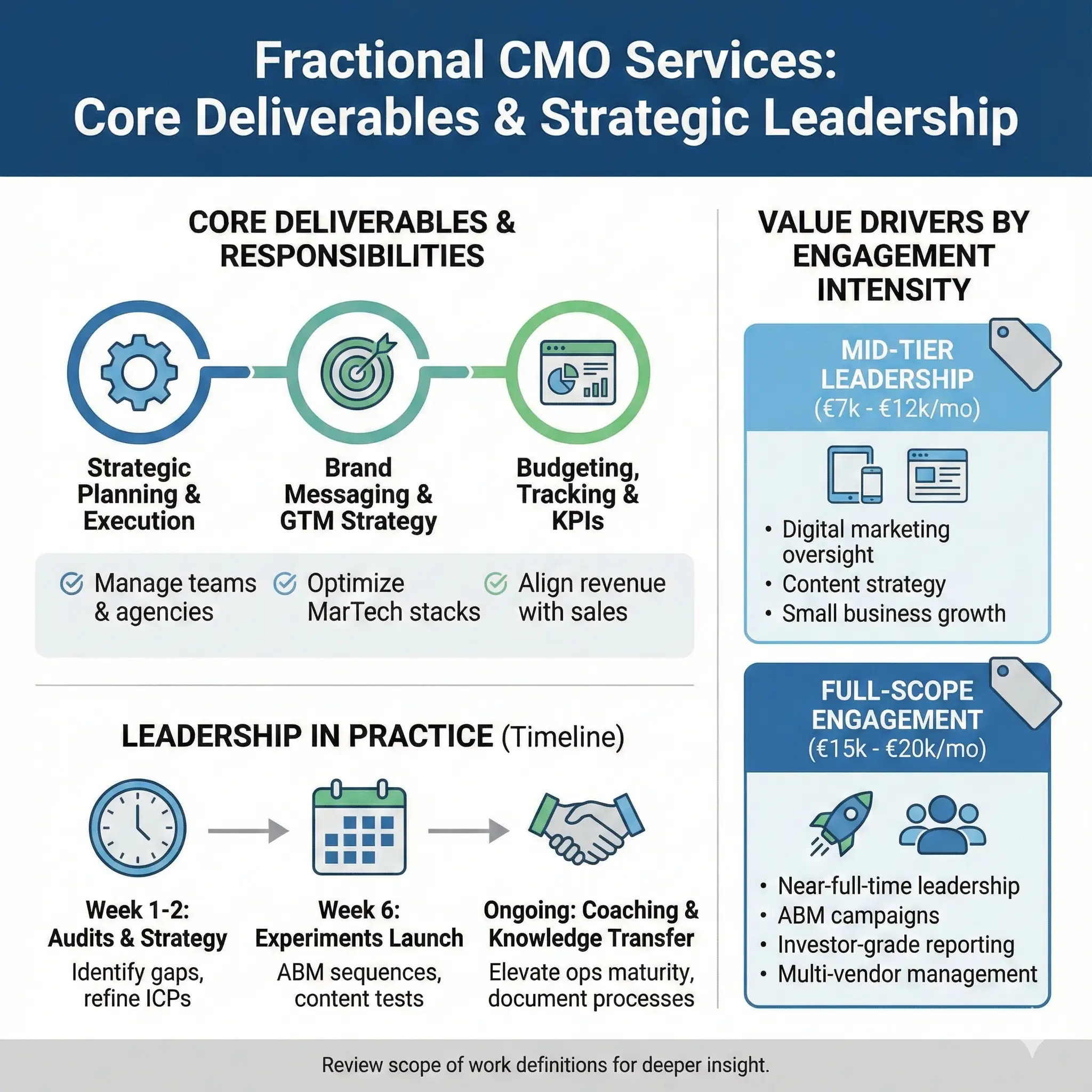
Fractional CMOs provide executive marketing leadership, not just consulting advice. They own outcomes, manage resources, and build operational efficiency into every process. Typical deliverables include comprehensive marketing strategy and planning, brand messaging, budgeting, tracking, and execution management across all marketing packages.
Key accountability areas span positioning and ideal customer profile development, go-to-market strategy, demand generation, and revenue alignment with sales. Unlike traditional consultants who deliver recommendations and leave, fractional leaders manage existing teams, coordinate agencies, oversee digital marketing services, and optimize MarTech stacks. They also set KPIs, establish dashboards, and ensure every campaign ties directly to pipeline and revenue metrics.
What Leadership Looks Like in Practice
A fractional CMO audits existing campaigns within week one, identifying gaps in messaging, targeting, or conversion paths. By week two, they codify ideal customer profiles, refine value propositions, and align sales on qualification criteria. Week six typically sees first experiments launched—whether that’s a new ABM sequence, content series, or paid channel test. This hands-on approach ensures strategic leadership translates immediately into tactical execution and measurable business scalability.
They also coach internal teams, elevate marketing operations maturity, and transfer knowledge so improvements stick after the engagement ends. For example, a Munich fintech firm used their fractional CMO to document repeatable processes for campaign launches, lead scoring, and quarterly planning. That foundation enabled the company to hire a full-time VP of Marketing 18 months later with confidence that systems and governance were already in place.
Value Drivers by Engagement Intensity
Mid-tier leadership—priced at €7,000 to €12,000 monthly—covers oversight of digital marketing services, content strategy, and small business growth initiatives. These engagements suit companies with some marketing infrastructure but lacking senior direction. Full-scope engagements at €15,000 to €20,000 monthly include near-full-time leadership, ABM campaigns, investor-grade reporting, and management of multiple agencies or vendors. This level makes sense for expansion-stage companies preparing for Series B or entering new markets where mistakes cost more and speed matters.
For deeper insight into how scope and deliverables shape cost, review scope of work definitions used by leading providers.
Your First 90 Days: The Fractional CMO Onboarding Roadmap
Successful fractional engagements follow a structured three-phase approach that balances diagnosis, strategy, and execution. Phase 1 (Days 1–30) includes market audit, competitive analysis, and KPI baseline establishment. This diagnostic period surfaces what’s working, what’s broken, and where quick wins hide. Phase 2 (Days 31–60) focuses on positioning refinement, channel testing, and budget mapping. Phase 3 (Days 61–90) delivers dashboard launches, performance improvements, and team capability lift.
By day 90, fractional CMOs typically achieve 20–30% pipeline growth, live KPI dashboards tracking all critical metrics, and documented transition playbooks that ensure continuity. These milestones prove value internally while building momentum for longer-term initiatives like brand repositioning or international expansion.
Quick Wins That Build Credibility
Effective engagements generate early credibility through tactical improvements in month one. Common quick wins include reducing demo-scheduler friction, patching call-to-action leaks on high-traffic pages, launching automated email nurture sequences, and refining service-level agreement documentation between marketing and sales. A Stuttgart software firm reduced marketing-to-sales handoff time by 40% and recovered 15 stalled opportunities in the first month through lead-scoring refinement and clearer SLA definitions.
These momentum builders validate the strategic leadership approach while preparing the foundation for larger experiments. They also demonstrate that fractional CMOs deliver hands-on operational efficiency, not just PowerPoint decks. Quick wins matter because they secure internal buy-in, making it easier to gain budget approval for bigger campaigns or technology investments later.
What Success Looks Like at 90 Days
A Munich fintech firm saw pipeline coverage ramp to three times quota and marketing-sourced bookings rise from 18% to 35% of total ARR within the first 12 weeks. That result came from a combination of improved targeting, clearer messaging, better lead scoring, and tighter sales alignment. The fractional CMO also implemented quarterly business reviews, documented repeatable campaign workflows, and trained the internal team on performance analysis.
The table below outlines typical deliverables across each phase of a 90-day fractional CMO roadmap, helping you benchmark expectations and track progress.
| Phase | Timeline | Core Activities | Deliverables | Success Metrics |
|---|---|---|---|---|
| Phase 1: Audit | Days 1–30 | Market audit, competitive analysis, KPI baseline, stakeholder interviews | Audit report, ICP definition, messaging framework | Baseline CAC, pipeline coverage, funnel conversion rates |
| Phase 2: Strategy | Days 31–60 | Positioning refinement, channel testing, budget mapping, SLA documentation | GTM strategy, channel roadmap, quarterly budget allocation | First campaign launches, improved MQL-to-SQL rates |
| Phase 3: Execution | Days 61–90 | Dashboard launch, quick wins, team training, process documentation | Live KPI dashboards, documented playbooks, capability lift plan | 20–30% pipeline growth, reduced handoff time, clear reporting |
The roadmap shown in the table provides a practical structure for companies embarking on fractional engagements. Reference it during onboarding to align expectations, track milestones, and ensure both parties stay focused on measurable outcomes.
How Engagement Models Scale with Company Stage
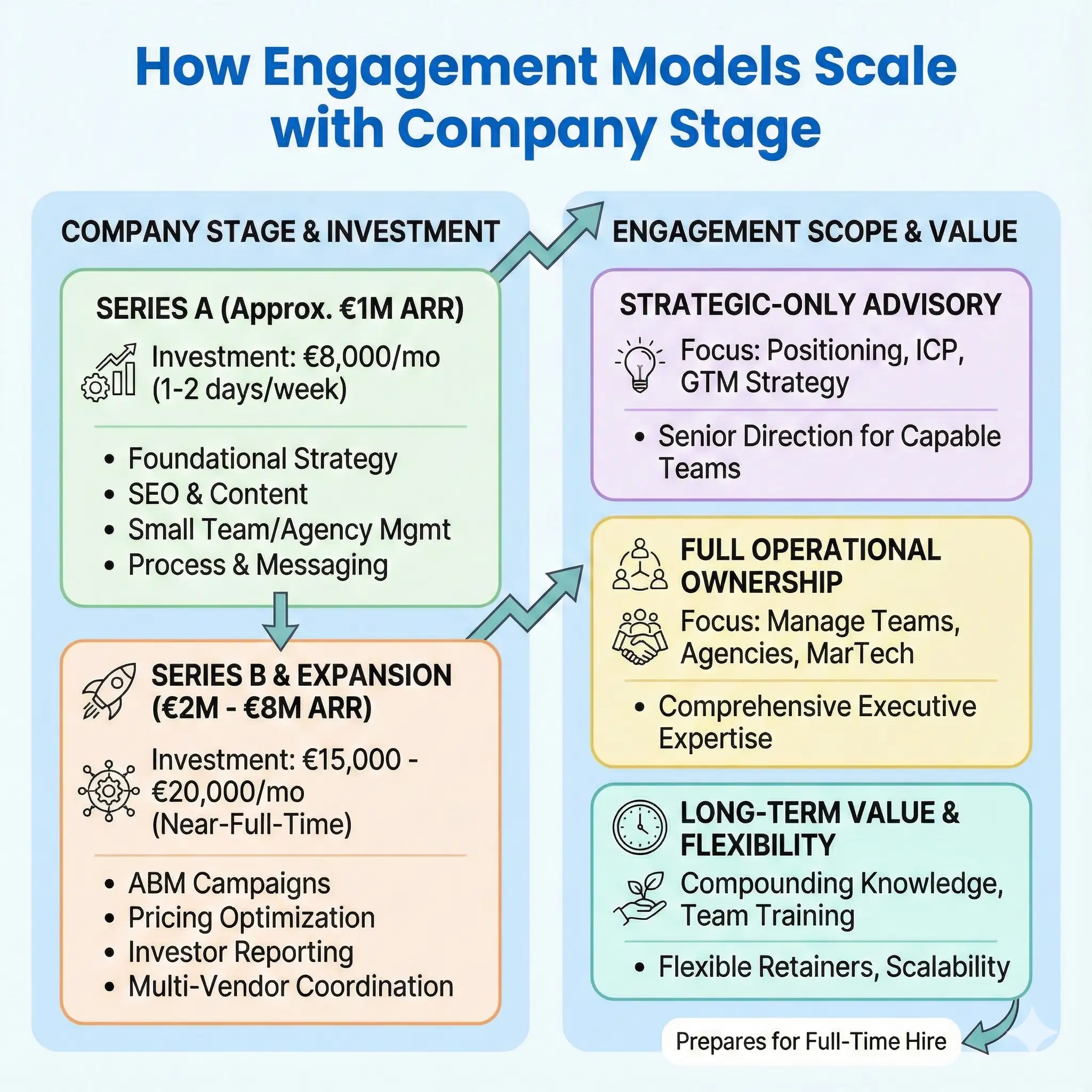
Fractional CMO packages adapt to revenue stage and growth velocity. Series A SaaS companies around €1M ARR typically invest €8,000 monthly for one to two days per week. At this stage, the focus lies on foundational marketing strategy, SEO, content development, and managing a small internal team or single agency. The fractional leader establishes processes, clarifies messaging, and ensures every euro spent ties to measurable pipeline contribution.
Series B and expansion-stage firms pay €15,000 to €20,000 monthly for near-full-time leadership. These engagements cover ABM campaigns, pricing optimization, investor-grade reporting, and coordination of multiple vendors or agencies. A Cologne B2B SaaS scaled from €2M to €8M ARR over 18 months using a fractional CMO focused on sales alignment, pricing optimization, and European GTM strategy. That result illustrates how outsourced marketing leadership delivers executive marketing expertise without the fixed cost of permanent hires.
Strategic-Only vs. Full Operational Ownership
Engagements range from strategic-only advisory to full operational ownership. Strategic projects focus on positioning, ideal customer profile definition, and go-to-market strategy. These suit companies with capable execution teams who need senior direction but not daily oversight. Full-scope roles manage teams, agencies, digital marketing services, and MarTech stacks, providing comprehensive CMO expertise across all marketing functions.
→ More about the fractional CMO model in Germany.
Companies often start with strategic advisory to test fit, then expand scope as trust builds. A Hamburg insurtech began with a six-month positioning and ABM design engagement at €10,000 monthly. After seeing pipeline improvements and faster deal cycles, they extended the contract and increased scope to include agency management and team hiring, raising the monthly retainer to €16,000.
Retainer Flexibility and Long-Term Value
Most providers structure contracts as monthly retainers with 30- or 60-day notice periods, offering flexibility as needs evolve. This model supports business scalability because you can adjust intensity without renegotiating entire agreements. For more detail on retainer structures, explore pricing models tailored to German market conditions.
Long-term engagements generate compounding value. A fractional CMO who stays 12 to 18 months understands your market deeply, builds institutional knowledge, and trains your team to operate independently. That continuity accelerates small business growth and prepares the organization for eventual full-time executive hiring when revenue justifies it.
Setting Up for Success: Infrastructure and Operational Requirements
Effective fractional engagements require pre-engagement preparation to maximize operational efficiency and accelerate time-to-value. Essential assets include decision-rights letters clarifying authority boundaries, eight quarters of pipeline and customer acquisition cost data for baseline analysis, and stakeholder alignment maps completed before day one. This infrastructure enables fractional CMOs to move immediately from diagnosis to execution, avoiding costly ramp-up delays.
Foundational Data and Decision Authority
Companies with documented processes, accessible marketing data, and clear decision authority see faster results. A decision-rights letter defines what the fractional CMO can approve independently—campaign budgets, vendor contracts, hiring recommendations—versus what requires founder or board sign-off. Without this clarity, even experienced leaders spend weeks navigating internal politics instead of driving results.
Pipeline and CAC data spanning two years allows the fractional CMO to establish accurate baselines, identify trends, and set realistic improvement targets. If your CRM lacks reliable attribution or your finance team cannot break out marketing spend by channel, allocate time before the engagement starts to clean and organize that data. The investment pays off in faster diagnostics and more credible recommendations.
Quick Wins That Validate the Model
Typical quick wins in month one demonstrate the value of proper setup. Examples include reducing marketing-to-sales handoff friction by documenting lead definitions and routing rules, implementing lead-scoring models that prioritize high-intent prospects, launching automated nurture sequences for mid-funnel contacts, and documenting service-level agreements between teams. A Stuttgart software firm recovered 15 stalled opportunities and reduced handoff time by 40% within 30 days through these foundational improvements.
These early actions build internal confidence and validate the fractional model. They also create space for the CMO to tackle bigger strategic initiatives—repositioning, new market entry, or pricing redesign—without constant firefighting. When operations run smoothly, strategic leadership can focus on growth levers that multiply revenue rather than patching tactical gaps.
Treating Fractional as Embedded Leadership
The fractional model works best when organizations treat the engagement as embedded strategic leadership rather than project-based consulting. Include the fractional CMO in executive meetings, give them access to financial dashboards, and empower them to make decisions within agreed boundaries. This integration ensures the CMO expertise fully aligns with existing teams and digital marketing services, accelerating impact and reducing friction.
For companies comparing options, understanding how retainer models differ from project work clarifies what level of authority and continuity to expect.
FAQ
What does a fractional CMO do in Germany?
A fractional CMO in Germany provides part-time executive marketing leadership, guiding strategy, positioning, campaign design, and team performance without the cost of a full-time hire. They help companies align marketing with sales goals, optimize budgets, and deliver measurable growth through structured engagements, typically on a monthly retainer.
How much does a fractional CMO cost in Germany?
Fractional CMOs in Germany usually cost between €7,000 and €15,000 per month, depending on scope, frequency, and business stage. Strategic-only roles fall on the lower end, while those managing multiple teams, agencies, or complex SaaS operations can exceed €18,000 when specialized expertise or rapid scaling support is required.
What services are included in typical fractional CMO packages?
Typical packages include strategic marketing planning, ICP development, messaging, go-to-market execution, budget management, vendor coordination, and performance tracking. They also cover auditing current efforts, setting KPIs, and driving early wins through improved processes, demand generation, and pipeline acceleration aligned with company stage and objectives.
What does a 90-day fractional CMO plan look like?
A standard 90-day roadmap involves three phases: auditing market and KPIs, redefining positioning and channels, and executing fast-win campaigns. By the end of the period, most companies achieve stronger pipelines, clear dashboards, and structured governance, ensuring sustainable marketing operations and measurable leadership impact.
Fractional CMO vs full-time CMO: which is better?
A fractional CMO offers cost flexibility and senior expertise part-time, ideal for growth-stage firms without full-time budgets. A full-time CMO provides consistent oversight and management depth. The best option depends on marketing maturity, scaling needs, and whether leadership needs are strategic or operationally intensive.
Fractional CMO vs marketing agency: what’s the difference?
A fractional CMO sets marketing strategy and manages in-house or agency execution, ensuring alignment with business goals. Agencies typically focus on campaign delivery and creative production. Companies often engage both, with the fractional CMO acting as strategic leader, integrating agency efforts for greater ROI and consistency.
Why are fractional CMOs popular among German SaaS startups?
German SaaS startups use fractional CMOs to scale rapidly without high fixed costs. These part-time leaders bring expertise in go-to-market strategy, demand generation, and pipeline optimization. They create fast wins and long-term frameworks, helping startups reach growth milestones before hiring full-time marketing executives.
Fractional CMO vs interim CMO: how do they differ?
A fractional CMO works long-term on a part-time basis, often several days monthly. An interim CMO fills a full-time temporary role, usually during transition periods or executive gaps. Fractional models focus on sustained strategic oversight, while interim roles emphasize continuity or turnaround management.
What quick wins can a fractional CMO deliver?
In the first month, quick wins include improving conversion paths, tightening lead scoring, and reducing handoff delays between teams. They also optimize messaging, audit campaigns, and fix data gaps. These actions build confidence internally while setting the foundation for scalable marketing performance and sustainable revenue lift.
When should a startup hire a fractional CMO?
A startup should hire a fractional CMO when it reaches consistent revenue traction—around Series A or €1M ARR—and needs structured marketing strategy. It’s ideal once founders require scalable go-to-market leadership but can’t yet justify a full-time executive, balancing investment with measurable growth acceleration.
Sources
- Umbrex – Fractional Chief Marketing Officer Playbook
- Revenue Works – Fractional CMO Onboarding: Your 90-Day Roadmap
- SaaS Consult – Fractional CMO Pricing
- The Marketing Blender – What Should Fractional CMO Services Include?
- Jolly Marketer – Fractional CMO Companies Germany