

Marketing leaders spend thousands every month on agencies and consultants yet watch pipeline velocity stall because no one actually owns the outcome. The question of fractional CMO vs marketing agency is not merely academic—it determines whether your next dollar drives measurable revenue growth or just more activity. I will show you which model accelerates pipeline fastest, which scenarios demand each approach, and how combining strategic leadership with execution power delivers the best ROI.
Contents
- 1 TL;DR
- 2 What Actually Drives Pipeline Speed (And Why Most Companies Get It Wrong)
- 3 Fractional CMO: Strategic Leadership That Owns Revenue Outcomes
- 4 Marketing Agency: When You Need Rapid Campaign Execution
- 5 Marketing Consultant: Targeted Problem-Solving Without Ongoing Execution
- 6 The Hybrid Model: How Strategic + Execution Power Delivers Fastest Pipeline Growth
- 7 Choosing the Right Model for Your Pipeline Goals
- 8 FAQ
- 8.1 What does a fractional CMO actually do?
- 8.2 Is a fractional CMO faster than a marketing agency?
- 8.3 How does a marketing consultant differ from a fractional CMO?
- 8.4 Which drives ROI faster: fractional CMO or agency?
- 8.5 When should a company hire a fractional CMO?
- 8.6 Are marketing agencies cost-effective compared to fractional CMOs?
- 8.7 What results can a company expect from a marketing consultant?
- 8.8 How does a hybrid fractional CMO and agency model work?
- 8.9 What are typical costs for a fractional CMO engagement?
- 8.10 How do these models impact pipeline velocity?
- 9 Sources
TL;DR
Fractional CMOs provide strategic leadership and accountability, driving 38% faster qualified pipeline growth and 30% improved alignment versus agency-only models. Agencies excel at rapid tactical execution when direction is clear, while consultants diagnose specific problems without ongoing responsibility. Hybrid approaches combining fractional CMO oversight with agency execution report 2.4× average ROI and faster time-to-revenue than either model alone.
- Fractional CMO costs $8,000–$15,000 monthly, delivering documented 50% ROI within the first year.
- Weekly pipeline tracking drives 34% annual revenue growth versus 11% for irregular monitoring.
- Companies optimizing sales cycles to 46–75 days achieve 21% velocity improvement while maintaining deal value.
What Actually Drives Pipeline Speed (And Why Most Companies Get It Wrong)
Pipeline velocity does not improve by accident. It requires strategic alignment between your marketing strategy, sales processes, and revenue goals—yet most organizations hire for tactics before establishing strategic direction. This creates a demand generation bottleneck without leadership accountability.
The root issue is a widening leadership gap. CMO median tenure dropped from 43 to 35 months between 2020 and 2022, leaving companies without consistent strategic oversight just when they need it most. At the same time, 61% of marketers report lead generation as their primary growth challenge.
→ More information: Fractional CMO – definition, responsibilites & cost.
The Real Bottleneck: Execution Without Strategy
A B2B SaaS company I worked with had misaligned marketing and sales teams producing steady activity but zero pipeline acceleration. Instead of immediately hiring an agency to scale campaigns, the leadership team deployed a fractional CMO to diagnose root issues first. The discovery revealed that the pipeline problem stemmed from positioning gaps and unclear ideal customer profiles—not channel performance or insufficient spend.
Organizations that track pipeline velocity weekly achieve 34% annual revenue growth compared to 11% for those monitoring irregularly. Optimizing sales cycles to 46–75 days yields a 21% velocity improvement. The difference is not just measurement frequency—it is pipeline management discipline driven by executive accountability.
Why Leadership Matters More Than Channel Tactics
Agencies optimize for campaign metrics such as impressions, clicks, and raw lead volume. Consultants deliver diagnostics and recommendations. Neither model inherently owns revenue outcomes unless a senior leader establishes priorities, defines KPIs, and holds teams accountable. This is where CMO services shift the equation—by connecting every marketing dollar to measurable business growth.
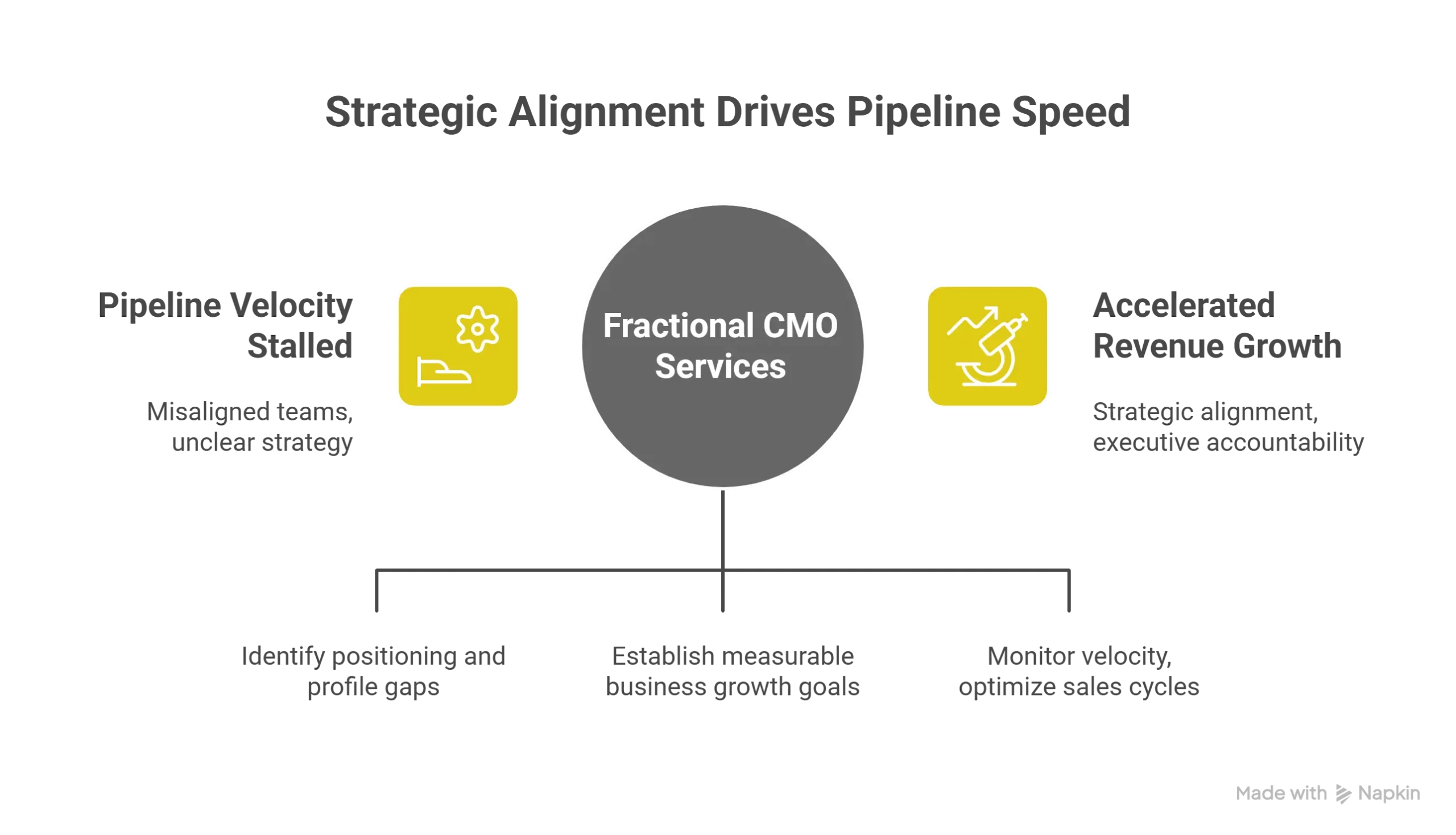
Fractional CMO: Strategic Leadership That Owns Revenue Outcomes
A fractional CMO provides senior-level marketing strategy and leadership on a part-time or contract basis. They define go-to-market priorities, align sales and marketing teams, and manage execution partners. This model gives companies executive strategy oversight without the full-time salary commitment of a traditional chief marketing officer.
How Fractional CMOs Accelerate Pipeline Growth
Companies using fractional CMOs report 38% faster qualified pipeline growth and 30% improved cross-department alignment compared to traditional agency-only approaches. They also achieve 32% faster marketing strategy execution and 27% higher campaign ROI versus agencies working without executive oversight.
The reason is simple: fractional marketing leaders diagnose and direct priorities before execution begins. A Series B SaaS startup I advised engaged a fractional CMO for 90 days to validate positioning, define go-to-market priorities, and establish KPIs before scaling. The result was 35% higher MQL volume within 12 weeks—not because of new channels, but because the messaging and target segments finally aligned.
Cost Efficiency and ROI Impact
Fractional CMOs typically cost $8,000–$15,000 monthly, approximately 50% less than full-time CMO salaries exceeding $200,000 annually. Despite the lower cost, most companies report strong ROI within months due to improved alignment, faster decision-making, and measurable increases in qualified pipeline growth. Learn more about fractional CMO cost efficiency and how it compares to traditional models.
A mid-market e-commerce brand invested $12,000 monthly in a fractional CMO to align marketing with revenue goals. Within six months, the brand achieved a 40% revenue lift, translating to a 1,567% monthly ROI when factoring in the engagement cost against incremental revenue.
When Fractional CMO Adoption Makes Sense
Adoption of fractional leadership exploded from 2,000 professionals in 2022 to 110,000+ by early 2024, with 25% of U.S. businesses now using fractional models. This shift reflects growing recognition that marketing expertise at the executive level drives better outcomes than tactical execution alone.
Understanding fractional CMO scope of work helps clarify what these leaders actually do – from setting go-to-market priorities to managing agency partners and tracking revenue metrics.
Marketing Agency: When You Need Rapid Campaign Execution
A digital marketing agency excels at tactical execution once strategic direction is clear. Agencies deliver measurable wins within 1–3 months through specialized expertise in paid media, content production, SEO, and campaign management.
What Agencies Do Best
Agencies provide production capacity and channel management at scale. A B2B marketing team with clear positioning and segment strategy hired an agency to execute demand generation campaigns across LinkedIn, email, and webinars. The agency launched live within four weeks, delivering immediate visibility and inbound activity.
Average agency retainers range from $3,000 to $25,000+ monthly, plus ad spend. This investment buys specialized talent, technology access, and execution speed that most small business marketing teams cannot replicate in-house.
The Critical Limitation: Strategy Dependency
Agencies optimize for campaign metrics—impressions, clicks, leads—rather than pipeline velocity and business growth unless guided by strategic leadership. Without a clear go-to-market strategy, agencies waste resources testing channels and messages that do not align with revenue goals.
This limitation is not a flaw in agency capability. It reflects the nature of the engagement: agencies execute what you ask them to build. If your brief is unclear or your priorities shift every quarter, even the best agency cannot drive consistent pipeline acceleration.
When Agencies Deliver Maximum Value
Agencies work best when your business already has marketing expertise defining priorities, or when paired with a fractional CMO providing direction and accountability. In these scenarios, agencies become force multipliers, translating strategic priorities into high-quality campaigns that directly support lead generation and revenue targets.

Marketing Consultant: Targeted Problem-Solving Without Ongoing Execution
A marketing consultant tackles specific problems or diagnostics on a project basis without leading ongoing implementation. Consultants provide expert insights, uncover inefficiencies, and recommend tactical improvements—but they do not own outcomes or manage teams long term.
How Consultants Add Value
Strategic marketing consultants charge $50–$300+ per hour or $5,000–$50,000 per project for focused expertise without implementation responsibility. A manufacturing firm engaged a consultant to diagnose why cost-per-lead spiked 40% quarter-over-quarter. The consultant identified funnel targeting inefficiencies and recommended channel reallocation, delivering actionable insights within two weeks.
Consultants excel at audits, research, and specific problem diagnosis. They bring deep expertise in areas such as funnel conversion, spend allocation, or targeting accuracy—offering high-impact changes that improve overall marketing performance.
→ More about the fractional CMO model in Germany.
The Speed Limitation
Consultants advise temporarily but do not integrate leadership into the business model. This creates gaps in accountability structure. Once the consultant delivers recommendations, execution and measurement fall back to internal teams or external partners. Without ongoing oversight, recommendations often stall in implementation.
Best Use Cases for Consultant Engagements
Consultants are most effective for project-based scope requiring specialized expertise: competitive analysis, messaging audits, channel performance reviews, or tactical diagnostics. They are less suited for sustained pipeline management or scenarios requiring continuous strategic leadership and accountability.

The Hybrid Model: How Strategic + Execution Power Delivers Fastest Pipeline Growth
The hybrid model pairs strategic oversight from a fractional CMO with a digital marketing agency’s execution capabilities. The CMO sets direction and measures success, while the agency implements campaigns. This arrangement improves accountability, ensures message consistency, and accelerates time-to-revenue through coordinated, cross-functional marketing operations.
Why Hybrid Approaches Outperform Single Models
Companies combining fractional CMO leadership with agency execution report 2.4× average ROI on marketing spend and faster time-to-revenue than either model alone. Ninety-day structured engagement frameworks drive 30–50% faster strategy implementation than traditional consulting-only approaches.
A fintech startup deployed a fractional CMO for strategic direction while an agency managed paid media campaigns. The CMO established positioning, defined target segments, and set weekly KPIs. The agency executed campaigns across LinkedIn, Google, and retargeting. The result: 203% membership growth in 120 days through coordinated execution and continuous optimization.
Integrated Growth Engine Structure
The hybrid model addresses the core challenge by combining marketing expertise with execution capacity under clear leadership accountability. Here is how it works in practice:
- Fractional CMO establishes marketing strategy, positioning, and KPIs.
- Agency executes campaigns across channels with production capacity and specialized skills.
- CMO monitors pipeline management metrics, optimizes resource allocation, and adjusts priorities based on performance data.
- Unified accountability for revenue outcomes replaces fragmented ownership.
A SaaS company using this model reduced average sales cycle from 89 to 62 days while maintaining deal size, lifting pipeline velocity by 28%. The fractional CMO tracked weekly metrics, identified bottlenecks in the sales handoff, and adjusted campaign targeting and messaging in real time. The agency responded quickly because strategic direction was clear and priorities remained stable.
Real-World Success: Coordinated Execution at Scale
Another example involved a B2B professional services firm struggling with inconsistent messaging and low conversion rates. The fractional CMO conducted a positioning audit, redefined the ideal customer profile, and established a quarterly campaign calendar. The agency then built and launched campaigns aligned to the new strategy. Within six months, the firm achieved a 45% increase in qualified opportunities and a 30% reduction in cost per acquisition.
Choosing the Right Model for Your Pipeline Goals
The decision between fractional CMO, agency, consultant, or hybrid depends on your current strategic clarity, execution capacity, and pipeline performance. Each model serves specific scenarios, and choosing the wrong one delays results and wastes budget.
Start with Fractional CMO If…
You lack strategic direction, have misaligned teams, need a go-to-market strategy, or previous marketing efforts produced activity without pipeline results. Fractional CMOs own strategy, accountability, and measurable outcomes across marketing and sales alignment. Determining when to hire a fractional CMO helps you recognize these scenarios early.
A fractional CMO is also the right choice when growth stalls due to unclear strategy, leadership turnover, or poor marketing–sales alignment. Companies between funding stages or preparing to scale benefit most by gaining executive-level direction, better KPIs, and faster time-to-market with controlled budget exposure.
Hire Agency When…
Your strategy and positioning are clear, you need production capacity and channel management, and you have leadership to direct and measure outcomes. Agencies move quickly once strategy is set but may waste resources without leadership guidance.
Agencies are also cost-effective for short-term campaigns requiring specialized execution in paid media, SEO, or content. However, their retainers and ad spend add up quickly, so clear objectives and performance tracking are necessary.
Engage Consultant For…
Specific diagnostic problems, audits, or specialized expertise gaps without need for ongoing execution or leadership accountability. Consultants deliver targeted insights that uncover inefficiencies and guide tactical improvements in areas such as funnel conversion, spend allocation, or targeting accuracy.
While consultants may not implement or manage teams long term, their focused diagnostic expertise often identifies high-impact changes that improve overall marketing performance.
Deploy Hybrid Approach When…
You need both strategic leadership and execution power with unified metrics—the fastest path to pipeline velocity for most small business marketing and mid-market growth scenarios. Companies leveraging a fractional CMO to oversee an agency often achieve the best speed-to-ROI and marketing efficiency ratios.
| Model | Time to Impact | Monthly Cost Range | Owns Revenue Outcomes | Best For |
|---|---|---|---|---|
| Fractional CMO | 60–90 days | $8.000–$15.000 | Yes | Strategic gaps, alignment issues |
| Marketing Agency | 30–60 days | $3.000–$25.000+ | No | Tactical execution, production capacity |
| Marketing Consultant | 15–30 days | $5.000–$50.000 (project) | No | Diagnostics, audits, specific problems |
| Hybrid (CMO + Agency) | 45–75 days | $11.000–$40.000 | Yes | Fastest pipeline velocity, scalable growth |
The table above summarizes how each model performs across key decision factors. Notice that the hybrid approach balances speed and accountability, making it the preferred choice for companies serious about accelerating pipeline velocity without sacrificing strategic oversight.
The Critical Metric: Weekly Pipeline Velocity Tracking
Companies tracking pipeline velocity weekly with executive oversight—fractional or full-time—consistently outperform those optimizing individual channel metrics without revenue alignment. This discipline transforms marketing from an activity center into a revenue engine.
FAQ
What does a fractional CMO actually do?
A fractional CMO provides senior-level marketing strategy and leadership on a part-time or contract basis. They define go-to-market priorities, align sales and marketing, and manage execution partners. This model gives companies executive strategy oversight without the full-time salary commitment of a traditional chief marketing officer.
Is a fractional CMO faster than a marketing agency?
A fractional CMO typically accelerates results faster when strategic alignment is missing because they diagnose and direct priorities before execution. Agencies move quickly once strategy is set but may waste resources without leadership guidance. Combining both often yields the fastest and most sustainable pipeline growth.
How does a marketing consultant differ from a fractional CMO?
A consultant usually tackles specific problems or diagnostics on a project basis without leading ongoing implementation. A fractional CMO owns strategy, accountability, and measurable outcomes across marketing and sales alignment. Essentially, consultants advise temporarily while fractional CMOs integrate leadership into the business model.
Which drives ROI faster: fractional CMO or agency?
Fractional CMOs generally deliver higher ROI sooner when companies lack marketing direction or unified KPIs. Agencies produce quicker tactical wins but depend on a solid strategy foundation. Businesses leveraging a fractional CMO to oversee an agency often achieve the best speed-to-ROI and marketing efficiency ratios.
When should a company hire a fractional CMO?
A fractional CMO is best hired when growth stalls due to unclear strategy, leadership turnover, or poor marketing–sales alignment. Companies between funding stages or preparing to scale benefit most by gaining executive-level direction, better KPIs, and faster time-to-market with controlled budget exposure.
Are marketing agencies cost-effective compared to fractional CMOs?
Agencies can be cost-effective for short-term campaigns requiring specialized execution in paid media, SEO, or content. However, their retainers and ad spend add up quickly. Fractional CMOs cost less than full-time executives while improving ROI through clarity and resource optimization across all marketing efforts.
What results can a company expect from a marketing consultant?
Consultants deliver targeted insights that uncover inefficiencies and guide tactical improvements in areas like funnel conversion, spend allocation, or targeting accuracy. While they may not implement or manage teams long term, their focused diagnostic expertise often identifies high-impact changes that improve overall marketing performance.
How does a hybrid fractional CMO and agency model work?
The hybrid model pairs strategic oversight from a fractional CMO with an agency’s execution capabilities. The CMO sets direction and measures success, while the agency implements campaigns. This arrangement enhances accountability, ensures message consistency, and accelerates time-to-revenue through coordinated, cross-functional marketing operations.
What are typical costs for a fractional CMO engagement?
Fractional CMOs generally charge between $8,000 and $15,000 per month, significantly less than full-time executive salaries exceeding $200,000 annually. Despite lower cost, most companies report strong ROI within months due to improved marketing alignment, faster decision-making, and measurable increases in qualified pipeline growth.
How do these models impact pipeline velocity?
Fractional CMOs improve pipeline velocity by setting measurable cadence and aligning marketing with revenue tracking. Agencies accelerate execution speed, while consultants offer optimization insights. Companies that combine strategic leadership and tactical execution typically achieve shorter sales cycles, higher deal values, and sustained revenue momentum.
Sources
- James Mattison – The Rise of the Fractional Brand Marketing Leader
- First Page Sage – Sales Pipeline Velocity Metrics
- Chief Outsiders – CEO Guide to Marketing Performance
- Fractional CMO Partners – Fractional CMO vs Marketing Agency
- CMOx – Strategic Marketing Consultant vs Fractional CMO