

Cold prospects don’t respond to generic pitches—content marketing is 3x more efficient at lead generation than traditional outbound tactics. Warming up leads requires delivering consistent, personalized value across multiple touchpoints before asking for commitment. This post shows you how to build content strategies that transform skeptical strangers into engaged prospects ready for conversations.
Contents
- 1 TL;DR
- 2 Why Content Beats Traditional Cold Outreach
- 3 Personalization and Segmentation Strategies
- 4 Building Multi-Touch Sequences That Convert
- 5 Content Formats That Build Trust
- 6 Strategic Content Repurposing for Sustained Engagement
- 7 Measuring Warming Effectiveness
- 8 FAQ
- 8.1 What is the best way to warm up cold prospects?
- 8.2 How does personalized content improve cold outreach results?
- 8.3 Email sequence vs single email: which works better?
- 8.4 Webinars vs case studies: which content warms leads faster?
- 8.5 How many follow-ups should I send in a cold campaign?
- 8.6 Video testimonials vs written reviews: which builds more trust?
- 8.7 What are the best channels to re-engage cold prospects?
- 8.8 How does content repurposing help nurture cold leads?
- 8.9 Outbound vs content marketing: which drives better lead quality?
- 8.10 How can social proof help convert cold prospects?
- 9 Sources
TL;DR
Successful cold prospect warming relies on personalized content sequences, multi-channel touchpoints, and value-first engagement. Combine segmentation with strategic follow-up to build trust through educational materials, social proof, and timely conversations that address specific pain points.
- Personalized emails drive 30% more opens than generic messages
- Follow-up sequences increase reply rates by 22% with just one additional touchpoint
- Interactive video achieves 25% higher conversion rates than static formats
Why Content Beats Traditional Cold Outreach
Traditional cold calling and mass email blasts create immediate friction. They interrupt prospects who aren’t ready to engage, often resulting in deleted messages or blocked numbers. Content-driven approaches flip this dynamic by offering value before requesting attention, creating relationship building through education rather than interruption.
The shift toward content marketing reflects changing buyer expectations. Prospects research independently, compare solutions thoroughly, and expect companies to demonstrate expertise before scheduling meetings. Generic pitches no longer work because buyers can easily find detailed information elsewhere—if your outreach doesn’t provide immediate relevance, it gets ignored.
Building Trust Through Value
Content allows you to demonstrate expertise while prospects remain anonymous. A well-crafted whitepaper or educational webinar recording addresses specific pain points without demanding immediate commitment. This approach respects the buyer’s timeline while positioning your brand as a helpful resource rather than another sales contact.
Effective prospecting techniques start by mapping common challenges across your target accounts. Identify recurring problems, regulatory changes, or industry shifts affecting your buyer persona, then create targeted content addressing these issues. This positions your outreach as timely assistance rather than unwanted solicitation.
The Sales Funnel Shift
Content changes how prospects enter and progress through the sales funnel. Instead of cold calls pushing contacts downward, valuable resources attract prospects naturally. They consume content at their own pace, building familiarity with your brand and approach before any direct conversation occurs.
A B2B SaaS company illustrates this shift effectively: rather than cold calling enterprise IT leaders, they publish security whitepapers and governance frameworks addressing compliance concerns. Mid-market prospects receive ROI calculators and implementation timelines. Each segment gets content matching their specific evaluation criteria, warming them through relevance rather than persistence.

Personalization and Segmentation Strategies
Mass outreach fails because it treats diverse prospects identically. Effective email outreach requires understanding who receives your message and what problems they’re trying to solve. Segmentation transforms generic campaigns into relevant conversations that capture attention and drive engagement.
The BANT framework—Budget, Authority, Need, Timeline—provides a practical structure for lead qualification. By categorizing prospects based on these criteria, you can customize nurturing campaigns that speak directly to each group’s situation. Decision-makers with budget authority need ROI-focused materials, while technical influencers require implementation details and integration guides.
Behavioral Targeting for Progressive Warming
Static segmentation based on firmographics provides a starting point, but behavioral data reveals true intent. Track which content pieces prospects download, which emails they open, and which pages they visit. This activity signals interest areas and readiness levels, allowing you to refine subsequent outreach dynamically.
A marketing services firm demonstrates this approach by qualifying cold leads using BANT criteria at initial contact. Decision-makers receive case studies highlighting revenue impact and cost savings. Technical influencers get detailed product comparison charts and implementation roadmaps. Adjusting content based on early engagement patterns increases relevance with each touchpoint.
Multi-stage segmentation works best when you start broad and narrow progressively. Initial outreach might target an entire industry vertical with generally applicable insights. Second-stage content addresses role-specific challenges. Third-stage materials tackle company-size considerations or technology stack compatibility. This layered approach warms prospects gradually while gathering data to improve targeting precision—an approach detailed in our guide to multichannel lead nurturing.
Building Multi-Touch Sequences That Convert
Single emails rarely generate responses from cold prospects. Building engagement requires persistence, but persistence without value becomes harassment. The solution lies in structured sequences that deliver fresh insights with each touchpoint, gradually building familiarity and trust.
Research shows that 80% of sales require five follow-up attempts after initial contact, yet most salespeople abandon after just one. This creates massive opportunity for those willing to maintain consistent, value-driven communication. A well-designed sequence combines educational content early, social proof mid-sequence, and clear calls-to-action as engagement increases.
The Seven-Email Framework
A proven email sequence structure spans approximately 60 days with seven strategic touchpoints. Email one introduces a relevant industry challenge with educational content. Email two shares a practical framework or methodology for addressing that challenge. Email three provides a case study showing how similar companies solved the problem. Emails four and five offer additional resources—templates, calculators, or checklists—that provide immediate utility. Email six incorporates customer testimonials or third-party validation. Email seven presents a clear offer with a specific call-to-action.
Timing matters as much as content. Space messages 7–10 days apart early in the sequence, allowing prospects time to consume materials without feeling pressured. Compress intervals to 3–5 days near the end as engagement signals indicate higher interest. This rhythm maintains presence without overwhelming busy professionals.
Multi-Channel Coordination
Email alone limits your reach. Combining email outreach with LinkedIn messages, strategic phone calls, and even SMS creates multiple pathways for engagement. Each channel reinforces others, building name recognition and message consistency that single-channel approaches can’t achieve.
A B2B agency executing this approach sends an educational email analyzing industry trends. Three days later, they share a LinkedIn post on the same topic, tagging relevant prospects. A week after that, they send a brief SMS with a calendar link for a discovery call. This coordinated approach gives prospects several opportunities to engage through their preferred channel while maintaining consistent messaging. If you’re facing radio silence, our article on being ghosted by prospects offers additional follow-up tactics.
| Day | Content Type | Primary Goal | CTA Strength | |
|---|---|---|---|---|
| 1 | 0 | Industry insight / challenge identification | Capture attention | Soft (content download) |
| 2 | 7 | Framework / methodology | Establish expertise | Soft (additional resource) |
| 3 | 15 | Case study | Show proof | Medium (webinar invite) |
| 4 | 24 | Practical tool / template | Provide utility | Soft (tool access) |
| 5 | 35 | Calculator / assessment | Personalize value | Medium (assessment results) |
| 6 | 48 | Customer testimonial | Build trust | Medium (demo request) |
| 7 | 60 | Direct offer | Request conversation | Strong (meeting booking) |
This table shows how content type and call-to-action intensity should evolve throughout your sequence. Early touchpoints focus on education with minimal commitment asks, while later messages assume higher familiarity and request more direct engagement.
Content Formats That Build Trust
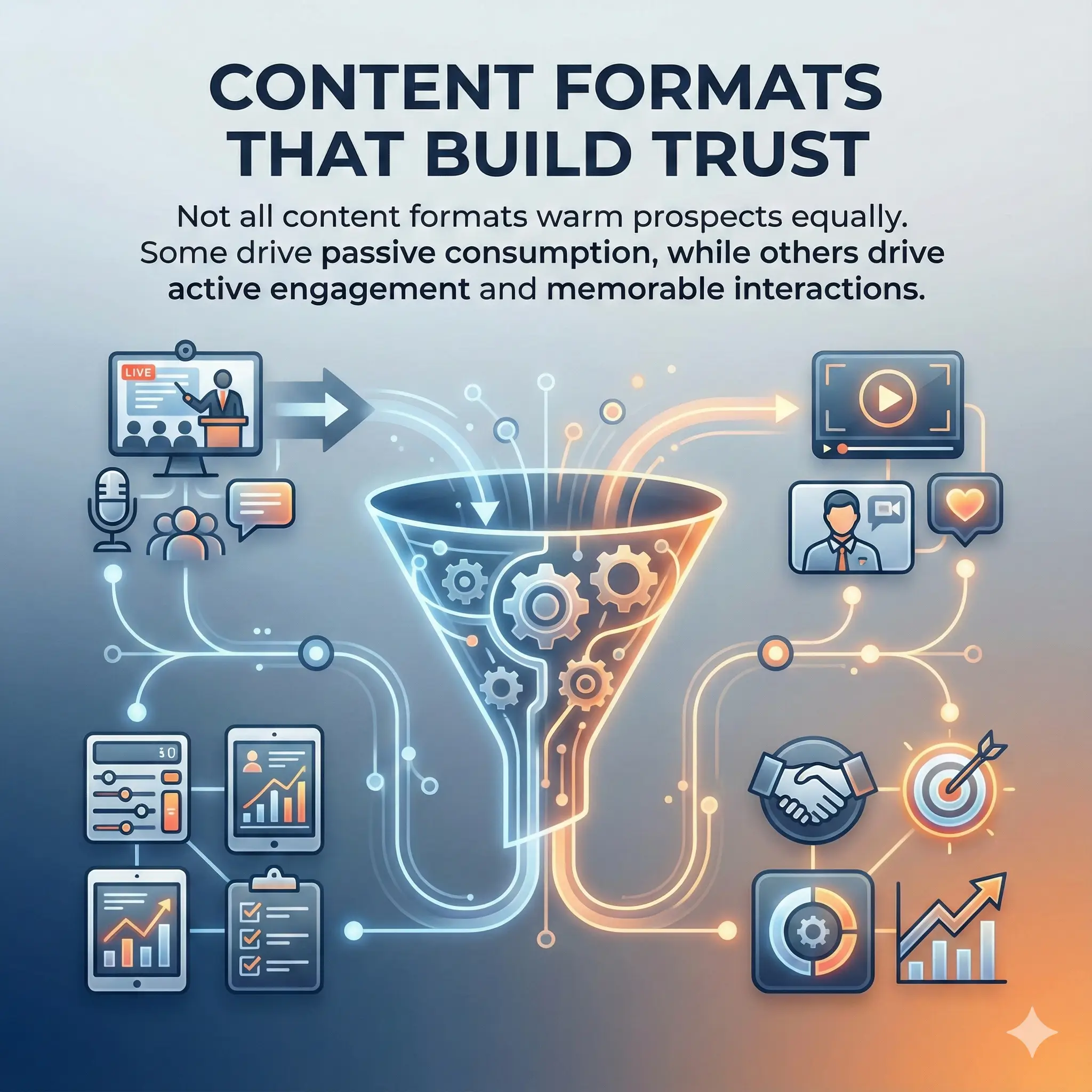
Not all content formats warm prospects equally. Some create passive consumption, while others drive active engagement and memorable interactions. Understanding which formats work best at different stages helps you allocate resources effectively and maximize conversion rates.
Webinars as Relationship Accelerators
Webinars deliver interactive learning that cold emails and static documents can’t match. Prospects see your expertise demonstrated in real-time, ask questions, and interact with peers facing similar challenges. This creates connection and credibility far faster than written content alone.
A financial services firm hosting monthly webinars on compliance updates and industry regulations uses these sessions to warm cold prospects systematically. They invite prospects who’ve engaged with earlier content but haven’t scheduled calls. During the webinar, they address specific questions, showcase thought leadership, and follow up with attendees using insights gathered from registration data and participation patterns. Non-attendees receive on-demand recordings along with supplementary whitepapers, keeping them engaged even if scheduling conflicts prevented live participation.
Video Testimonials for Authentic Proof
Written case studies build credibility, but video testimonials create emotional connection. Viewers see genuine customers describing real challenges and measurable results. Tone, expression, and authentic enthusiasm convey trustworthiness that text alone struggles to achieve.
A software company embeds 90-second customer success videos in welcome emails sent to cold prospects. These videos feature clients similar to the prospect—same industry, comparable company size, familiar challenges—discussing specific ROI achieved after implementation. This social proof reduces skepticism while humanizing the brand, making subsequent conversations feel less risky for prospects considering engagement.
Interactive Content for Deeper Engagement
Interactive assessments, calculators, and configurators transform passive consumption into active participation. Prospects input their specific parameters and receive customized results, creating personalized value that generic content can’t deliver. This engagement also provides valuable data about prospect priorities and readiness.
ROI calculators work particularly well for warming leads in the consideration stage. Prospects input current costs, expected usage, and key variables, then receive projected savings or revenue impact. This exercise helps them visualize specific value while giving you insight into their budget ranges and timeline expectations—information that informs subsequent outreach.
Strategic Content Repurposing for Sustained Engagement
Creating fresh content for every touchpoint quickly becomes unsustainable. Strategic repurposing extends the reach and lifespan of high-value assets while maintaining consistent communication with cold prospects. One substantial piece can fuel months of nurturing campaigns across multiple channels.
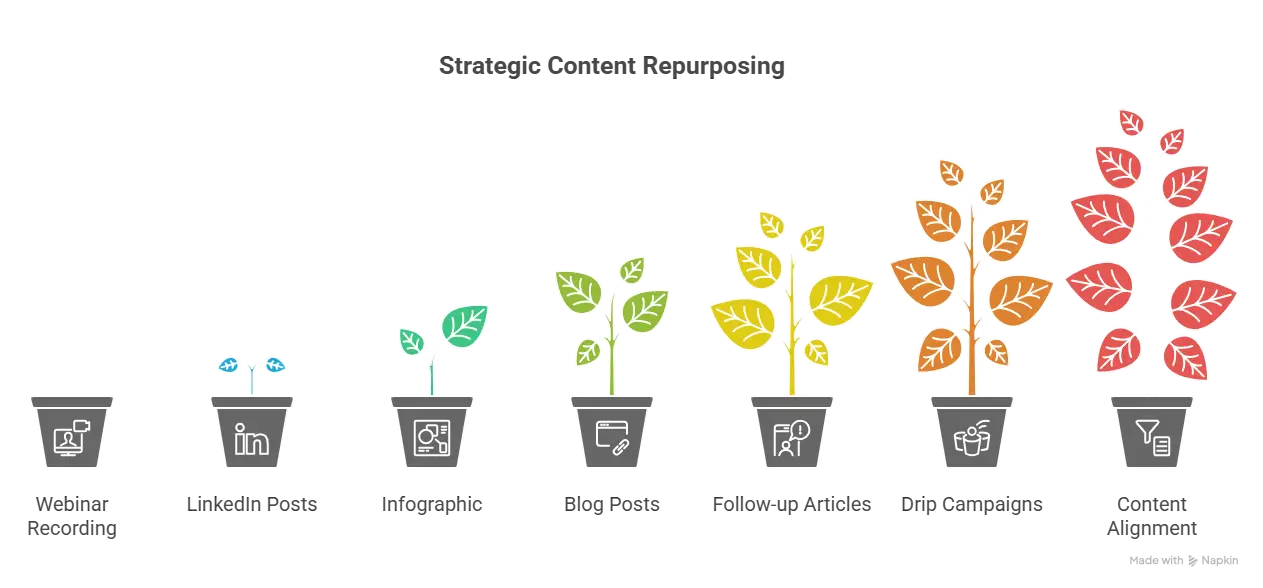
A consulting firm hosting a 60-minute webinar on industry trends illustrates effective repurposing. Attendees receive the full recording immediately. Key insights become a series of LinkedIn posts published over two weeks. Main takeaways transform into an infographic distributed through email campaigns. Individual sections become standalone blog posts attracting organic search traffic. Questions raised during the live session inspire follow-up articles addressing specific concerns. This approach generates six to eight distinct content assets from a single webinar, each serving different segments and channels.
Drip Campaigns for Long-Term Warming
Not every cold prospect is ready to engage immediately. Drip campaigns allow you to maintain presence over extended periods, keeping your brand visible while prospects progress through their buying journey at their own pace. These automated sequences deliver relevant content based on time triggers or behavioral signals, nurturing relationships without constant manual effort.
Effective drip campaigns balance frequency with value. Monthly newsletters with industry insights maintain awareness without overwhelming recipients. Quarterly deep-dive reports position you as a knowledge resource. Triggered messages responding to specific actions—downloading a guide, visiting pricing pages—deliver timely relevance. This sustained engagement ensures you remain top-of-mind when prospects finally reach buying readiness.
Matching Content to Sales Funnel Progression
Different content serves different stages. Early-stage cold prospects need educational materials establishing credibility and addressing broad challenges. Mid-stage leads require comparison frameworks and implementation considerations. Late-stage prospects want proof—customer testimonials, detailed case studies, and ROI validation.
Mapping content to funnel position prevents mismatched messaging. Sending product demos to cold prospects who haven’t yet recognized their problem creates friction. Offering only educational content to warm leads actively evaluating solutions wastes momentum. Strategic alignment ensures each touchpoint advances prospects appropriately based on their current position. For complex B2B environments, consider our framework for buying committee content strategy to address multiple stakeholders simultaneously.
Measuring Warming Effectiveness
Tracking engagement metrics reveals which content and sequences actually warm prospects versus those that generate activity without meaningful progress. Focus on metrics indicating genuine interest rather than vanity statistics that look impressive but don’t correlate with conversion.
Open rates measure initial attention but don’t confirm value delivery. Click-through rates show interest in learning more. Time spent on linked resources indicates genuine engagement. Repeat visits signal growing consideration. Meeting bookings or direct replies represent successful warming. Track these metrics across segments to identify which approaches work best for specific buyer personas and industries.
Response velocity—how quickly prospects move through your sequence—provides insight into message resonance. Prospects engaging with every email and clicking multiple resources are warming faster than those with sporadic interaction. Use this data to identify highly engaged individuals for prioritized outreach while adjusting content for slower-warming segments.
FAQ
What is the best way to warm up cold prospects?
The best way to warm up cold prospects is by sending personalized, value-driven content over multiple touchpoints. Use segmented lists to tailor messages to specific needs, share educational materials first, and build trust before pitching. Gradually guide prospects toward engagement through consistent and relevant communication.
How does personalized content improve cold outreach results?
Personalized content makes messages more relevant, increasing open and response rates. When you address a prospect’s specific pain points or interests, they are more likely to engage. Using behavioral or demographic data for personalization turns generic outreach into meaningful conversations that build credibility and trust over time.
Email sequence vs single email: which works better?
An email sequence works better because it nurtures interest over time. Single emails often get ignored, while multi-step sequences build familiarity and maintain engagement. Delivering value first through educational content, followed by testimonials or offers, helps cold prospects gradually warm up toward conversion.
Webinars vs case studies: which content warms leads faster?
Webinars often warm leads faster because they provide interactive learning and real-time engagement. Prospects can ask questions and see expertise firsthand. However, case studies remain valuable for reinforcing credibility afterward, showing proven results from similar clients and strengthening trust built during earlier interactions.
How many follow-ups should I send in a cold campaign?
Studies suggest five to seven follow-ups spread over 45–60 days yield the best results. Each follow-up should provide fresh value, such as insights, examples, or resources, instead of repeating the same offer. Persistence, combined with thoughtful timing and personalization, significantly improves response rates.
Video testimonials vs written reviews: which builds more trust?
Video testimonials typically build more trust because viewers can see genuine emotion and authenticity. They convey credibility through tone, expression, and measurable results. Written reviews still help, especially for quick validation, but video content leaves a stronger impression and humanizes the brand effectively.
What are the best channels to re-engage cold prospects?
The best channels include email, LinkedIn, and social media, supplemented by SMS or calls. Combining these in an omnichannel strategy ensures message consistency and broader visibility. Using each platform strategically—educational content on email, personal outreach on LinkedIn—creates stronger engagement and better conversion opportunities.
How does content repurposing help nurture cold leads?
Content repurposing extends the life of valuable material while maintaining consistent outreach. Turning a single webinar or article into newsletters, social posts, or infographics keeps leads engaged without constant new production. It reinforces key messages, diversifies touchpoints, and steadily helps cold prospects become warm leads.
Outbound vs content marketing: which drives better lead quality?
Content marketing typically drives better lead quality because it attracts prospects genuinely interested in learning and problem-solving. Outbound tactics may generate faster contact but often lower intent. Educational, trust-building content nurtures relationships organically, leading to more qualified and conversion-ready leads over time.
Social proof, such as testimonials, case studies, or reviews, helps cold prospects trust your brand by showing real results from similar customers. It reduces skepticism and demonstrates credibility. Sharing authentic success stories through videos or quotes builds confidence and encourages hesitant prospects to engage further.
Sources
- Inbeat Agency – Lead Generation Statistics
- The CMO – How to Increase Email Open Rate
- Martal – B2B Cold Email Statistics
- Firework – Interactive Video Statistics
- Only-B2B – Webinars for Lead Nurturing in B2B


