
Every B2B sales professional knows the frustration of watching promising leads go cold without warning. Many prospects who initially engage with your outreach eventually stop responding, leaving valuable opportunities on the table. Learning how to re-engage cold B2B leads isn’t just about reviving dead conversations. It’s about implementing a clear sequence that can turn silence into conversations again.
Key Takeaways
- A well-structured re-engagement sequence pays off: according to Saleshandy, 57% of positive replies came from follow-ups, not from the first message
- The sequence below uses four touchpoints over about three weeks, each adding new value
- Personalization beyond the first name makes a follow-up harder to ignore than a generic one
- A clear, low-friction call-to-action in each message makes replying easier
- Combining email, phone, and social media gives prospects more chances to notice you than a single channel
Why Prospects Go Cold (And Why It’s Not Always Your Fault)
Before diving into recovery tactics, it’s important to understand why prospects disappear. The silence rarely reflects a firm rejection of your solution. Most often, it happens because competing priorities push your conversation to the backburner.
Common Reasons Leads Go Silent
Common reasons for disappearing acts include:
- Internal restructuring or shifting budget priorities
- Unexpected project delays or timeline changes
- Decision-maker changes or vacation periods
- Information overload from multiple vendors
- Earlier messages that did not make the value clear
- A purchase from a competitor that nobody told you about
Understanding these factors helps create a re-engagement approach that acknowledges business realities rather than applying pressure. This perspective shift is crucial for crafting messages that resume conversations naturally.
The Cost of Letting Cold Leads Stay Cold
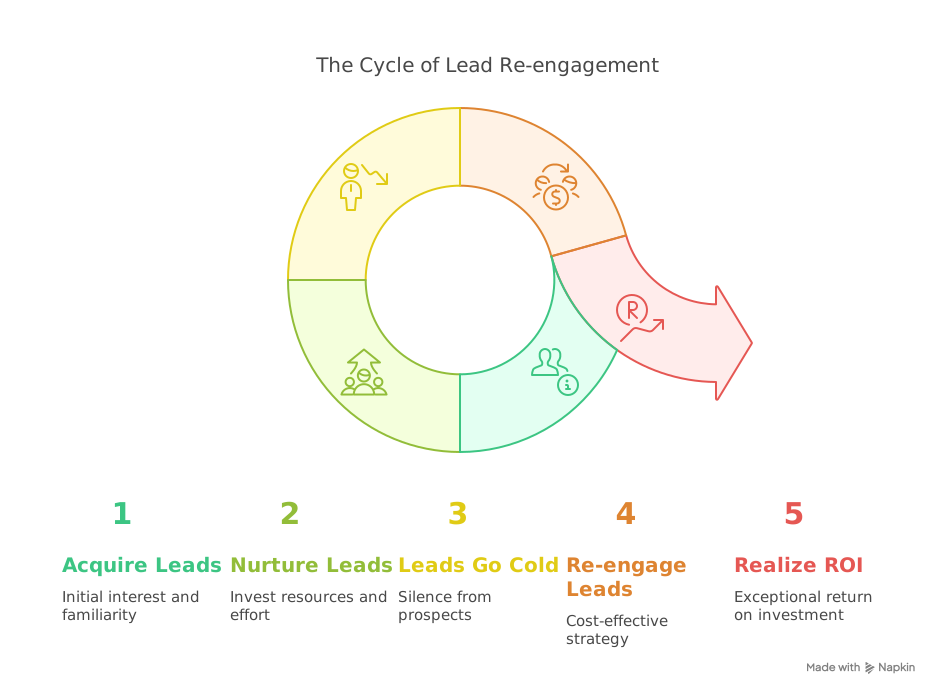
The financial impact of abandoned leads extends beyond lost sales opportunities. Re-engaging an existing lead usually takes less effort than building a new one from scratch. Your cold leads have already shown initial interest and familiarity with your company, a significant advantage.
When your prospects go silent, you’re not just losing potential revenue. You’re also wasting the resources already invested in acquiring and nurturing those leads to that point. An effective re-engagement strategy can provide a strong return compared to constantly filling the top of your funnel.
The Perfect Re-Engagement Sequence Framework
The most successful re-engagement campaigns follow a clear structure designed to overcome common objections and provide multiple opportunities for response. This sequence creates a balance between persistence and respect, ensuring you stay top-of-mind without becoming annoying.
Message #1: The Value-Add Follow-Up (Day 0)
Your first follow-up should avoid the “just checking in” approach that signals little value. Instead, provide a specific resource that directly addresses a pain point you’ve identified in previous conversations. This could be a case study from their industry, a useful template or tool, or recent research that impacts their business.
Example: “Since our last conversation, we have put together an analysis that addresses your challenge with [specific problem]. May I send it over briefly?”
The message should be concise, reference your previous conversation, include the value-add resource, and end with a low-friction question that makes responding easy. For deeper insights on crafting these messages, check out effective B2B email templates that drive action.
Message #2: The Insight Trigger (Day 5-7)
If your first message doesn’t receive a response, your second touchpoint should introduce a new perspective or insight. This approach signals you’re not just persistently following up, you’re consistently providing value. Effective approaches include sharing a relevant industry trend with your analysis, offering a custom observation about their business based on recent news, or providing a different angle on addressing their known challenges.
This message should acknowledge the lack of response without making the prospect feel guilty, while still moving the conversation forward with fresh thinking.
As a rule of thumb, leave 5-7 days between the first messages. In an analysis by Saleshandy, successful sequences had four to six follow-ups over 20 to 21 days, and more follow-ups were not automatically better: the reply rate per follow-up fell from 0.80% for the first to 0.37% from the fifth onward.
Message #3: The Pattern Interrupt (Day 12-14)
By the third message, it’s time to change your approach. This pattern interrupt can take various forms, but the goal is to stand out from typical follow-up messages. Consider a different communication channel (LinkedIn if you’ve been emailing), a dramatically shorter message (3 lines or less), an unexpected format like a voice note or short video, or a subject line that creates curiosity (“Quick question about X”).
You can also make replying as easy as possible with a multiple-choice question:
“I understand you are busy. Could you tell me briefly where you stand?
A) We have other priorities right now
B) I would like more information on [topic]
C) Please contact me again in [timeframe]”
This approach respects the recipient’s time and makes a reply easy.
Message #4: The Permission Close (Day 18-21)
The final message in your sequence should specifically address the silence and state clearly that this is your last attempt for now. This permission close gives the prospect an easy way to either continue or end the conversation definitively. A common structure includes:
- Acknowledging the lack of response
- A brief reminder of the value proposition
- A direct question about their interest level
- Clear permission to end the pursuit if timing isn’t right
Example: “Since I have not heard back, I assume [your offer] is not a priority for you right now. I will not contact you again, but the door stays open. Feel free to get in touch whenever your situation changes.”
This approach respects the prospect’s time while creating a psychological trigger, the fear of missing out, that often prompts responses even from long-silent contacts. It also removes pressure and triggers loss aversion: the prospect realizes this is their final opportunity to engage.
The Psychology Behind Successful Re-Engagement
Successful re-engagement strategies rely on basic psychological principles that influence human decision-making.
Using FOMO Deliberately
The fear of missing out (FOMO) is a strong psychological trigger. In your sequence you can use this effect by pointing to limited offers, exclusive information, or time-limited opportunities. It is important not to overdo it, though, because artificially created urgency quickly comes across as manipulative.
Stimulating Reciprocity
The principle of reciprocity is deeply rooted in social behavior. When your sequence offers real value, whether helpful information, free resources, or useful insights, the recipient naturally feels like giving something back.
Value-oriented messages tend to work better than plain status requests and show that you see the contact as a relationship rather than a transaction.

Crafting Messages That Drive Responses
The structure of your re-engagement sequence matters, but the content of each message determines whether prospects will actually respond. Certain elements can improve response rates across industries.
Personalization Beyond The First Name
Basic personalization (first name, company) is now the minimum expectation. Stand out by including deeper personalization signals that show you’ve done your homework:
- Reference previous conversations, specific company initiatives, or recent news
- Acknowledge changes in their role or organization
- Connect your message to industry challenges they face
Personalization at this level makes ignoring your message significantly harder because it’s clearly not a mass-sent template. For international audiences, localizing your approach can make a substantial difference, as covered in cold emailing guides for different markets.
Segmentation for Targeted Outreach
Not all inactive leads should receive the same sequence. Segment your database by criteria such as:
- Time of last interaction
- Previous depth of engagement
- Industry and company size
- The contact’s position in the buying process
This segmentation lets you develop tailored sequences that address the specific needs and situations of each group. For a deeper look at effective outreach strategies, our Cold Outreach Handbook can provide valuable input.
Subject Lines That Demand Opening
For email re-engagement, your subject line determines whether the rest of your message gets seen. Useful subject line types for re-engagement are:
- Question-based: “Still interested in improving your [specific metric]?”
- Curiosity-driven: “I found this about [Company Name]”
- Direct: “[First Name], let’s reconnect”
- Value-focused: “A resource for your [specific initiative]”
Keep subject lines under 50 characters to ensure they’re fully visible on mobile devices, since many business emails are first opened on mobile devices.
Creating Frictionless Response Paths
Every re-engagement message should include a specific call-to-action that makes responding as easy as possible. The best CTAs ask a simple yes/no question, request a specific small action, or offer multiple-choice options.
For example, rather than “Let me know if you’d like to discuss further,” try “Is improving [specific metric] still a priority for Q3, yes or no?” This approach makes responding require minimal effort, increasing your chances of breaking through.
Technical Aspects of a Successful Re-Engagement Sequence
Besides the content, technical factors also play a role in the success of your efforts.
Send Times and Intervals
The timing of your messages can influence reply rates, but less than the message itself. In an analysis of 7.5 million cold emails from 2025 by Belkins, reply rates were 0.48% on Wednesdays and Thursdays versus 0.45% on Mondays and Tuesdays, and emails sent between 8 AM and noon performed best at 0.54%. The differences are small, so test send times with your own audience.
The entire re-engagement sequence should be spread over 2-3 weeks, with increasing gaps between messages. Messages sent too quickly one after another can feel annoying, while pauses that are too long make it harder to rebuild the conversation.
A/B Testing for Continuous Improvement
Systematic testing is the fastest path to improving re-engagement performance, especially with larger databases of inactive contacts. Begin with small test groups and test one variable at a time, then scale the successful variants:
- Subject line variations
- Message length (short vs. detailed)
- Call-to-action phrasing
- Timing between touches
- Different value propositions
Pay attention to actual replies, not just opens and clicks.
Advanced Tactics for Difficult-to-Reach Prospects
When standard re-engagement sequences fail to generate responses, these advanced tactics can help revive even the coldest conversations.
The Multi-Channel Approach
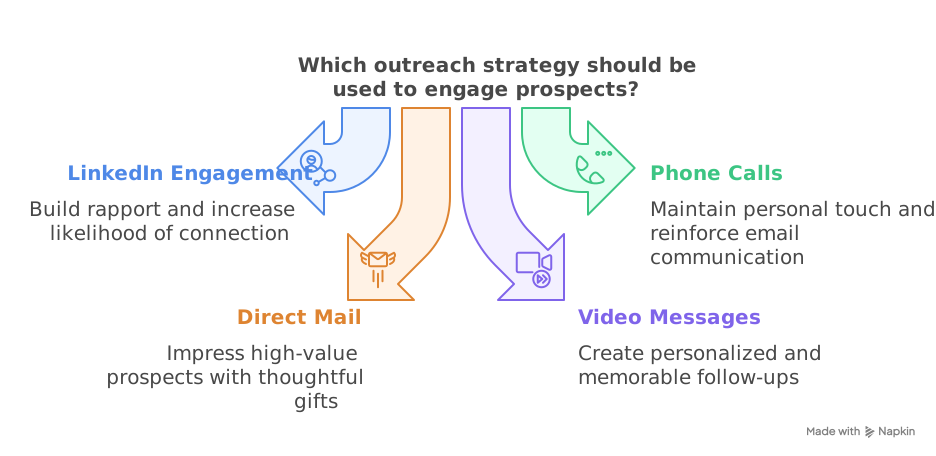
Limiting outreach to a single channel reduces your visibility. A coordinated approach across multiple touchpoints can increase recognition and response rates:
- Follow and engage with prospects on LinkedIn before sending connection requests
- Use direct phone calls strategically between email touchpoints
- Consider direct mail for high-value prospects (sending a relevant book or useful item)
- Use video messages for personalized, high-impact follow-ups
Each channel reinforces the others, creating a perception of omnipresence without crossing into nuisance territory.
The Executive Reach-Out
When regular sales approaches fail to generate response, involving senior leadership can restart conversations. This tactic works best for high-value opportunities where the investment of executive time makes sense. The message from an executive should reference the previous conversations, express genuine interest in the partnership potential, offer direct access (their personal email or phone), and suggest a brief 10-minute conversation.
Avoiding Typical Re-Engagement Mistakes
There are a few pitfalls in winning back inactive contacts that can hurt your results.
Following Up Too Aggressively
A common mistake is excessive persistence, which can feel annoying. More follow-ups are not automatically better: in the analysis by Saleshandy, the reply rate per follow-up fell from 0.80% for the first to 0.37% from the fifth onward.
Respect the contact’s freedom to decide and accept that not every lead can be reactivated. Sometimes an elegant exit is the more professional option.
Missing Concrete Value
Messages that only ask for a status without offering real value are rarely answered. Every contact attempt should include a clear benefit for the recipient.
Avoid phrases like “I just wanted to check in…” and offer concrete information, insights, or solution ideas that are relevant to the lead.
Legal Framework for Outreach in the DACH Region
The examples in this article use email, phone, and LinkedIn. Before you re-engage a contact in Germany, check that you may contact them at all: under Section 7(2) no. 2 of the German Unfair Competition Act (UWG), email advertising requires the recipient’s prior express consent, including in B2B. The only exception, Section 7(3) UWG, covers existing customers whose address you received in connection with a sale and use for similar offers of your own, provided they have not objected. Phone advertising toward businesses requires at least presumed consent under Section 7(2) no. 1 UWG.
Under data protection law, processing B2B contact data can usually rely on legitimate interests under Art. 6(1)(f) GDPR. You must also meet the information duty under Art. 14 GDPR if you did not collect the data from the person directly. A past conversation with a lead does not replace consent for email advertising. If in doubt, have your approach reviewed legally.
Measuring and Optimizing Your Re-Engagement Strategy
Like all sales activities, re-engagement requires careful tracking and optimization. The right metrics help identify what’s working and where adjustments are needed.
Key Performance Indicators to Track
Focus on these critical metrics to gauge the effectiveness of your re-engagement efforts:
- Recovery Rate: Percentage of cold leads that respond to your sequence
- Pipeline Reactivation: Value of opportunities revived from cold status
- Channel Effectiveness: Response rates by communication channel
- Timing Impact: Response patterns by day of week and time of day
- Content Performance: Which message types generate the highest response
Tracking these metrics allows for continuous refinement of your approach based on actual results rather than assumptions. Even small improvements in response rates can significantly impact your overall sales results when applied across your entire pool of cold leads.
Turning Re-Engaged Prospects Into Customers
Getting a response is just the first step. Converting re-engaged prospects into customers requires a thoughtful approach that addresses the initial disappearance while moving the relationship forward.
The First Conversation After Re-Engagement
When a cold prospect finally responds, your next interaction is crucial. Focus on these key elements:
- Express appreciation for reconnecting without mentioning the gap
- Confirm their current situation and priorities have remained the same
- Provide a concise reminder of where you left off
- Suggest a clear, specific next step
This approach acknowledges the reconnection positively while creating immediate momentum toward the next stage of your sales process.
Creating a “No Ghosting” Culture
To prevent future disappearances, establish communication expectations early in the rekindled relationship. This might include:
- Setting a regular check-in cadence
- Documenting next steps with clear ownership
- Creating a shared project space or document
- Establishing multiple points of contact at both companies
These practices create mutual accountability that reduces the likelihood of future communication gaps, keeping opportunities moving forward consistently.
Tools and Resources for Re-Engagement Sequences
The right technology can make your re-engagement efforts more efficient and effective.
Automation Platforms
Modern CRM and marketing automation systems allow you to build complex re-engagement sequences with conditional logic that adapts to the recipient’s behavior. Many of these systems offer dedicated features for this.
These systems also let you track open and click rates and adjust the sequences accordingly. Automation should never come at the expense of personalization.
Templates as a Starting Point
While every re-engagement sequence should be adapted to your specific situation, established templates can serve as a solid starting point. Our B2B cold email templates give you a good foundation that you can adapt to your needs.
Conclusion: Persistence with a Purpose
Re-engaging cold B2B leads isn’t about relentless follow-up. It’s about delivering consistent value that reminds prospects why they were interested in the first place. The strategic sequence outlined here balances persistence with respect, creating multiple opportunities for prospects to reengage on their terms.
Remember that timing is often the primary reason for disappearances. Your persistent, value-focused outreach ensures you’re top-of-mind when the timing improves. With a systematic approach to re-engagement, you can recover pipeline value that would otherwise be lost.
Most importantly, each recovered relationship represents not just immediate revenue opportunity, but the potential for long-term partnership and growth. By mastering the art of re-engagement, you transform what many salespeople see as a dead end into a valuable second chance at connection.
Frequently Asked Questions
Is a re-engagement sequence worth the effort for cold B2B leads?
Yes. Cold leads have already shown initial interest in your company. According to Saleshandy, 57% of positive replies in its cold email data came from follow-ups rather than the first message, so a structured sequence gives you more chances to start a conversation again.
How many touchpoints should be included in a B2B lead re-engagement sequence?
The sequence in this article uses four touchpoints over about three weeks, spaced roughly 5-7 days apart, each adding new value. Saleshandy found that successful sequences had four to six follow-ups over 20 to 21 days. This timing balances persistence with respect, providing multiple opportunities for prospects to respond without appearing aggressive or desperate.
Why do B2B prospects stop responding to sales outreach?
Prospects typically go silent due to competing priorities, internal restructuring, budget changes, decision-maker turnover, project delays, or information overload from multiple vendors, not because they rejected your solution. Understanding these factors helps craft naturally-resuming messages rather than applying pressure.
Does personalization improve B2B email response rates?
Personalization makes a follow-up harder to ignore than a generic one. Beyond basic name insertion, deeper personalization that references specific company initiatives, recent news, or industry challenges makes messages significantly harder to ignore because they’re clearly customized.
What makes an effective subject line for re-engagement emails?
Effective re-engagement subject lines are question-based, curiosity-driven, direct, or value-focused, kept under 50 characters for mobile visibility. Examples include ‘Still interested in improving [metric]?’ or ‘I found this about [Company]’.
How does multi-channel outreach improve cold lead recovery?
Multi-channel approaches combining email, phone, social media, and potentially direct mail give prospects more chances to notice you than a single channel. Coordinating touchpoints across channels reinforces recognition and visibility without crossing into nuisance territory.
What is a ‘pattern interrupt’ in B2B re-engagement sequences?
A pattern interrupt is your third touchpoint that changes approach completely, using a different channel, a dramatically shorter message, an unexpected format like video, or a curiosity-driven subject line. This stands out from typical follow-ups and recaptures prospect attention after two previous attempts.
Why does the ‘breaking up’ email work for re-engaging cold prospects?
The ‘breaking up’ email triggers psychological loss aversion by signaling this is the final outreach, removing pressure while creating urgency. This approach often prompts responses from previously silent prospects because they realize it’s their last opportunity to engage without being pursued further.
What should the first conversation after re-engagement focus on?
After re-engagement, express appreciation without mentioning the gap, confirm their current situation and priorities, remind them where you left off, and suggest a specific next step. This approach creates positive momentum while moving the relationship toward closing without dwelling on the disappearance.
How can you prevent future ghosting after re-engaging a B2B prospect?
Establish mutual accountability through regular check-in cadences, documented next steps with clear ownership, shared project spaces, and multiple contact points at both companies. These practices create transparency and shared responsibility that reduce future communication gaps and keep opportunities consistently moving forward.