
The Revenue Engine
Outbound, inbound and CRM in one system. Predictable pipeline in 90 days.
A campaign brings leads for as long as it runs. A Revenue Engine brings meetings, because target accounts, messaging, channels and CRM are wired together as one system.
Built in your systems: first qualified meetings from week 3, and by day 90 a pipeline with a reliable forecast that belongs to your team.
No tool zoo – No retainer forever – No agency dependency.
First meetings
From week 3
On day 90
Pipeline, forecast, playbooks
Ownership
Everything stays with you
Leadership
One point of contact
// The system
What a Revenue Engine is, and what it is not.
A Revenue Engine is your complete go-to-market system. Lead generation, nurturing and sales handover run automatically in one CRM: target accounts and offer, outbound via cold email and LinkedIn, inbound via content and lead magnets. Every lead carries source, signal and stage. One data source, one forecast, one pipeline number, not five reports from five tools.
Revenue Operations, RevOps for short, is the discipline behind it. It connects marketing, sales and customer success on shared data and processes. As a revenue operations agency we build this system for B2B SaaS, tech services and industrial SMEs. From Berlin, for the DACH market.
The engine is not a third offer. Whether you work with us as a lead gen service or have your marketing led by a fractional GTM / CMO: both models run on the same engine. Lead gen operates part of it for you. Fractional builds the whole engine in your company and hands it over.
The difference from an agency: an agency delivers campaigns and takes its knowledge with it. The engine is built in your systems. Domains, lists, sequences, CRM logic and playbooks belong to you from day one. Orchestrated by AI agents, built and handed over to your team.
Not more activity. A system that turns target accounts into meetings, repeatably.
Campaign compared to Revenue Engine
| Campaign | Revenue Engine | |
|---|---|---|
| Starting point | One channel, one budget | Target account and offer, then channels |
| Channels | Separate, one per vendor | Outbound and inbound in one system |
| Where leads land | Inbox, spreadsheet, tool | CRM with source, signal and stage |
| Steering | Clicks, opens, replies | Meetings, opportunities, forecast per stage |
| Handover to sales | By shouting across the room | Defined: qualified, routed, followed up |
| After the contract ends | The channel stops | System and playbooks stay with you |
// The bottleneck
Why your pipeline is not predictable.
Most B2B teams do not have a campaign problem. They have a system problem. The revenue architecture breaks at these five points.
Unclear positioning and target accounts
Differentiation and ideal customer profile are too vague. That creates waste in every channel.
Pipeline without architecture
Many activities, no clear path from lead to opportunity. Activity replaces system.
Sales and marketing not aligned
No shared definition of when a lead is qualified, no SLA. Handovers frustrate instead of scaling.
CRM without steering power
The data is there, the steering is missing. The forecast stays a gut feeling.
CAC rises, growth stalls
More budget, hardly better economics. Growth gets more expensive, not more predictable.
What we hear in first calls
“I want to know what comes in next quarter.”
“The founders are the sales team.”
“We do marketing on the side.”
“We tried it. It did not work.”
Inbound fizzles out
Content without distribution, leads without nurturing, a funnel that leaks at the bottom. Traffic, but no pipeline.
Outbound burns out
Generic mass emails, no signal timing, no connection to the CRM. Activity, but no meetings.
The answer is not one or the other. It is both, in one system.
More campaigns will not fix this. The bottleneck is the missing wiring between the channels and the CRM.
More mediocre leads only amplify the chaos. The engine fixes the system, not the volume.
// The building blocks
Four layers, one system.
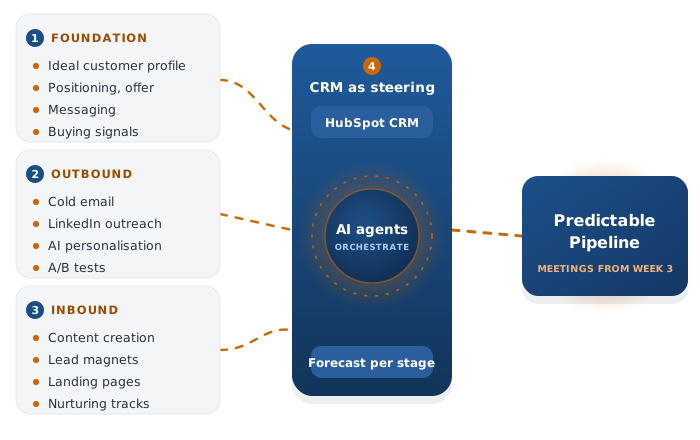
Nine components on four layers. Each feeds the next, all run together in the CRM. Strategy, outbound, inbound and CRM work as one, not side by side. Every building block stays with you.
01
Strategy and offer
Who exactly, with which pain, why now. Without this layer, every other layer optimises into a void.
What we build
- Ideal customer profile with buying committee
- Positioning and offer
- Messaging in your customers’ language
- Buying signals that set the timing
Go deeper: Create an ideal customer profile · B2B messaging · Sales triggers and signals
What changes
Every channel addresses the same target accounts with the same message.
Less waste, higher reply rates, sales and marketing mean the same customer.
02
Multichannel outbound
Cold email and LinkedIn, signal-based and personalised. The goal is meetings, not replies.
What we build
- Target lists, enriched and verified
- Domains and mailboxes with warm-up
- Sequences with AI personalisation
- LinkedIn outreach, aligned with the email sequence
- A/B tests on subject line and sequence
Go deeper: Cold email agency · LinkedIn lead generation
What changes
From week 3, qualified meetings land in your sales team’s calendar.
10 to 50 qualified B2B leads per month, depending on target market, straight into the CRM.
03
Demand and inbound
Inbound that is not left to chance. Content and lead magnets that trigger enquiries instead of collecting clicks.
What we build
- Inbound channels
- Content creation
- Lead magnets that trigger enquiries
- Landing pages and forms, connected to the CRM
Go deeper: Warming up leads with content
What changes
Warm enquiries complement the outbound stream. Target accounts you are not contacting today find their way to you.
Every enquiry lands in the CRM with its source and is followed up, instead of dying in an inbox.
04
CRM intelligence
The CRM is not a storage space, it is a steering system. HubSpot as the standard, other CRMs if they connect cleanly.
What we build
- CRM with lifecycle stages and routing
- Lead nurturing and follow-up, automated
- Conversion optimisation per stage
- Dashboards and forecast
- Playbooks
- AI best practices in sales and marketing
Go deeper: HubSpot services · Multichannel lead nurturing · Automation and AI
What changes
Handovers are defined, no lead expires, the forecast becomes reliable.
You see per channel what pipeline is created and where it stalls. Leadership by numbers instead of gut feeling.
// The build
How the engine is built in 90 days.
First the foundation, then the fastest channel, then the rest of the system. The order is deliberate: first meetings from week 3 buy the patience for building the remaining layers.
Day 1 to 14
Foundation
Audit and layer 1
Audit of positioning, channels, CRM and data. Ideal customer profile, positioning, offer and messaging are defined. In parallel: domains and mailboxes set up and warmed, target lists built and verified, first sequences written.
What you see
- One ideal customer profile shared by sales and marketing
- Offer and messaging in writing
- Target lists for approval
Week 3
First meetings
Layer 2 is running
The mailboxes are warm, the first outbound campaign goes live. Replies flow into the CRM, qualified contacts are handed to your sales team. In parallel, content creation and the first lead magnet start.
What you see
- First qualified meetings in the calendar
- Reply rate and audience response per segment
Day 31 to 60
Build-out
Layers 3 and 4 join
Inbound channels, content and lead magnets deliver the first enquiries. The CRM gets lifecycle stages, routing and lead nurturing. With cold email + LinkedIn, the second outbound channel joins. A/B tests on subject line and sequence, lists are replenished.
What you see
- Outbound and inbound in one CRM
- Pipeline per stage instead of a lead list
- One dashboard for sales and management
Day 61 to 90
Scale
Optimise, document, hand over
Conversion optimisation based on the numbers: what works gets more volume, the rest is cut. Playbooks are documented, AI best practices anchored in the team, your team is trained on the engine.
What you see
- A steady stream of qualified meetings
- A forecast you can trust
- Playbooks your team uses to run the engine
Day 90
Your decision
Day 90 review: numbers on the table, you decide.
Contacts reached, reply rate, meetings booked and held, opportunities in the CRM. Qualified means: the contact matches the agreed ideal customer profile, replied to the outreach and agreed to a conversation. The engine stands in your systems, whatever you decide.
Take over
Your team runs the engine itself. Handover is part of the 90 days.
Scale
We stay on the engine and build on the foundation.
Expand
More channels, segments or markets on the same system.
The plan shows the full build of all four layers in the fractional model. In the lead gen model we build and run layer 2 for you, align layer 1 with you and hand meetings into your CRM.
// The entry point
Two ways into the engine.
Buy the channel. Or the system that steers it. Two channels, fully done for you. Or your entire marketing, senior-led. Both run on the same Revenue Engine, the difference is scope.
Lead Gen
We book. Your team closes.
- Cold email + LinkedIn, fully done for you
- First qualified meetings from week 3
- 10 to 50 qualified leads per month, straight into the CRM
- Strategy, offer and closing stay with you
Layers of the engine
Layer 2 fully as a service. We align layer 1 with you and connect layer 4: meetings land in your CRM.
Fits if: Your sales team closes, the top of the funnel lacks supply.
One channel, delivered as a service. From 3,995 euros per month.
Fractional GTM / CMO Recommended
Senior leadership for your marketing. The know-how stays in-house.
- Senior GTM leadership, 1 to 2 days per week
- Owns positioning, offer, all channels, CRM and funnel
- Builds the Revenue Engine in 90 days, then hands it over
- Leads your team, your tools and your vendors
Layers of the engine
All four layers, built in your company. Playbooks documented, team trained, engine handed over.
Fits if: Nobody with seniority owns marketing and pipeline.
Leadership and system, built to keep. Price once we know your situation.
Lead Gen: Your sales team closes, the top of the funnel lacks supply.
Fractional: Nobody with seniority owns marketing and pipeline.
Packages, services and terms for both models: Pricing and packages.
// The difference
Why Jolly Marketer and not the next agency.
Offer first, not channel first
We start with the offer and the positioning. Only then do we scale channels.
AI agents in the stack
Enrichment, personalisation and reporting run AI-assisted across around 50 tools and agents. More depth per lead, less friction.
Revenue architecture instead of one-off campaigns
We build a system with an owner and a forecast, not a loose bundle of tactics.
20+ years of B2B
Experience from enterprise GTM at IBM, Microsoft and Infor, applied to SMEs. Official HubSpot partner.
Built to keep. What always applies.
No lock-in
Domains, mailboxes, lists, sequences, CRM logic and playbooks belong to you, from day one and after the engagement ends.
One point of contact
Richard Buettner leads every engagement personally. Execution runs on our own stack of around 50 tools and AI agents. No juniors, no handing off.
No minimum term
Planned on a rolling three-month basis, because building an engine takes that long. There is no fixed commitment.
24-hour notice period
Either side can cancel at any time in writing, also before day 90. Billing is monthly in advance.
// Self-check
Is a Revenue Engine right for you?
Fits if
You have a validated offer and first customers
You sell B2B software, tech services or industrial products with 10 to 250 employees
Your sales cycle takes 30 days or longer and involves several decision-makers
Someone on your team can take and close meetings
You want a system, not another campaign experiment
Does not fit if
You do not have product-market fit yet
You sell to consumers or purchases are decided within days
Nobody internally has time to attend meetings
You are looking for a one-off action without CRM integration
Frequently asked questions about the Revenue Engine
What exactly is the Revenue Engine?
The Revenue Engine is your go-to-market system on four layers: strategy and offer, multichannel outbound via cold email and LinkedIn, demand and inbound via content and lead magnets, and a CRM that steers everything. Every lead carries source, signal and stage. The goal is not more activity, but repeatable pipeline with a forecast you can trust.
Is the Revenue Engine a separate package?
No. It is the machine underneath both models. In the lead gen model we build and run layer 2 for you and hand meetings into your CRM. In the fractional model we build all four layers in your company, lead your team and hand the engine over after 90 days. Packages and terms are on the page Pricing and packages.
What distinguishes RevOps from a classic marketing agency or lead generation?
An agency delivers campaigns, classic lead generation optimises one channel. RevOps builds the system underneath: ideal customer profile, messaging, handovers, KPIs and CRM logic first, then the channels. Marketing, sales and CRM run on shared data, with one owner and one forecast instead of isolated tactics. The result is less chance, higher lead quality and a setup that keeps scaling internally.
How are inbound and outbound integrated into one system?
All channels feed the same CRM through an automation layer. Every lead carries source, signal and stage. That creates one data source and one shared forecast instead of separate silos per channel or vendor.
Revenue Engine or hiring our own SDRs?
An SDR without a system stays limited: no verified lists, no warm domains, no signal timing, no CRM logic. The engine provides the infrastructure in which an SDR or GTM engineer can scale in the first place. Often the system is the better first step, and your team takes it over afterwards.
How is ROI measured?
By pipeline value and pipeline per stage, not by clicks or opens. You see per channel what is created in meetings, opportunities and pipeline, and where it stalls. The numbers live in the CRM, not in an agency report.
Is this worth it for industrial SMEs too, not just SaaS?
Yes. Especially in industrial SMEs with long cycles and several decision-makers, an integrated system pays off in predictable pipeline. Signal-based outbound reaches technical decision-makers who do not respond to classic marketing, and the CRM keeps long cycles traceable.
What results are realistic in 90 days?
First qualified meetings from week 3, if target focus, messaging, sequences and CRM routing are set up cleanly early on. By day 90, structural effects follow: a shared ideal customer profile, clear handovers, more stable conversion and a forecast per stage. On day 90 it is measurable whether pipeline quality and steerability have improved.
Do I need HubSpot, or does it work with my CRM?
HubSpot is our standard and the fastest to integrate, Jolly Marketer is an official HubSpot partner. We also work with existing CRMs, as long as they connect cleanly to channels and automation. What works in your stack stays and gets connected. What slows you down, we replace. The goal is less tool zoo, not more.
Who owns the engine after the engagement?
You do. Domains, mailboxes, lists, sequences, CRM setup, dashboards and playbooks are built in your systems and stay there, also after the engagement ends. In the fractional model, handover to your team is part of the 90 days. In the lead gen model we hand over lists, domains and sequences cleanly if you bring the channel in-house.
Lead Gen or Fractional GTM / CMO: how do I decide?
If your sales team has capacity to close and only lacks supply at the top, Lead Gen is enough. If senior marketing leadership is missing, or an agency has already failed at execution, Fractional is the right model. We settle this in the first call in 30 minutes.
Can I start with Lead Gen and switch to Fractional later?
Yes. Lead Gen proves the machine on one channel, Fractional then scales it to all layers with leadership. All assets from the lead gen phase, meaning lists, sequences and CRM setup, are carried over.
What does the Revenue Engine cost?
Entry starts at 3,995 euros per month for cold email, depending on channels and scope. For cold email + LinkedIn and the fractional model we quote the price once we know your situation. There is no minimum term, either side can cancel with 24 hours’ notice in writing, billing is monthly in advance. All packages and terms: Pricing and packages.
Who actually works on my project?
Richard Buettner leads every engagement personally: ideal customer profile, positioning, messaging and alignment with your sales team. Operational execution, meaning list building, data enrichment, personalisation and reporting, runs on our own stack of around 50 tools and AI agents that Jolly Marketer develops itself. No juniors, no handing off to other agencies. You have one point of contact, from start to finish.
What happens if there are no results after 90 days?
On day 90 the numbers are on the table: contacts reached, reply rate, meetings booked and held, opportunities in the CRM. Qualified means: the contact matches the agreed ideal customer profile, replied to the outreach and agreed to a conversation. On that basis you decide: handover to your team, continuation or end. You can cancel with 24 hours’ notice even before day 90.
About the author
Richard Buettner is the founder of Jolly Marketer and fractional CMO for B2B companies in the DACH region. Over 20 years of go-to-market experience, including at IBM, Microsoft and Infor, plus his own B2B startups. His focus: revenue systems that create predictable pipeline instead of one-off campaigns.
Let’s build your Revenue Engine.
One conversation, an honest assessment, a clear next step. No sales theatre. You leave with a recommendation: which model, which layer first, which price. Terms and packages are on the page Pricing and packages.