

As of June 2026, Revenue Operations has evolved from an experimental function into the dominant architecture for aligning sales, marketing, and customer success in B2B companies. Modern buyers do much of their research independently, budgets face tighter scrutiny, and growth must be efficient rather than purely aggressive. This playbook delivers a complete implementation framework for RevOps, from mandate and governance to lifecycle design and AI readiness, based on patterns I see deployed across DACH mid-market companies.
For the current numbers on adoption, budgets and ROI across B2B teams, see our AI in B2B marketing statistics.
TL;DR
RevOps unifies sales, marketing, and customer success under shared data, processes, and metrics spanning the entire customer lifecycle. It eliminates silo conflicts, improves forecast accuracy, and turns disconnected tools into a coherent revenue engine. According to HubSpot, the share of teams planning to add new RevOps tools quadrupled between 2023 and 2025, which raises the need for integration. This playbook shows how to design the operating model, architect lifecycle processes, and implement a 90-day maturity program.
- End-to-end ownership across account selection, demand, closing, onboarding, renewal, and expansion reduces handoff friction and aligns teams around customer value.
- A single source of truth for revenue data eliminates interpretive conflicts when sales questions marketing pipeline or finance reviews forecast reliability.
- Cross-functional KPIs like pipeline conversion, net revenue retention, and sales efficiency replace departmental vanity metrics and drive collaborative behaviour.
What is Revenue Operations in B2B Companies
Quick Answer: Revenue Operations is a strategic framework that unifies sales, marketing, and customer success teams under common goals, data, and processes. It replaces siloed planning and overlapping tools with a single architecture spanning target account selection to multi-year renewal.
I see RevOps as the operating system of go-to-market. It is not about an additional organizational layer. RevOps embodies a systemic way of thinking about optimizing the entire customer and revenue journey.
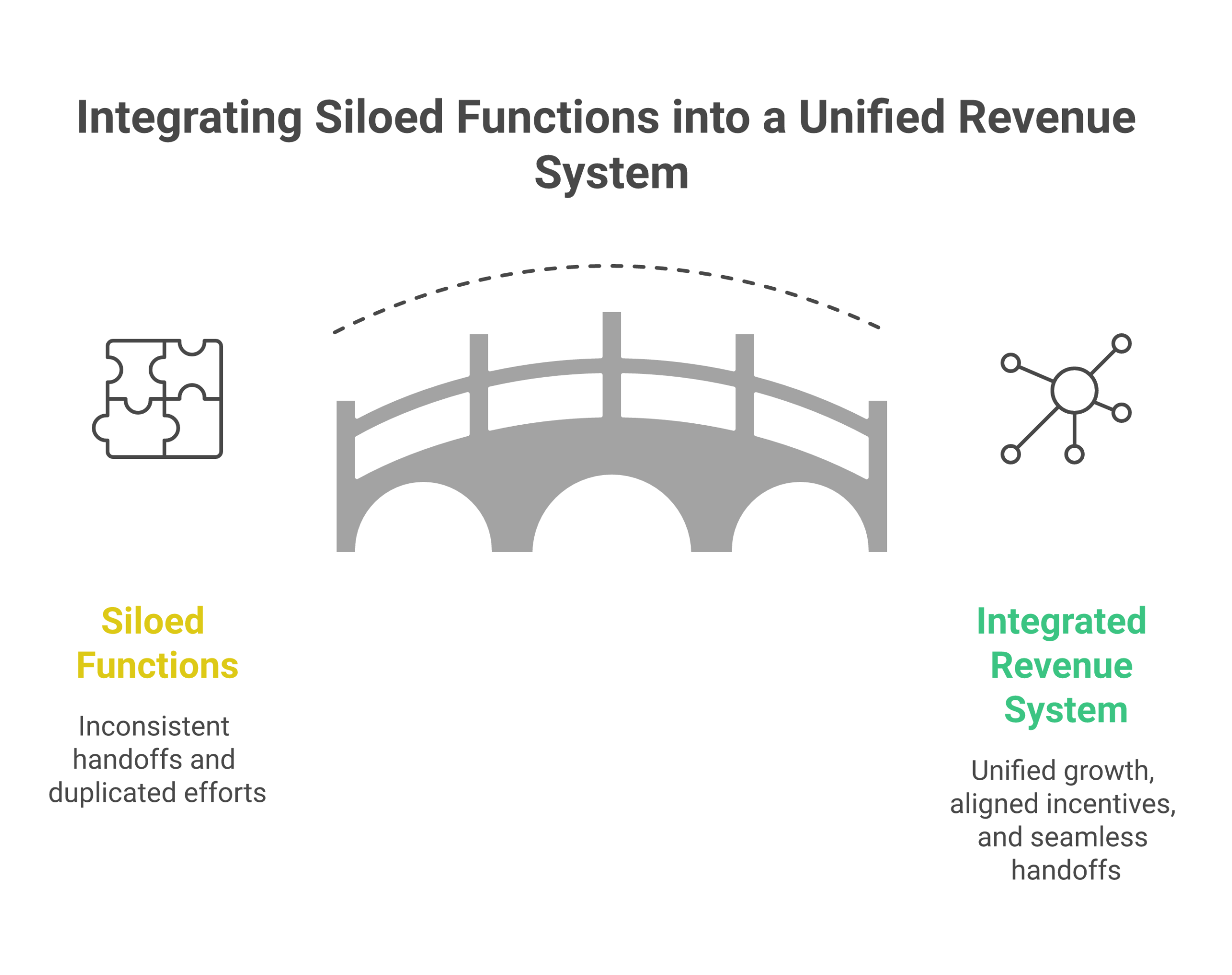
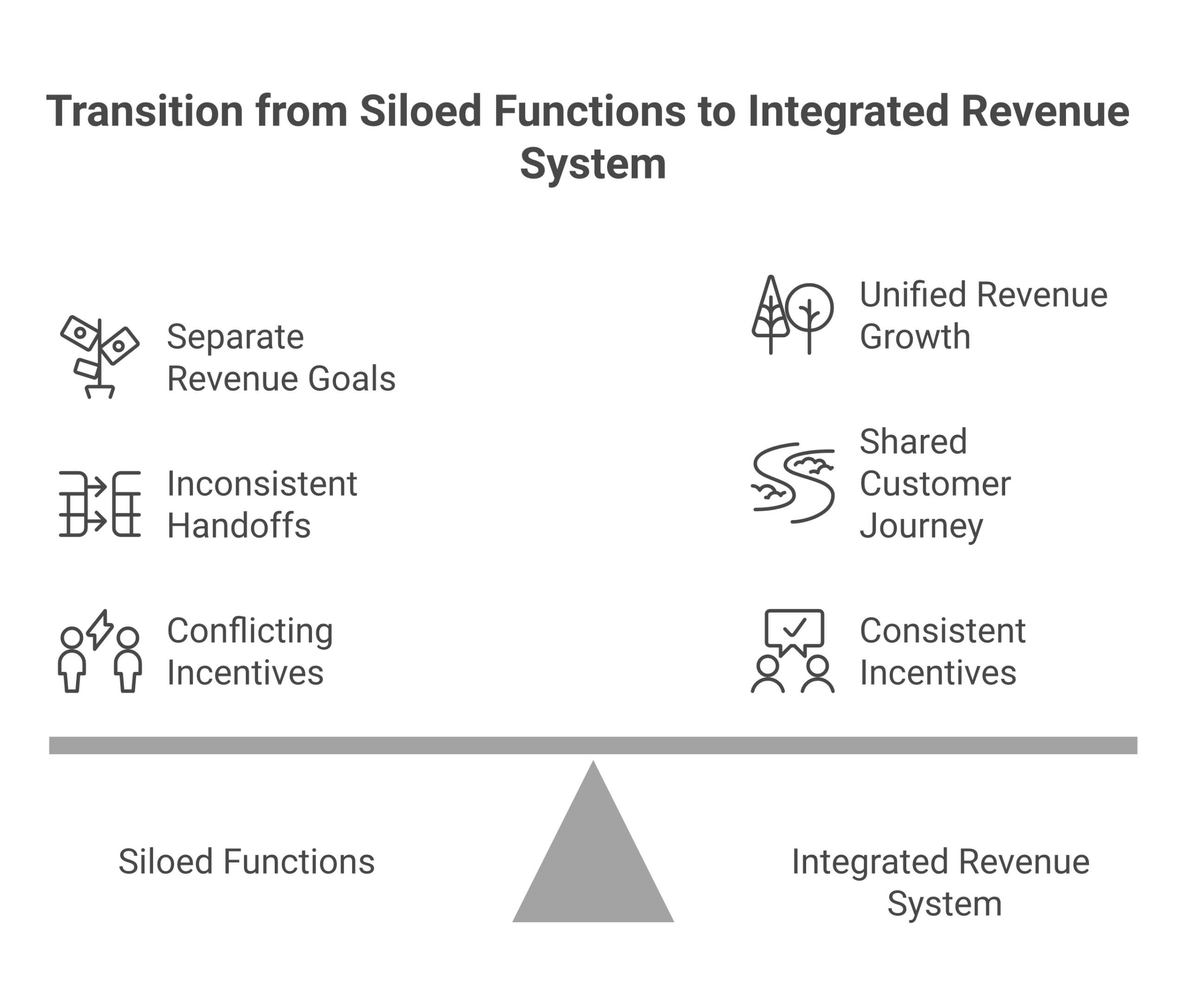
The fundamental problem RevOps solves is structural misalignment. Marketing measures leads, sales tracks bookings, customer success owns renewals. Each uses separate tools and interprets data differently. Handoffs break, incentives conflict, and growth suffers.
RevOps reframes this as a system design problem. It creates interconnected processes, shared definitions, and governance spanning all revenue activities. Instead of producing reports, RevOps curates the customer journey and aligns people, platforms, and metrics around it.
This shift has real consequences for decision-making. Which markets to prioritize, how to structure territories, how to balance new bookings against expansion, these questions get addressed with a holistic lens rather than departmental lobbying.
Takeaway: RevOps is custodian of the revenue engine, not an administrative support function.
Differentiation from Classic Ops Functions
Sales Operations traditionally focuses on sales process, territory planning, quota management, and CRM administration. RevOps encompasses that scope but extends it across marketing and customer success.
The difference lies in the end-to-end perspective. RevOps looks at the entire revenue process from the first marketing touchpoint to the contract renewal. This creates systematic sales optimization across functional boundaries.
The critical difference is lifecycle breadth. Sales Ops cares about opportunity stages and close rates. RevOps owns the connective tissue from demand generation through renewal, ensuring marketing’s qualified accounts meet sales’ acceptance criteria and that customer success data informs acquisition strategy.
When you centralize responsibility for the entire lifecycle, conflicts dissolve. Marketing no longer optimizes for volume that sales rejects. Customer success churn insights feed directly into ICP refinement.
Marketing Operations manages campaign execution, automation platforms, and lead workflows. RevOps integrates those efforts with sales and customer success for end-to-end performance.
Marketing Ops ensures emails deploy correctly and landing pages convert. RevOps ensures those conversions meet a shared definition of qualified, that handoffs to sales happen on time, and that pipeline metrics connect to business outcomes.
In practice, Marketing Ops often reports into or collaborates closely with RevOps to maintain alignment on data schemas, lifecycle stages, and shared KPIs.
The Strategic Role in 2026
The complexity of modern B2B buying forces RevOps structures. Multiple stakeholders, hybrid touchpoints and subscription models fragment data across marketing automation, CRM and customer success systems. RevOps overcomes this fragmentation.
Forrester names four central RevOps must-dos for 2024 planning: a data center of excellence, a clear line of sight into buying groups, sales activity tracking and the role of a revenue process architect. These fields form the basis of a modern operating model.
The Business Case: How RevOps Drives EBITDA and Efficient Growth
Quick Answer: RevOps improves profitability by reducing redundant tool spend, improving sales efficiency, and increasing net revenue retention. It aligns acquisition cost with customer lifetime value and eliminates waste caused by poor handoffs and conflicting metrics.
Budget Pressure and Capital Allocation
In my fractional CMO engagements I keep running into the same pain: optimizing single funnel stages in isolation has limited effect. When data breaks, conflicting target systems and incompatible tools distort the overall picture, the investment fizzles out.
Budgets face tighter scrutiny in 2026. The 2026 benchmarks for private B2B SaaS companies show median total spend between 96% (bootstrapped) and 101% (equity-backed) of annual recurring revenue. In that environment every investment has to be quantifiable. Companies must demonstrate efficient growth: revenue expansion paired with controlled cost and strong unit economics.
RevOps becomes the vehicle for data-based prioritization. It uncovers inefficiencies in funnel orchestration, and the link between growth initiatives and financial results gets tighter.
- A shared data basis prevents redundant tool investments
- Uniform processes reduce manual effort in sales and marketing
- Transparent attribution shows which channels actually contribute to revenue
- Integrated forecasts improve planning quality and resource allocation
Efficiency Through Process Automation
The State of RevOps 2025 by HubSpot reports that the share of respondents planning new RevOps tools rose from 4% in 2023 to nearly 20% in 2025, a fourfold increase. AI-supported automation captures sales activities, transcribes meetings and feeds interactions into the CRM without manual effort.
This makes previously invisible parts of customer interaction measurable. Buying groups are mapped systematically, and pipeline movements and churn risks become transparent. The value lies not in more systems but in a consistent operating model.
RevOps directly impacts three levers of profitability. First, it consolidates technology spend. When each function procures its own tools, overlapping subscriptions proliferate. RevOps evaluates the full stack and rationalizes platforms.
Second, RevOps improves sales efficiency. Clear qualification criteria mean sellers spend time on winnable deals. Forecasting accuracy improves, reducing the cost of missed quarters. Territory design balances coverage and quota attainability.
Third, RevOps lifts net revenue retention by closing the loop between customer success health scores and acquisition targeting. When churn patterns inform ICP updates, acquisition becomes more durable.
Takeaway: RevOps converts operational discipline into measurable margin improvement and capital efficiency.
Finance cares about customer acquisition cost payback, lifetime value to CAC ratio, and forecast variance. RevOps owns the systems that generate these numbers with integrity.
- CAC payback period shortens when lead quality improves and conversion rates rise.
- LTV expands when RevOps aligns retention and expansion motions with initial fit.
- Forecast accuracy increases when pipeline hygiene and stage criteria are enforced consistently.
I see CFOs treat RevOps as a strategic partner once it demonstrates reliable data governance and process discipline. The function earns budget authority and hiring priority when it proves it can de-risk revenue delivery.
Building the Data Foundation: CRM Hygiene and Documentation
Quick Answer: Clean, well-structured CRM data is the foundation for forecasting, reporting, and AI deployment. RevOps enforces shared definitions, mandates data entry standards, and documents every field, stage, and workflow so teams trust the system.
I see the same picture in almost every new engagement: customer data spread across CRM instances, marketing automation, customer success tools and reporting platforms. No shared view of the customer. No basis for reliable analysis.
Data Center of Excellence as Core Competence
Forrester lists persistent data quality issues at the top of the obstacles facing B2B marketing organizations. Many companies manage customer data in distributed silos. A data center of excellence overcomes this fragmentation through central data skills and governance.
This creates the basis for reliable revenue analyses, forecasts and performance measurement. Strategic decision-making and cross-functional alignment improve, and the investment in data quality pays off across all go-to-market functions.
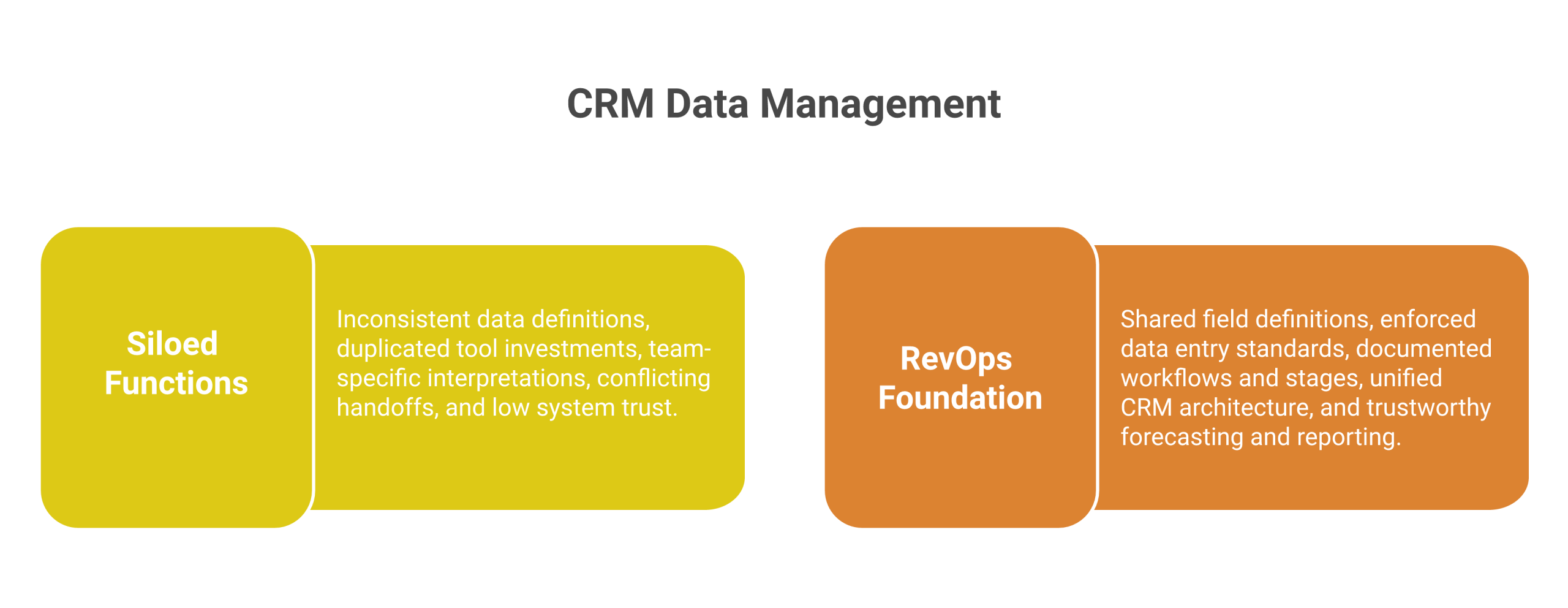
Revenue systems are only as effective as the data inside them. Garbage in, garbage out applies brutally in B2B operations. Without shared definitions and entry discipline, reporting becomes interpretive art rather than reliable insight.
RevOps must define and document every core object: what constitutes an account, a lead, an opportunity, a qualified stage. Each lifecycle stage needs objective entry criteria. Subjective judgment invites inconsistency.
Documentation and Process Governance
Technology alone does not solve data problems. Without clear roles, responsibilities and processes around data quality management, RevOps merely digitizes existing silo structures. Successful approaches combine technological, procedural and cultural interventions.
I recommend three pillars: First, dedicated data stewards with a clear mandate for data quality. Second, documented processes for data entry, cleansing and enrichment. Third, regular audits and feedback loops for continuous improvement.
| Dimension | Responsibility | Metric | Frequency |
|---|---|---|---|
| Data entry | Sales & Marketing | Completeness of required fields | Weekly |
| Data cleansing | Data Steward | Duplicate rate, inconsistencies | Monthly |
| Integration | RevOps Lead | API availability, latency | Daily |
| Reporting | Revenue Process Architect | Data freshness, deviations | Weekly |
Field-level governance matters. Which fields are required at each stage? Who owns updates? What happens when sales disagrees with a marketing source attribution? RevOps writes these rules, trains teams, and audits compliance.
Takeaway: Documentation transforms the CRM from a black box into a shared operating manual.
The most common failure is orphaned records. Leads enter the system but never get qualified or disqualified. Opportunities linger in pipeline for months without activity. Accounts lack ownership or territory assignment.
Another trap is duplicate records. Without deduplication rules and merge workflows, the same company appears three times under variant names. Reporting breaks, and sellers waste time chasing the same contact.
A third issue is missing or inconsistent industry, region, or revenue data. Segmentation and territory logic depend on firmographic accuracy. RevOps must either enforce manual entry or integrate enrichment services.
| Metric | Target direction | Why It Matters |
|---|---|---|
| Required field completion rate | As high as possible | Enables reliable segmentation and reporting |
| Duplicate account rate | Close to zero | Prevents territory conflicts and skewed analytics |
| Stale opportunity ratio (no activity >30 days) | Low | Ensures forecast reflects real pipeline health |
| Unassigned lead age (median days) | Short | Speeds response time and improves conversion |
Lead Management and MQL-to-SQL Handoff
Quick Answer: A formal Service Level Agreement between marketing and sales defines what qualifies as a marketing-qualified lead, how quickly sales must respond, and how rejected leads are routed back. This SLA eliminates blame and focuses both teams on conversion.
The handoff from marketing to sales is the highest-stakes process transition in the revenue lifecycle. When it works, pipeline fills with winnable opportunities. When it breaks, marketing burns budget on leads sales ignores, and sales complains about quality.
Definition and Enforcement of SLAs
RevOps mediates this tension by codifying a lead management SLA. Marketing commits to delivering leads that meet agreed fit and engagement criteria. Sales commits to contacting those leads within a defined window and providing disposition feedback.
The SLA specifies objective qualification criteria: firmographic fit (industry, size, geography), engagement threshold (content downloads, demo requests, event attendance), and intent signals (pricing page visits, competitor searches). Leads meeting all criteria become MQLs.
Sales accepts or rejects each MQL within the SLA window. Accepted leads become Sales Accepted Leads (SALs) and enter active follow-up. Rejected leads return to marketing with a documented reason: wrong fit, not ready, duplicate, or other.
In my projects I typically set a 24-hour rule for first contact with SQLs. For MQLs, 48 hours are enough. What matters is the documented feedback: sales must mark every lead as accepted, disqualified or rejected.
- MQL definition: firmographic criteria, engagement score, recognizable buying signal
- SQL definition: need confirmed, budget identifiable, decision-maker identified
- Follow-up SLA: first contact within 24 hours for SQLs
- Feedback loop: sales marks the lead status within 72 hours of handover
Takeaway: The SLA turns a blame cycle into a feedback loop that improves targeting and conversion over time.
Tool Integration and Automation
SLAs only work with technical support. Automated workflows assign leads, remind sellers to follow up and track conversion rates. The Revenue Engine setup connects marketing automation with the CRM through defined triggers and status updates.
Manual lead assignment introduces delay and error. RevOps automates routing based on territory, account ownership, product line, or round-robin logic.
- Named account leads route to the assigned account executive immediately.
- New territory leads distribute via round-robin with capacity weighting.
- Inbound demo requests trigger instant Slack or email alerts to the owner.
Automation also tracks SLA compliance. If a seller hasn’t touched a lead within the SLA window, escalation workflows notify the manager. Dashboards show acceptance rates, contact rates, and conversion by source.
I use lead scoring models that combine firmographic and behavioral signals. Above a defined threshold, the lead is handed to sales automatically. The system documents every interaction and makes the pipeline transparent.
Forecasting: From Forecast Call to Forecasting Process
Quick Answer: Reliable forecasting requires standardized opportunity stages, rigorous pipeline hygiene, and a repeatable submission process. RevOps builds the structure so forecast calls focus on strategy rather than data archaeology.
Most B2B organizations run weekly or biweekly forecast calls. Sales leaders present their pipeline, finance scrutinizes the numbers, and executives decide whether to adjust hiring or spending.
Without RevOps, these calls devolve into arguments about data quality. Which deals are real? Why did this opportunity appear overnight? Why hasn’t that stage moved in six weeks?
Data-Based Forecast Models
I build forecasts on three pillars: pipeline coverage, historical win rates and deal velocity. Pipeline coverage shows whether enough opportunities are in the funnel to reach the target. Win rates by stage and source give probabilities. Deal velocity shows how fast deals move through the funnel.
Combining these dimensions yields a forecast based on real data. Deviations become visible before the quarter ends, which allows timely intervention.
RevOps transforms forecasting from an interrogation into a decision process by enforcing pipeline discipline year-round. Each opportunity stage has entry criteria, required fields, and expected duration. Deals that violate these norms get flagged automatically.
RevOps also defines forecast categories: commit (high confidence, near-term close), best case (qualified but uncertain timing), and pipeline (early stage). Sellers submit categorized forecasts in the CRM, managers review and adjust, and RevOps aggregates into executive dashboards.
The forecast call itself becomes strategic. Instead of debating whether a deal is real, the team discusses win strategy, competitive threats, and resource allocation. Trust in the numbers allows faster, better decisions.
Takeaway: Forecasting is a process, not an event, and RevOps owns the infrastructure that makes it reliable.
Continuous Process Control
RevOps automates forecast updates. Dashboards show pipeline movements in real time, and alerts warn when coverage falls below defined thresholds. This does not replace the forecast call, but it shifts the focus from “What is the number?” to “Where do we need to intervene?”.
I recommend weekly pipeline reviews with an automated pre-read. Sales leads prepare based on current data, and the call focuses on risks, deals running late and required resources.
Pipeline coverage ratio (total pipeline divided by quota) is necessary but insufficient. RevOps tracks velocity and conversion metrics that predict future performance.
- Stage conversion rates (MQL to SQL, SQL to closed-won) identify where deals stall.
- Average sales cycle length by segment and product reveals capacity needs.
- New opportunity creation rate signals whether top-of-funnel is healthy.
When these indicators trend down, RevOps raises the alarm before the quarterly number misses. Early warning allows corrective action: accelerating campaigns, reallocating headcount, or adjusting targets.
Retention and Expansion as RevOps Metrics
Quick Answer: Net revenue retention, churn analysis, and expansion pipeline are core RevOps responsibilities. They connect customer success activities to overall revenue strategy and inform acquisition decisions by revealing which customers deliver durable value.
For B2B SaaS and subscription businesses, retention and expansion are major drivers of ARR growth. RevOps must therefore treat the post-sale lifecycle with the same rigor as acquisition.
I see many RevOps teams that focus exclusively on new-customer acquisition. That is a mistake. Retention and expansion decide profitability.
ICP Fit and Customer Quality
RevOps starts with the ideal customer profile. Which customers have the highest retention? Which the highest lifetime value? Which the fastest time to value? These questions define the ICP.
Marketing and sales must be measured against this ICP. Lead quality is not volume but fit. RevOps ensures that qualification criteria, scoring models and sales processes are aligned with ICP fit.
- ICP definition: firmographic traits, technographics, buying behavior
- Lead scoring: weighting ICP fit higher than engagement
- Sales enablement: playbooks and pitch decks for ICP segments
- Customer success: onboarding and support by ICP profile
Churn Analysis and NRR Management
Net revenue retention (NRR) measures revenue from a cohort of customers over time, including upgrades, cross-sells, and churn. An NRR above 100 percent means existing customers are growing faster than they are leaving. According to the retention benchmarks by SaaS Capital, higher growth at private B2B SaaS companies tends to go together with higher retention.
RevOps calculates NRR by segment, product, and cohort vintage. This granularity reveals which ICPs deliver sustainable growth and which require too much service cost relative to expansion potential.
Churn analysis goes deeper. RevOps categorizes churn by reason (product fit, competitor win, budget cut, usage decline) and by customer profile. Patterns emerge: certain industries churn faster, deals below a revenue threshold rarely expand, or customers acquired via one channel retain better than others.
These insights feed directly back into acquisition strategy. If one customer segment retains far better than another, RevOps adjusts ICP definitions and demand programs accordingly.
I use early indicators such as declining login frequency, missing feature adoption or absent renewal conversations. Automated workflows trigger customer success interventions before customers cancel.
Takeaway: Treating retention as a RevOps metric closes the loop between what you sell and what actually drives long-term value.
Expansion opportunities (upsell, cross-sell, seat growth) require the same pipeline discipline as new business. RevOps defines expansion stages, qualification criteria, and ownership rules.
Customer success managers often identify expansion signals: increased usage, new stakeholder engagement, or feature requests that map to higher tiers. RevOps ensures these signals convert into formal opportunities with clear next steps and forecast categories.
AI in Go-to-Market: Foundation Before Automation
Quick Answer: AI tools for lead scoring, opportunity prediction, and content personalization require clean data, well-defined processes, and continuous monitoring. RevOps manages deployment, validation, and governance to ensure AI enhances rather than amplifies existing problems.
By 2026, machine learning and generative AI are embedded across revenue platforms. CRMs score leads automatically, predict close probability, and suggest next-best actions. Marketing automation personalizes email content and landing pages based on firmographic and behavioral signals.
These capabilities promise efficiency and insight, but they depend entirely on data quality and process integrity. In its Revenue Operations Survey 2024, Forrester found that 38% of revenue operations leaders count data lacking accuracy and quality among data users’ top challenges. An AI model trained on messy CRM data produces unreliable scores. A lead-scoring algorithm that reflects historical bias amplifies that bias at scale.
RevOps must therefore treat AI deployment as a governance and change management challenge, not merely a technology implementation. Before enabling AI features, RevOps audits data quality, validates training datasets, and defines success criteria.
Once deployed, AI models require ongoing monitoring. RevOps tracks model accuracy, reviews edge cases where predictions fail, and retrains models as buyer behaviour or market conditions shift. This discipline prevents AI from becoming a black box that erodes trust.
Automated Sales Activity Capture
Forrester names sales activity tracking as one of four RevOps must-dos. AI-supported tools capture meetings, emails and interactions automatically, without manual CRM effort. This makes previously invisible parts of customer interaction measurable.
I see many sales teams neglect CRM hygiene. Automated capture solves the problem: conversations are transcribed, commitments extracted and follow-ups triggered. The data foundation improves without sellers investing more time.
Takeaway: AI accelerates revenue operations only when RevOps manages the foundation of data, process, and accountability.
Buying Group Transparency Through AI
Modern B2B buying processes involve multiple stakeholders. AI analyzes email threads, meeting participants and LinkedIn interactions to map buying groups systematically. RevOps ensures that this data flows into the CRM and is usable for sales teams.
I use AI-supported buying signals to recognize when a deal stalls. Missing stakeholders, unanswered emails or rescheduled meetings are early indicators. RevOps orchestrates the response: automated alerts, prepared playbooks, escalated resources.
Lead scoring models combine fit (industry, size, tech stack) and engagement (web visits, content downloads) to rank inbound leads. RevOps validates scores against actual conversion data and adjusts weighting.
Opportunity risk prediction flags deals likely to slip or close-lost based on activity patterns, stage duration, and stakeholder engagement. Sales managers use these alerts to intervene early.
Content and messaging personalization tailors email copy, landing pages, and ad creative to vertical, role, or buying stage. RevOps ensures personalization rules align with brand guidelines and compliance requirements.
Implementing RevOps: Maturity Assessment and 90-Day Plan
Quick Answer: Start with a maturity assessment across data, process, technology, and organization. Prioritize the highest-impact gaps, then execute a 90-day plan focused on quick wins that build credibility and momentum for longer-term transformation.
Most B2B companies already have fragments of RevOps: a sales operations manager, a marketing automation specialist, scattered process documentation. The challenge is evolving these pieces into a cohesive, empowered function.
Maturity Assessment
Begin with a structured maturity assessment. Evaluate four dimensions: data, processes, technology, and organization. Score each on a scale from 1 (ad hoc) to 5 (optimized) and identify the biggest gaps.
Common patterns emerge. Early-stage companies lack formal processes and documentation. Growth-stage firms have tools but inconsistent data. Mature organizations struggle with governance and change management as complexity grows.
Data: Is there a single source of truth? Are data quality and governance established? Processes: Are marketing-sales SLAs defined and enforced? Technology: Are tools integrated or isolated? Organization: Are there dedicated RevOps roles with a clear mandate?
- Stage 1 (ad hoc): no RevOps function, isolated tools, manual processes
- Stage 2 (repeatable): first SLAs, CRM basics established, reactive reporting
- Stage 3 (defined): dedicated RevOps roles, integrated dashboards, documented processes
- Stage 4 (managed): automated workflows, data governance, strategic forecasting
- Stage 5 (optimized): continuous optimization, AI-supported insights, revenue process architect
The Focused 90-Day Plan
I recommend a lean 90-day plan with three to four priorities. Typical levers: improve data quality, implement marketing-sales SLAs, build integrated pipeline reporting and hire a revenue process architect.
Weeks 1 to 4: complete the assessment, identify quick wins, align stakeholders. Weeks 5 to 8: clean up the data foundation, define SLAs and set up first automation. Weeks 9 to 12: take dashboards live, run first pipeline reviews and establish a feedback loop.
Once you understand current state, define the target operating model: what RevOps will own, how it will engage with other functions, which metrics it will report, and what success looks like in 12 months.
Then build a 90-day implementation plan focused on three to five high-impact initiatives. Quick wins build credibility. Examples: standardize opportunity stages and run a pipeline audit, implement an MQL-to-SQL SLA with automated routing, or launch a monthly revenue review with cross-functional KPIs.
Takeaway: RevOps transformation is iterative; start with foundations that prove value, then expand scope and sophistication over time.
Executive sponsorship is the first hurdle. Without a senior leader who champions RevOps, the function lacks authority and budget. Secure a CRO, COO, or CEO sponsor by framing RevOps as risk mitigation and efficiency gain, not just process improvement.
Data migration and cleanup often consume more time than planned. Resist the temptation to fix everything at once. Prioritize the data required for your 90-day initiatives, clean that subset rigorously, and tackle the rest in phases.
Resistance from sales, marketing, or customer success is natural when new processes impose constraints. Involve team leads early, solicit feedback, pilot changes with a small group, and demonstrate results before rolling out broadly. Trust is earned through delivery.
FAQ
What is Revenue Operations in B2B?
Revenue Operations (RevOps) is an integrated steering function that connects marketing, sales, customer success and IT along the entire customer journey. The goal is to harmonize processes, data and technology in order to systematically increase growth, efficiency and customer success in B2B.
Why is RevOps becoming more strategically important in 2026?
RevOps is developing from a support function into a strategic lead discipline. Rising costs, complex buying processes and tool sprawl demand data-driven steering and a unified architecture, so that growth stays efficient, scalable and customer-centric.
How does RevOps differ from classic Sales Operations?
Sales Operations focuses on sales efficiency, while RevOps works across functions. RevOps integrates marketing, sales and customer success through shared data, processes and KPIs. This makes it the connecting layer of the whole revenue engine rather than pure sales support.
What role does AI play in Revenue Operations?
Artificial intelligence automates data capture, analysis and reporting in RevOps. It enables more precise forecasts, detects patterns in buying behavior and reduces manual tasks. This creates transparency along the customer journey and improves the quality of the information that marketing and sales teams base decisions on.
RevOps 2026 vs. 2024: What has changed?
Between 2024 and 2026, RevOps became more professional and more strategic. Data centers of excellence, automated sales activity capture and roles such as the revenue process architect are establishing themselves. The tool landscape is growing, AI is gaining weight and steering follows financial and operational efficiency criteria more strongly.
RevOps vs. Marketing Operations: What is the difference?
Marketing Operations concentrates on campaigns, tools and data within marketing. RevOps, in contrast, connects marketing, sales, customer success and IT. It optimizes the entire revenue process across functions and aligns all growth activities around shared KPIs.
How do data centers of excellence support RevOps?
A data center of excellence bundles data skills and governance. It ensures that RevOps teams have consistent, high-quality data. This makes revenue analyses, forecasts and performance measurement more reliable, which significantly improves strategic decision-making and cross-functional alignment.
RevOps vs. AI-based automation: Which drives growth more?
AI automation increases operational efficiency, while RevOps orchestrates the whole system. The two complement each other: AI delivers data and insights, RevOps steers their use strategically. Growth emerges when automation and RevOps structures work together to steer processes in a data-based and adaptive way.
How does RevOps influence investment strategy in B2B?
RevOps leads to more precise budget steering along efficiency and ROI targets. Through data-based transparency, companies prioritize investments that demonstrably support revenue and profitability. RevOps thus becomes the central instrument for steering growth initiatives financially and optimizing capital use.
RevOps vs. traditional sales management: Which approach is more future-proof?
Traditional sales management is mostly channel-focused and reactive, while RevOps works in an integrated and data-driven way. RevOps creates end-to-end transparency from marketing to customer success and increases efficiency and scalability. The RevOps approach is therefore considered more future-proof for B2B organizations from 2026.
Sources
Forrester: Planning Guides Revenue Operations
Forrester: 2026 Budget Planning for B2B Marketing, Sales, and Revenue Operations
HubSpot: State of RevOps 2025
SaaS Capital: Spending Benchmarks for Private B2B SaaS Companies
SaaS Capital: Retention Benchmarks for Private B2B SaaS Companies
If you would rather not build Revenue Operations in-house, our RevOps services build the system and hand it over to you.