

As of June 2026, an Outcomes Rocket survey of 511 B2B professionals in the US and UK shows: only 37% have a clear understanding of go-to-market as an integrated, cross-functional revenue framework. Many still treat GTM as a collection of activities rather than a cross-functional discipline. This guide shows how DACH B2B companies build a structured GTM strategy that covers every decision level, from ideal customer profile through channel and motion choice to measurable KPIs.
TL;DR
A successful B2B go-to-market strategy for DACH in 2026 rests on a precise ICP, a GTM motion chosen deliberately by deal size, AI-assisted personalization, and GEO-optimized content. Measurability through LTV:CAC, sales cycle, and funnel KPIs is mandatory.
- 86% of about 280 respondents in the bvik trend barometer 2026 (in German) rate generative engine optimization as a must-have alongside classic SEO.
- Only 38% of 522 surveyed B2B leaders call their GTM strategy very effective, although 83% call it very important (HBR Analytic Services, sponsored by LeanData).
Why only 37% of B2B companies understand GTM as a revenue framework
Quick Answer: Many B2B organizations treat GTM as a list of marketing campaigns instead of an integrated revenue discipline with cross-functional steering. In the Outcomes Rocket survey, only 37% of respondents show a clear understanding of GTM as a framework with clear responsibilities across marketing, sales, and customer success. The result is fragmented channels, unclear KPIs, and poor measurability.
The Outcomes Rocket study of 511 B2B professionals in the US and UK shows: 29.1% have only limited confidence that their GTM initiatives translate into measurable business impact. A typical pattern: many companies start with a channel strategy, a messaging deck, and a pipeline forecast without first clarifying ICP, motion, and positioning. The result: campaigns without a shared foundation, sales without a playbook, customer success without a feedback loop.
Defining GTM as a cross-functional discipline
Successful GTM strategies in 2026 treat market entry and scaling as a shared revenue task. Marketing defines ICP and messaging, sales builds playbooks and tests pitches, customer success feeds churn and upsell data back into the system. This feedback loop ensures GTM does not end at launch but keeps iterating.
Structured GTM approaches above all create clarity: every function knows its role, which KPIs it steers, and how its work feeds into the full funnel.
Why DACH B2B is under AI and budget pressure in 2026
In our view, AI-assisted personalization is no longer a nice-to-have but a hygiene factor. The bvik trend barometer 2026 (in German) names budget pressure, AI disruption, volatile markets, and hybrid customer journeys as forces shaping B2B marketing, including AI-driven search and generative answers.
This demands clear prioritization: Which channel delivers the highest ROI? Which motion fits the deal size? Where does automation pay off? Companies that do not answer these questions scatter their effort across activities with no measurable effect.
Takeaway: GTM success in 2026 requires cross-functional steering, clear KPIs, and data-based iteration instead of isolated campaigns.
ICP precision: the foundation of every successful market strategy
Quick Answer: A precise ideal customer profile defines industry, company size, location, revenue, and concrete pain points. It is the basis for segmentation, messaging, and channel choice. Without a sharp ICP, B2B teams waste budget on audiences that never buy.
A B2B purchase usually involves several stakeholders with different priorities. This complexity demands a clear audience definition from the start. Effective GTM strategies begin with an ideal customer profile, buyer personas, and clear positioning as the foundation.
ICP definition by DACH segmentation
DACH B2B GTM guides recommend segmenting along five dimensions:
- Industry: Which verticals benefit most from the offer?
- Location: Germany, Austria, Switzerland, or all three markets?
- Company size: Number of employees.
- Revenue: ARR, annual revenue, or budget for solving the problem.
- Pain points: Concrete challenges the product addresses.
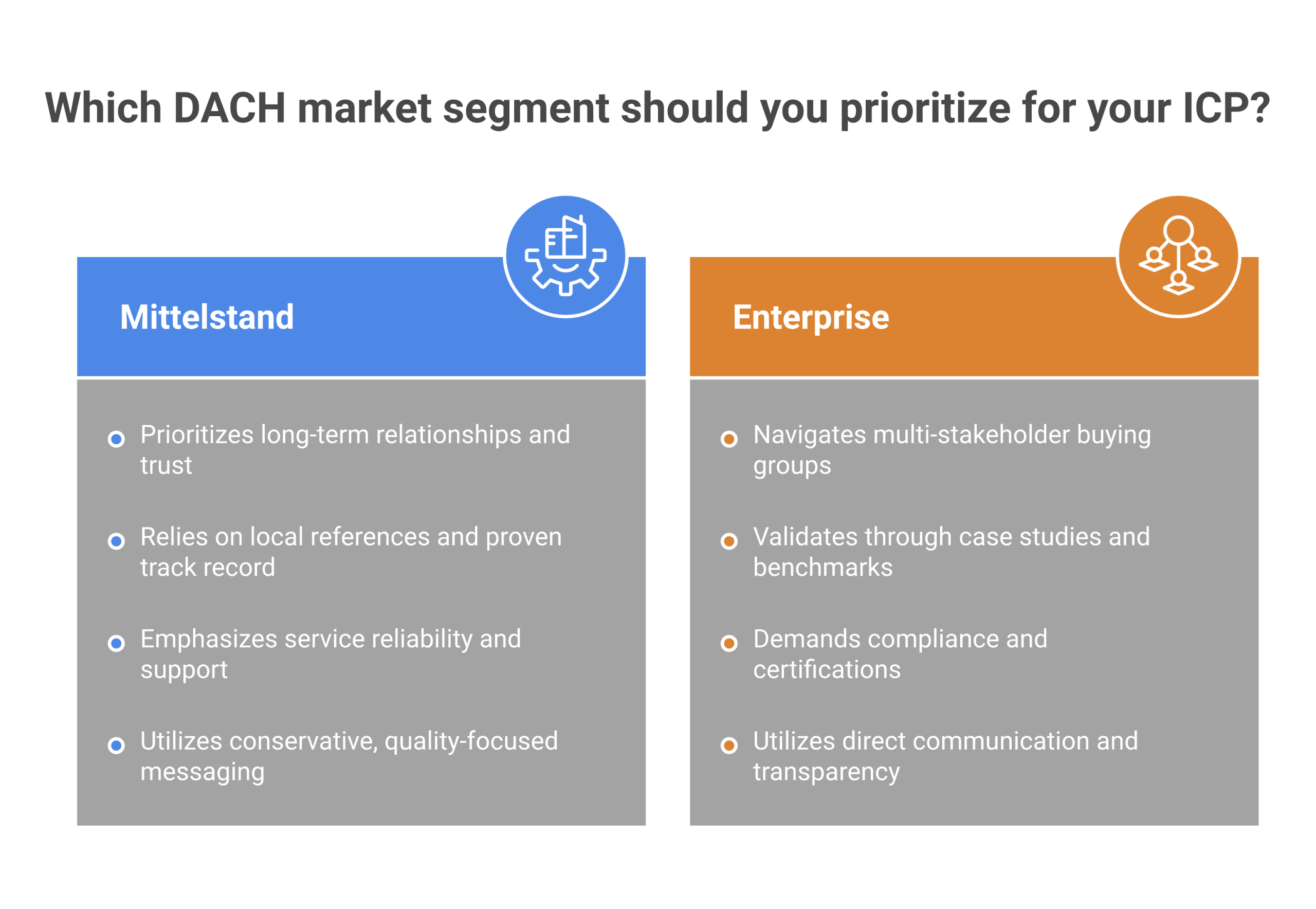
An illustrative scenario: A mechanical engineering software vendor defines its ICP as manufacturing companies in DACH with high product variety. It maps the stakeholders involved in each deal and interviews existing customers to develop reliable buyer personas. The aim is messaging that appeals equally to technical buyers, production managers, and the CFO.
Mapping the buying committee and understanding stakeholder logic
Every deal passes through several stakeholders with different priorities. Technical evaluators check features, procurement compares prices, the business unit wants fast implementation, the C-level demands proof of ROI. A complete GTM strategy addresses all four perspectives with specific content and messaging.
Many DACH B2B companies underestimate the role of compliance and data protection officers, especially in regulated industries. A healthcare software vendor must anchor GDPR, MDR, and ISO requirements in messaging and sales deck, otherwise the deal fails at the last gate.
| Role | Priority | Content format |
|---|---|---|
| Technical evaluators | Features, integration | Whitepapers, demos |
| Procurement | Price, contract terms | ROI calculators, case studies |
| Business unit | Time to value, support | Onboarding guides, webinars |
| C-level / CFO | Business impact, LTV | Executive summary, benchmarks |
| Compliance / legal | GDPR, ISO, risk | Certificates, security audits |
Positioning and value proposition: ROI-first instead of feature-first
A complete value proposition describes precisely which problem is solved and why the solution is superior. In 2026, B2B messaging must be authority-driven and ROI-focused. Abstract claims like “leading platform” or “innovative tool” convince nobody. Decision-makers want to know: What result do I reach, and in what time?
Before-and-after messages with an outcome focus
Practical recommendation for DACH B2B: formulate messages as a before-and-after scenario with a few core statements that change the customer’s day-to-day. An illustrative scenario: A logistics data analytics vendor words its core message not as “platform with hundreds of KPIs” but as a measurable result such as “reduce transport costs within twelve months”. It backs this with reliable DACH case studies plus an ROI calculator in the sales deck.
This approach makes positioning tangible. Instead of abstract promises, it delivers concrete figures that can be quoted in budget discussions. That can help champions build the business case internally and push the deal forward.
Differentiation through whitepapers, case studies, and ROI calculators
SaaS GTM frameworks recommend a crystal-clear value proposition that links differentiating product benefits to a clear business outcome story. That means: do not just explain what the product can do, show how it changes the target group’s day-to-day.
Typical formats in DACH B2B are:
- Whitepapers: Industry analyses, best-practice frameworks, benchmarks.
- Case studies: Customer stories with concrete figures on cost reduction, time savings, or revenue growth.
- ROI calculators: Interactive tools that calculate the business case individually.
- Battlecards: Internal sales documents showing how the solution is positioned against competitors.
These assets serve not only brand positioning but sales enablement. Sales uses them in pitches, champions use them internally, marketing distributes them through content channels.
GTM motions by deal size: from product-led to field sales
Quick Answer: The GTM motion follows deal economics. For small ACVs, product-led and inbound-driven approaches are usually the most efficient, for mid-size deals inside sales plus demand generation, for large deals account-based marketing with field sales. The wrong motion burns budget without scaling.
Choosing the GTM motion is not a matter of strategic taste but follows clear economic principles. DACH B2B commercial excellence means reaching customers at the right time, with the right offer and price, through the most effective channel.
Product-led and inbound for small ACVs
For small ACVs, product-led and inbound-driven GTM motions are usually the most efficient. That means: self-service, freemium or free trial, automated onboarding, digital conversion. Sales steps in only for expansion or upsell. This model scales through content, SEO, GEO, and performance marketing, not through human headcount.
An illustrative scenario: An HR tools SaaS vendor offers a free tier for small teams, automated onboarding by email sequence, and in-app guides. Only when a customer upgrades to an enterprise plan or buys many licenses does an account manager join. That keeps CAC low and allows fast scaling.
Inside sales and demand generation for mid-size deals
For mid-size deals, inside sales plus demand generation fits. Marketing generates qualified leads through webinars, whitepapers, and LinkedIn campaigns, SDRs qualify and book first calls, account executives close the deal by video call or on site. This motion combines human interaction with scalable campaigns.
An illustrative scenario: A cybersecurity vendor runs LinkedIn ABM campaigns for IT managers at mid-sized companies, invites them to monthly webinars, and has SDRs run follow-up calls.
Field sales and ABM for enterprise deals
Above that, account-based marketing with field sales takes over. That means: 1:1 or 1:few campaigns for defined target accounts, personal pitches, multi-stage decision processes, long sales cycles. This motion is justified only for high ACV and multi-year contracts.
An illustrative scenario: A cybersecurity vendor splits its GTM: for small add-ons it relies on product-led trials and inbound, for large bundles on ABM campaigns with field sales teams and strategic channel partners in the DACH region. That allows parallel scaling in both segments without motion conflict.
Takeaway: The GTM motion must fit the deal economics; the wrong motion leads to inefficient CAC and prevents scaling.
Channel strategy 2026: GEO, YouTube, and core-channel focus
In the bvik trend barometer 2026 (in German), 86% of about 280 respondents rate generative engine optimization as a must-have alongside classic SEO. That shows the shift from search engine rankings to answer engines and AI-assisted interfaces. Which further channel pays off depends on the ICP; we have no reliable DACH figure for YouTube ROI.
Core-channel dominance before multichannel expansion
Heinz Marketing advises deliberately pausing or narrowing one initiative, segment, or motion. Applied to channel choice, that means: dominate one core channel first before diversifying across several. In practice: do not launch LinkedIn, YouTube, SEO, events, and performance marketing at once, but begin with one or two channels, achieve measurable success there, and then expand.
A structured channel mix prevents resource sprawl. B2B companies often fail because they want to be present on too many channels without mastering any of them. The result: mediocre performance everywhere, no breakthrough anywhere.
Typical core-channel combinations in DACH B2B 2026:
- LinkedIn + GEO: For software, consulting, professional services.
- YouTube + SEO: For products that need explanation, complex solutions.
- Events + email: For traditional industry, mechanical engineering, manufacturing.
- SEA + webinars: For fast lead generation, inside sales motions.
An illustrative scenario: A B2B software vendor in the DACH Mittelstand starts with LinkedIn + YouTube as core channels, uses GEO-optimized video answers to frequent buying questions, and runs quarterly co-webinars with industry associations before expanding later into paid search and events.
Co-marketing and partner ecosystems as a reach lever
Co-marketing formats such as webinars, virtual events, and joint whitepapers are common GTM tactics with partners. They combine reach, credibility, and shared costs. An illustrative scenario: An IT service provider runs regular webinars with technology partners and generates leads this way without its own paid budget.
Partner ecosystems matter in the DACH market, where trust and recommendations play a large role in the buying process. An illustrative scenario: A data analytics vendor builds strategic partnerships with ERP integrators, management consultancies, and industry associations and uses their networks for market entry and customer acquisition.
Partner marketing and outbound as active growth levers
Partner marketing goes beyond joint webinars. It includes reseller programs, affiliate models, and co-selling with established vendors. In the DACH market, the channel model can pay off especially well. System integrators, ERP integrators, and industry associations hold existing customer relationships. Activating these networks can shorten trust building. The basis is a clear partner program with defined margins, onboarding, and shared sales targets. Without structure, partnerships stay non-binding and deliver no pipeline contribution.
Outbound remains a plannable demand channel in 2026 when it is set up cleanly. Cold email and LinkedIn outreach only work with a precise target audience and a relevant hook. Generic mass outreach is ignored and harms domain reputation. Successful DACH teams combine signal-based targeting with personalized sequences. Triggers such as new hires, funding rounds, or tech changes make outreach more relevant. The legal basis matters: B2B outbound in DACH is subject to the UWG and the GDPR. A documented legal basis must be clarified before every campaign. The two channels complement each other: partners deliver warm introductions, outbound opens new segments proactively.
Legal frame for DACH outbound: under Section 7(2) no. 2 UWG, email advertising requires the recipient’s prior express consent, B2B included. The exception in Section 7(3) covers existing customers under narrow conditions only. Advertising calls to businesses require at least presumed consent under Section 7(2) no. 1. For processing contact data, Art. 6(1)(f) GDPR (legitimate interests) is often the legal basis, together with the information duties under Art. 14 GDPR. This is not legal advice for individual cases.
An illustrative scenario: A SaaS vendor in the Mittelstand combines both levers deliberately. Sales partners regularly deliver referrals from the existing customer network. In parallel, a signal-based outbound sequence targets freshly funded scale-ups. The warm partner leads close faster, the cold outbound leads fill the upper pipeline. That keeps the forecast plannable even without a large paid budget.
A note from practice: this interplay of strategy and execution is exactly what we build at Jolly Marketer as a Revenue Engine. Positioning, ICP, outbound, inbound, lifecycle and CRM work together as one system. AI-driven personalization plus sales and marketing automation keep the pipeline predictable. For many B2B companies across the DACH region this is the foundation for steady, profitable growth. Teams that would rather not build it in-house can have the Revenue Engine set up turnkey.
Content, AI, and GEO: from SEO to answer engines
In 2026 the content strategy shifts fundamentally from classic SEO to generative engine optimization. In the bvik trend barometer 2026 (in German), 86% of about 280 respondents rate GEO a must-have for content creation and website optimization. That means: content must not only be optimized for Google rankings but also appear prominently in AI-assisted search interfaces, chatbots, and generative answers.
GEO-optimized answer pages and video content
GEO optimization demands structured, unambiguous answers to concrete buying questions. Instead of long blog posts with diffuse SEO keywords, successful DACH B2B companies build “answer pages” that answer one question clearly, compactly, and in a citable way. Such pages are easier for generative search engines to cite because they deliver usable information quickly.
An illustrative scenario: An industrial software vendor builds an AI-assisted content hub with GEO-optimized “answer pages”, YouTube explainer videos, and interactive ROI calculators that appear prominently in generative search interfaces and trigger personalized nurturing streams. Each page answers one concrete question such as “How do I reduce machine downtime?” or “Which metrics do I need for predictive maintenance?”.
AI-assisted personalization and loop marketing
Companies that go beyond AI experimentation and embed AI into measurable workflows increase output and business impact even with stagnating budgets, according to Evergreen Media. Evergreen also suggests making share of voice in chatbots and AI search engines a KPI along the buyer journey. “Loop marketing” is a useful complement, an approach to continuously reactivating audiences.
Loop marketing means: content, once created, is distributed across several channels, updated regularly, and adapted to different personas. A whitepaper becomes a LinkedIn carousel, a YouTube video, an email sequence, and a GEO-optimized landing page. That maximizes ROI per content asset and keeps audiences engaged over time.
Pipeline performance and measurability: GTM as a revenue discipline
In the Outcomes Rocket survey, 29.1% of surveyed B2B professionals report only limited confidence that their GTM initiatives translate into measurable business impact. That is a central problem: many companies start GTM programs without clear KPIs, without tracking infrastructure, without a feedback loop. The result is campaigns without measurable effect.
Benchmark KPIs: LTV:CAC, sales cycle, conversion rate
It is advisable to define CPL, conversion rate, sales cycle, and CAC as core KPIs for funnel steering from day 1. SaaS GTM strategies stress continuous tracking of CAC, LTV, and churn and regular iteration of GTM measures based on these metrics.
An illustrative scenario: An HR tech vendor defines clear target values for CPL, SQL rate, sales cycle, and LTV:CAC. It tracks them in a central RevOps dashboard and adjusts channel budgets and messaging experiments quarter by quarter based on data. That allows a fast response to performance changes and prevents wasted budget.
RevOps dashboards and cross-functional steering
The HBR Analytic Services survey of 522 B2B leaders shows the need: only 32% say the teams involved in executing the strategy are very aligned, and 43% name siloed data as a barrier to execution. Successful companies therefore treat GTM as an enterprise discipline with cross-functional steering. That means: marketing, sales, and customer success work with a shared dashboard, shared KPIs, and shared review meetings. Introducing RevOps ensures data flows cleanly, pipelines are transparent, and optimizations run in a coordinated way.
An illustrative scenario: A B2B IT service provider sets up monthly GTM reviews with marketing, sales, and customer success, uses a shared playbook, and makes sure new campaigns launch with sales pitches, battlecards, and relevant case studies. The aim is to reduce friction and raise conversion rates along the funnel.
Sales enablement and GTM alignment: playbooks, training, content
A key success factor of modern GTM approaches is sales enablement with tools, training, and content to close deals effectively. Many DACH B2B companies build excellent marketing campaigns but fail to equip sales with the right assets. The result: qualified leads fail in the pitch because sales cannot tell the story or address the right objections.
Playbooks and test scripts for consistent pitches
It is advisable to integrate sales into the GTM strategy from the start and to build playbooks, test scripts, and qualified first-call pitches. A playbook defines which questions are asked in which phase, how objections are handled, and which assets are used when. That standardizes the sales process and makes it scalable.
An illustrative scenario: A B2B software vendor builds a GTM playbook with three layers: discovery questions for first calls, demo scripts for technical evaluators, ROI presentations for C-level decision-makers. Each asset is tailored to a specific stakeholder role and updated regularly based on win-loss analyses.
Feedback loops between marketing, sales, and product
Effective GTM frameworks stress feedback loops between marketing, sales, and product teams, with clear responsibilities and regular review meetings. Sales reports back which objections come up most often, which features are missing, which messages work. Marketing adapts content and campaigns, product integrates frequently requested features into the roadmap.
An illustrative scenario: An IT service provider sets up monthly GTM reviews with marketing, sales, and customer success and uses a shared playbook. These reviews discuss win-loss analyses, evaluate conversion rates by channel, and plan new messaging experiments. That makes sure GTM is not a one-off project but is optimized continuously.
DACH-specific execution: markets, languages, compliance
The bvik trend barometer 2026 (in German) names budget pressure, AI disruption, volatile markets, and hybrid customer journeys as forces shaping B2B marketing. Among the trends it rates are GEO (86% of about 280 respondents call it a must-have) and trade shows and events with AI as a success factor. Breaking down silos between sales and marketing helps use these levers effectively.
Multilingualism and regional adaptation
DACH is not a homogeneous market. Germany, Austria, and Switzerland differ in language, culture, regulation, and buying behavior. Successful GTM strategies account for these differences from the start. An illustrative scenario: A mid-sized industrial supplier builds a multilingual (DE/EN) GTM strategy for DACH, combines regional trade fairs, German-language YouTube series, and GEO-optimized solution pages, and sets up a joint GTM team across marketing, sales, and service.
Swiss B2B companies often have to appear in several languages (DE/FR/IT). Local events, regional media, and DACH-specific compliance requirements must be reflected in the channel strategy. Callbox, a lead generation vendor, stresses in its guide to B2B lead generation in DACH that successfully selling in the DACH market takes much more than translating your English website into German, and recommends native German-speaking sales representatives. A guide from eCommerce Germany to online marketing in DACH sums up the principle this way: “Localisation + authenticity = trust”.
GDPR, data protection, and trust building
DACH B2B buyers place particular value on data protection, compliance, and long-term partnerships. Aggressive outreach campaigns meet rejection and are legally permissible only within narrow limits (see the section on outbound and the UWG above). Instead, successful DACH GTM strategies rely on content marketing, thought leadership, references, and co-marketing with established partners.
An illustrative scenario: A SaaS vendor for financial services builds its brand positioning on GDPR compliance, ISO 27001 certification, and transparent data processing. These trust signals are placed prominently across all channels and communicated as differentiators against US competitors.
Roadmap, experiments, and continuous iteration
GTM is not a one-off launch project but a continuous discipline. Modern GTM guides define a launch plan with timeline, roles, and milestones to ensure cross-functional coordination.
MVP campaigns and hypothesis tests before scaling
It is advisable to start with MVP campaigns and hypothesis tests instead of scaling immediately. That means: first formulate a few core hypotheses on ICP, message, and channel, test them at small scale, identify successful combinations, and then scale. GTM strategies should leave room for tests, experiments, and optimization from the start, including variation of offers along TOFU/MOFU/BOFU.
An illustrative scenario: A fintech defines a 12-month GTM roadmap for 2026 with three experiment waves (Q1 to Q3). In Q1 it tests three ICP segments with different messaging, in Q2 three channel combinations (LinkedIn + webinars, SEO + YouTube, events + email), in Q3 two pricing models. From Q4 it scales the most successful combinations based on clear KPIs such as CPL, SQL rate, and LTV:CAC.
Quarterly reviews and data-based iteration
Successful GTM strategies live on regular iteration. Quarterly reviews with marketing, sales, and customer success make sure performance data is turned into optimizations. Typical review agendas include:
- Funnel analysis: Where do leads drop off? Which channels deliver the best SQL quality?
- Win-loss analyses: Why do we win deals? Why do we lose them?
- Content performance: Which assets does sales use? Which not?
- Channel ROI: Which channels deliver the best LTV:CAC?
- Messaging tests: Which messages resonate? Which do not?
An illustrative scenario: An HR tech vendor runs quarterly GTM reviews, evaluates conversion rates by channel, and adjusts budgets based on data. If it finds that LinkedIn ABM delivers better SQL quality than SEA, it shifts part of the paid budget. This agility is crucial to stay competitive in dynamic markets.
Anyone who builds their 2026 GTM strategy on clear KPIs, cross-functional steering, and continuous iteration benefits from a structured B2B sales funnel that translates measurably into business impact. Organizations that keep treating GTM as a collection of activities risk being overtaken by data-driven competitors in the DACH market. Organizations entering DACH benefit from a free Revenue Operations workshop to review their GTM strategy thoroughly.
FAQ
What makes a successful B2B go-to-market strategy in DACH in 2026?
A successful GTM strategy in DACH B2B in 2026 rests on a clearly defined ICP, AI-first approaches, GEO-optimized content, and cross-functional collaboration between marketing, sales, and customer success. It integrates ROI-oriented metrics and uses data-based iteration for continuous optimization and sustainable revenue growth.
How does AI-first GTM differ from traditional GTM approaches?
AI-first GTM relies on data-driven automation, personalization, and AI-assisted decision models, while traditional approaches lean more on human experience and manual processes. This allows AI-first GTM more precise audience targeting, real-time measurement, and more efficient resource allocation along the entire funnel.
What is generative engine optimization (GEO) in B2B marketing?
Generative engine optimization optimizes content so that it appears prominently in generative search engines or AI answer systems. In the bvik trend barometer 2026 (in German), 86% of about 280 respondents rate GEO a must-have, in addition to classic SEO. The goal is more visibility, brand authority, and conversions.
How does YouTube ROI play out in DACH B2B in 2026?
We have no reliable figure for YouTube ROI in the DACH B2B market. Video content can support brand building, product demos, and sales enablement and, like any channel, counts only once it is measured against its own KPIs. More important than the channel choice is dominating one core channel before adding others.
How do you measure the success of a B2B GTM strategy?
Success criteria are KPIs such as CAC, LTV, conversion rate, and sales cycle. DACH B2B companies use RevOps dashboards to track these metrics continuously and derive data-based optimizations.
What distinguishes product-led from sales-led GTM motions?
Product-led GTM motions rely on self-service, free trials, and online conversions, ideal for smaller ACVs. Sales-led GTMs work with inside sales, ABM strategies, and personal contacts for complex deals. In 2026, successful B2B companies combine both models depending on deal size.
Sources
- bvik: B2B Trends 2026 (in German)
- Outcomes Rocket: The 2026 State of B2B Go-to-Market Strategy
- LeanData: HBR Research Reveals Execution Gap in B2B Go-to-Market Strategy
- Heinz Marketing: B2B GTM Strategy 2026, 7 Decisions to Finalize Before Year-End
- Evergreen Media: B2B Marketing Trends and Priorities 2025/2026
- Callbox: B2B Lead Generation Strategies in DACH Region
- eCommerce Germany: Time to rethink your online marketing in DACH?
- Gesetze im Internet: UWG, Section 7 (English)
- GDPR Art. 6
Once the strategy is set, you can have us build your Revenue Engine, with inbound, outbound and CRM in one system.