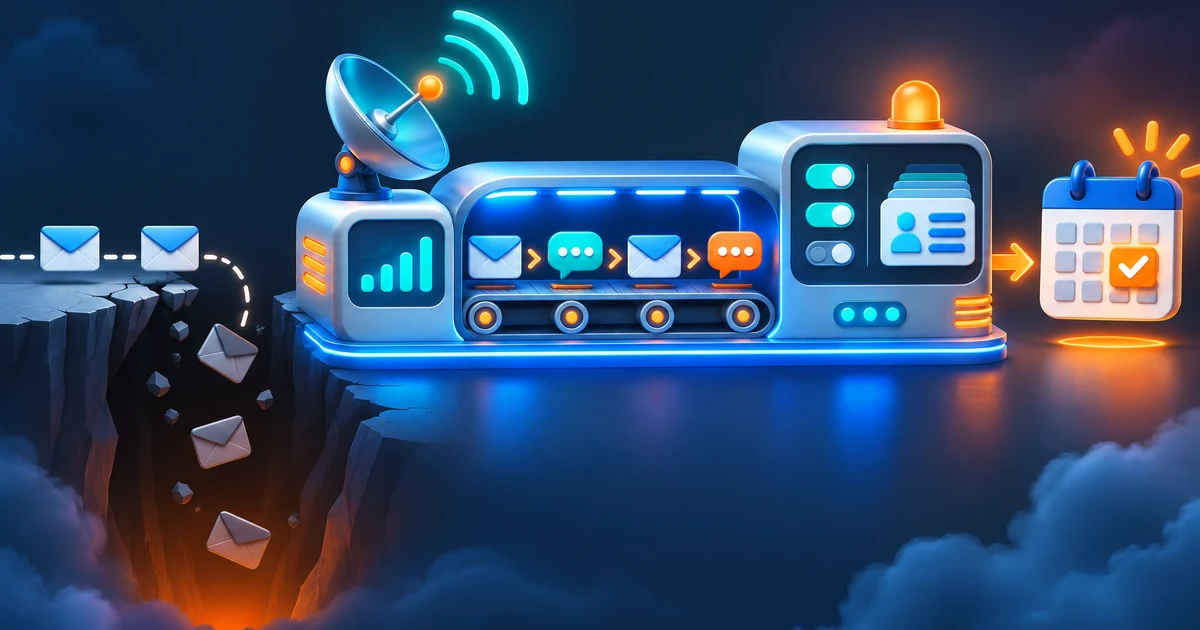
B2B lead nurturing is the planned follow-up of contacts between first interest and the buying decision. It makes sure a contact is not lost after the first reply. In B2B this path usually takes weeks or months, and several people have a say. A single email rarely carries a contact all the way to a meeting. Nurturing only holds up as a system: signals trigger the next touch, sequences deliver the content, CRM rules keep everything together. This guide shows how such a follow-up engine is built and how to measure it.
What is B2B lead nurturing?
B2B lead nurturing means guiding contacts with the right content at the right moment until they are ready to buy. It starts after the first contact and ends with a qualified conversation or a deliberate close.
Lead management is the wider frame. It covers capture, qualification, routing to sales and nurturing. Nurturing is the part in between: the contact knows the offer but is not buying yet.
| Lead management | Lead nurturing | |
|---|---|---|
| Scope | The whole path from first contact to handover to sales | The stretch between interest and readiness to buy |
| Core question | Who is the contact, and who owns it? | What does the contact need next? |
| Typical tools | CRM, lead scoring, routing rules | Sequences, expert content, signals |
B2B adds two specifics. First, one person rarely decides alone; a buying committee is usually involved. Second, demand often depends on an event: new budget, a change in management, a vendor who disappoints. Good nurturing keeps the contact warm until that event happens. In regulated industries this takes especially long. There, what counts most is being known already when the reason to switch arrives.
So much for the theory. In practice, nurturing rarely fails at the definition. It fails at one specific point in the process.
Why follow-ups stop after the second touch
Follow-ups usually stop because they depend on a person instead of a rule. After the second email there is no reason for a third touch, and nobody is responsible for it.

Cold outreach data shows the pattern clearly. For its report The State of Cold Email 2026, Smartlead analysed more than 850 million emails. They were sent in the first half of 2026. The typical campaign has three emails. A quarter of senders send two at most, a tenth send only one.
Yet the second email still brings noticeable replies. According to the report, a reply to the first email takes 85 contacts, to the second 137. From the fifth email on, the yield drops sharply. It then takes 270 contacts or more per reply.
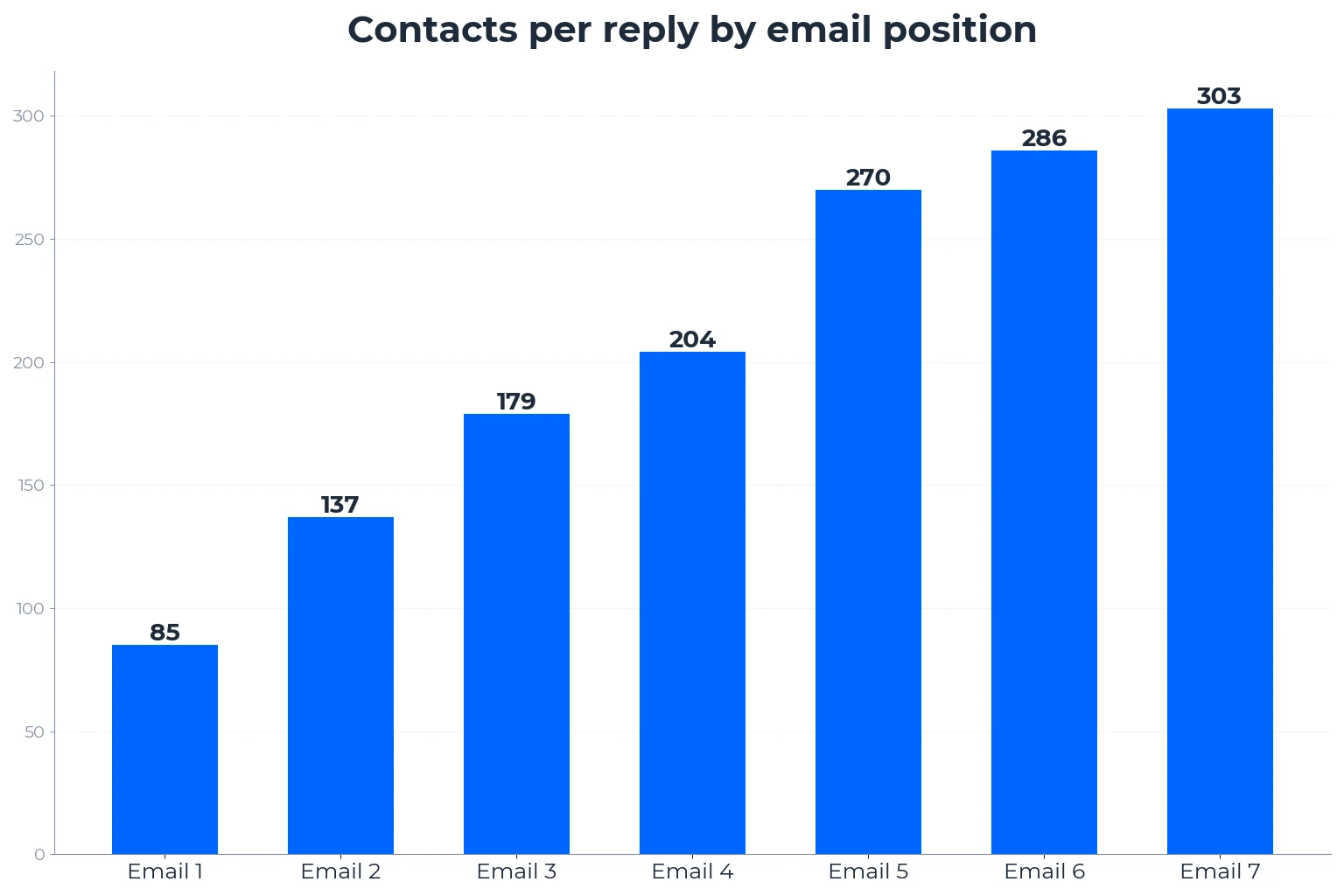
A second finding is less comfortable. Unsubscribes stay flat across all emails, at 0.02 to 0.05 percent. Recipients do not unsubscribe; they stop reading. That is why the damage done by poor follow-ups stays invisible.
The causes rarely lie in the wording. In Jolly Marketer client projects, three patterns come up again and again:
- The lead sits in the wrong tool. Positive replies stay in the outreach tool until someone books a demo. The CRM only learns about the contact afterwards.
- Nobody is responsible. Without an owner and without a task, the third touch depends on one salesperson’s memory.
- There is no reason. After “Just wanted to follow up”, the third email has nothing left to say. So it never gets sent.
A follow-up engine addresses exactly these three points. It replaces individual memory with rules.
The follow-up engine: signals, sequences, CRM rules
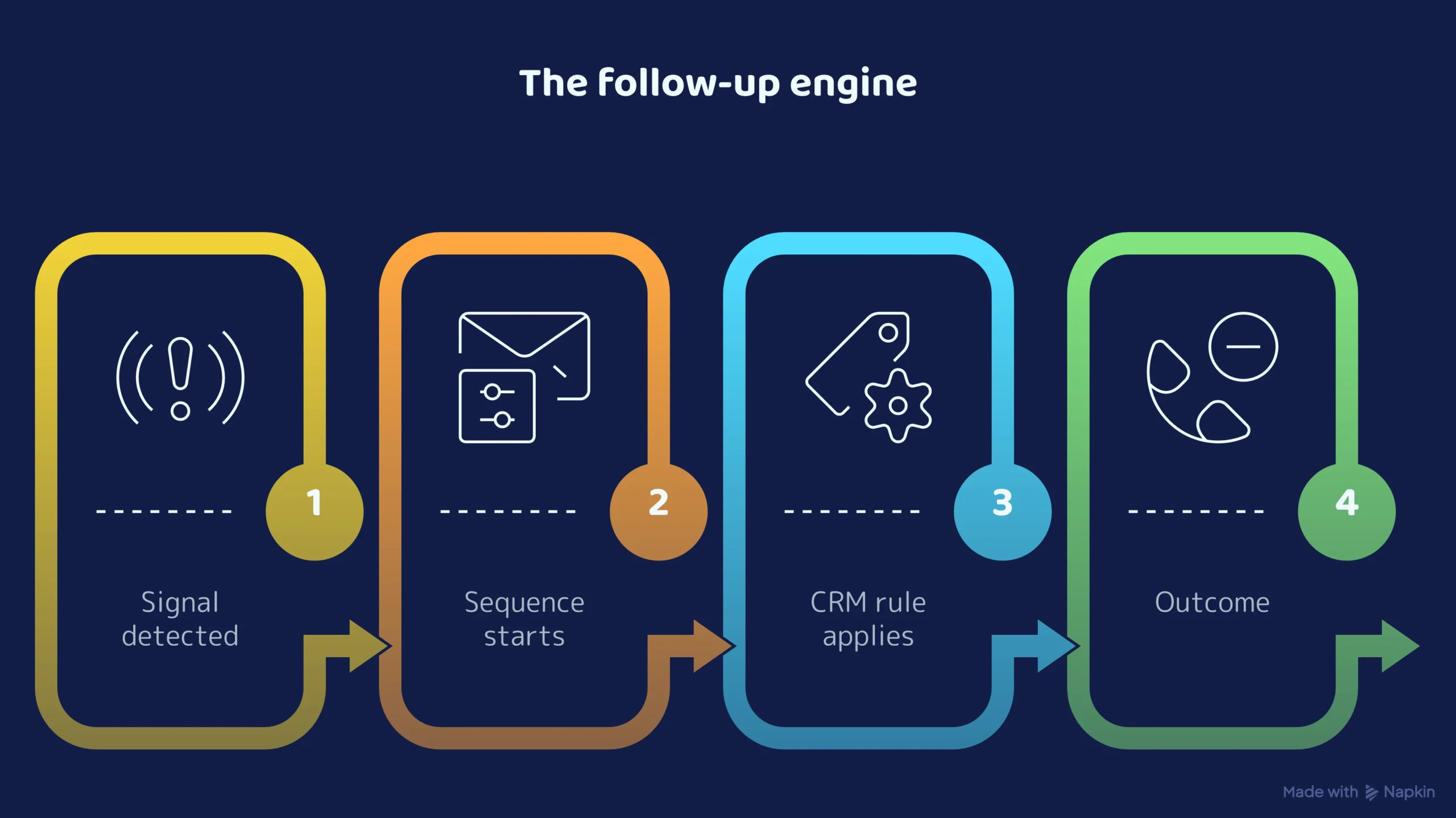
A follow-up engine has three building blocks. Signals decide when a contact gets the next step. Sequences define what they get. CRM rules make sure nobody is contacted twice, wrongly or not at all.
| Building block | Guiding question | Example |
|---|---|---|
| Signals | When does the next touch make sense? | Positive reply, job change, guide download |
| Sequences | What does the contact get? | Three cold emails, then useful content instead of chasing |
| CRM rules | Who may do what, and when does it end? | Status MQL, exclusion from cold campaigns, task for the owner |
Jolly Marketer builds this engine as the third part of the Revenue Engine, next to outbound and inbound. Outbound and inbound create contacts. The follow-up engine turns them into conversations.
Signals: what triggers the next touch
A signal is an observable event that shows interest or need. The basic rule: react to an event, never send a mass email to everyone.
- Positive reply plus ICP fit, meaning a match with the ideal customer profile. The contact becomes an MQL right away, a marketing qualified lead.
- New role or new company. A former contact changes position and often brings new budget.
- Guide download or a visit to the pricing page. The contact is actively researching.
- Lost deal with a fitting loss reason. “No budget this year” is a reason to come back next year.
- Trade fair contact. A business card from the booth is a buying signal that expires without follow-up.
Signals only work with a sharp ideal customer profile. A download by a student is not a buying signal. That is why the ICP fit check comes before any automation.
Sequences: what the contact gets
Cold outreach and nurturing need different sequences. In cold outreach, three emails are enough as a standard. The Smartlead numbers support this: up to the third email every step pays off, from the fifth on hardly any.
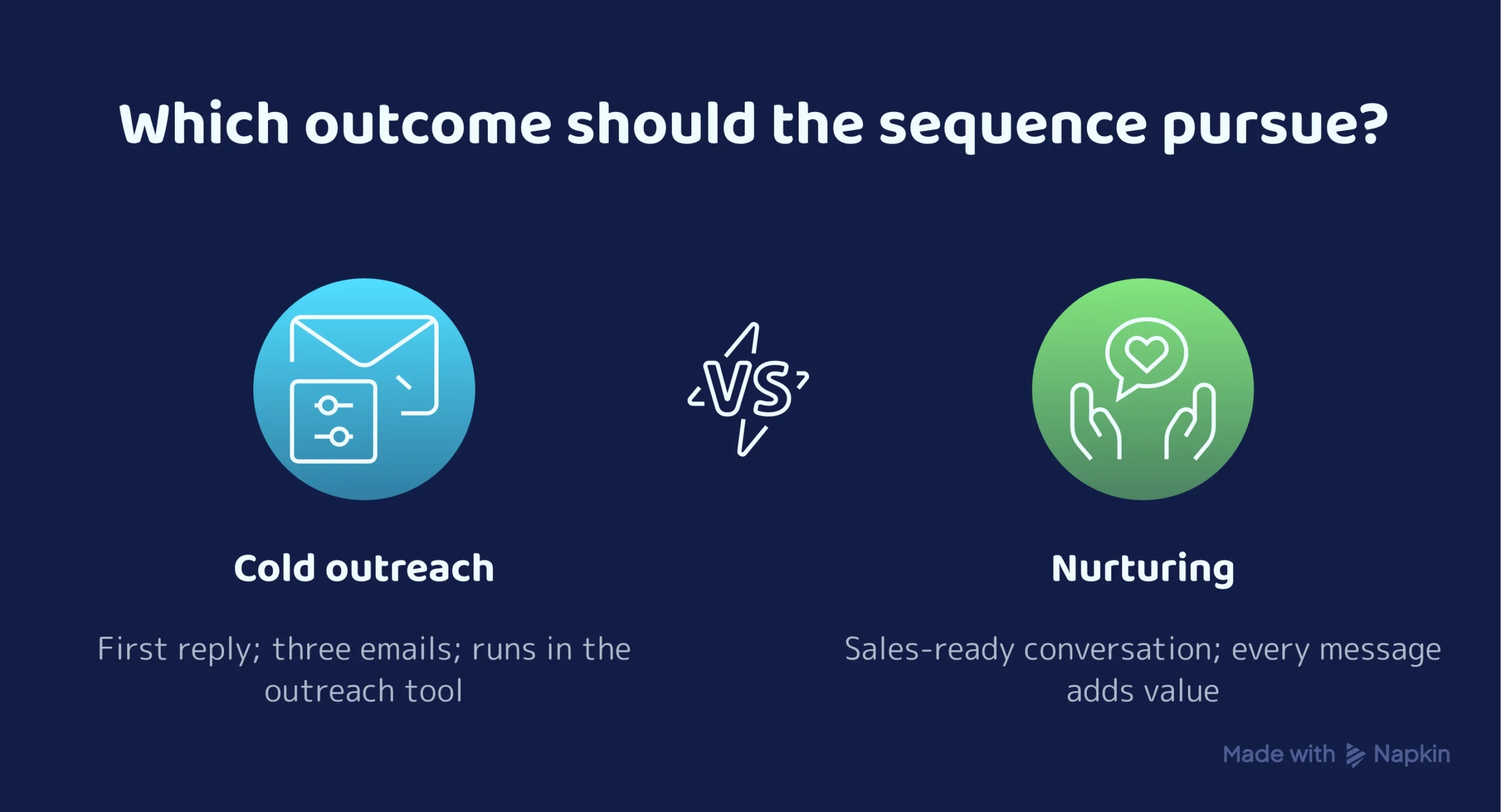
After a positive reply, the contact moves into a nurturing sequence. There, value counts instead of chasing. Every message delivers something concrete: an industry case study, a checklist, a comparison, a webinar invitation.
With long buying cycles, pressure does little. A learning track over months works better. Its building blocks are expert articles, a monthly newsletter and LinkedIn posts from management. The goal is to be known and trusted already when the reason to switch comes up.
Channel switches are part of it. After two emails without a response, a LinkedIn connection request or a call from the owner can follow. What matters is that all channels see the same status in the CRM.
CRM rules: what holds the system together
The CRM is the only place that knows the history and the loss reason. The outreach tool only knows the campaign. That is why nurturing belongs in the CRM, not in the cold outreach tool.
- Status logic: positive reply plus ICP fit equals MQL. SQL is only set after a qualified conversation.
- Exclusion: anyone who is an MQL never ends up in a new cold campaign.
- Loss reason as a filter: contacts from lost deals are selected by reason. A customer who was dropped as a client, for example, gets no reactivation.
- Existing customers out: they belong with account management, not in an acquisition track.
- Run marker: a property such as “Nurturing run 2” prevents anyone from getting the same track twice.
- End rule: every track has a defined end, such as a meeting, a no or a fixed number of steps.
These rules look unspectacular. They still decide whether a contact feels looked after or pestered. The HubSpot example shows what they look like in the tool.
Building the lead nurturing process with HubSpot workflows
In HubSpot, the lead nurturing process is built with workflows. A workflow starts at a trigger, branches on conditions and then sets properties, tasks or emails.
A typical first workflow for a positive reply has six steps:
- Trigger: the reply is marked as positive in the outreach tool. An integration syncs the contact to the CRM.
- Check: an if/then branch tests industry, company size and role against the ideal customer profile.
- Status: on a match, the workflow sets the lifecycle stage to MQL.
- Exclusion: the contact is added to a list that excludes all cold campaigns.
- Task: the responsible owner gets a task for the personal follow-up.
- Nurturing: in parallel, a sequence with expert content starts. It ends automatically once a meeting is booked.

A second workflow handles lost deals. It starts when a deal moves to “lost” and reads the loss reason. Depending on reason and industry, it picks its own track or deliberately none.
Three settings prevent the most common mishaps. Re-enrollment stays off unless it is deliberately wanted. Suppression lists keep customers and unsubscribes out. And every workflow gets a goal; once it is reached, the contact exits.
More on combining email, LinkedIn and phone is in the article on multichannel lead nurturing with HubSpot. Data model, status logic and handovers between marketing and sales are the job of a RevOps agency. Without this foundation, even good workflows go nowhere.
How to measure lead nurturing
Lead nurturing is measured by conversations and pipeline, not by open rates. What matters is how many nurtured contacts turn into qualified meetings and how fast that happens.
| Metric | What it shows |
|---|---|
| MQL to SQL rate | Whether the track creates sales-ready conversations |
| Time from first contact to meeting | Whether nurturing shortens the path |
| Reply quality per step | Whether a step triggers conversations or complaints |
| Pipeline from reactivated contacts | What lost deals and old contacts are still worth |
| Win rate with and without nurturing | Whether nurtured contacts buy more often |
Reply quality per step is the one most often overlooked. In a 2026 client campaign, all deletion requests came after the second email, none after the first. Four of seven replies to that email asked for the data to be deleted. The email was then removed. Looking only at the reply rate, nobody would have noticed.
Open rates are of little use for this assessment. They say nothing about whether a conversation happens. Unsubscribes help little too, because according to Smartlead they stay flat across all steps. Anyone measuring should therefore classify every reply: interest, rejection, out of office or complaint.
Common lead nurturing mistakes
Most mistakes happen at the handovers between tools and teams. A single email is rarely the cause.
- Nurturing in the cold outreach tool: prospects drift back into the next cold campaign and get the wrong tone.
- MQL only after the demo: anyone who replies positively and fits expires without status and without owner.
- Following up without content: “Just wanted to follow up” gives the recipient no reason to reply.
- Mass reactivation: emailing all lost deals at once ignores loss reason and timing.
- Existing customers on the list: a customer who receives an acquisition email starts to doubt the vendor’s care.
- Sequences that are too long: from the fifth email on, the yield drops sharply. The damage to the brand grows quietly.
- A fuzzy ideal customer profile: without a clear ICP, every signal becomes noise.
Each of these mistakes can be fixed with a rule in the CRM. That is the real advantage of a system. A mistake is fixed once, not again for every contact.
When outside support pays off
Outside support pays off when contacts come in but rarely turn into conversations. Then the connection between the channels is usually missing.
The follow-up engine is the third building block of the Jolly Marketer Revenue Engine. It connects outbound, inbound and CRM into one system. A lead generation agency should cover all three parts. Otherwise it only fills the top of the funnel.
Teams that first need more initial contacts start with a cold email agency for B2B. Teams that want to sort out strategy, positioning and sales system together are better served by a Fractional CMO. In both cases, without a follow-up engine a large share of the contacts won stays unused.
Sources
- Smartlead: The State of Cold Email 2026, analysis of more than 850 million emails, January to June 2026
- HubSpot Knowledge Base: Use lifecycle stages
- HubSpot Knowledge Base: Add re-enrollment triggers to a workflow
- HubSpot Knowledge Base: Use goals in contact-based workflows
- Jolly Marketer: experience from 2026 client projects, anonymised
