
Many companies face the same challenge today: revenue targets keep rising, marketing is becoming more complex, and budgets and resources remain limited. Founders, CEOs, and sales leaders know that “more marketing” is needed. But where should they start? And is investing in a senior marketing leader really worth it?
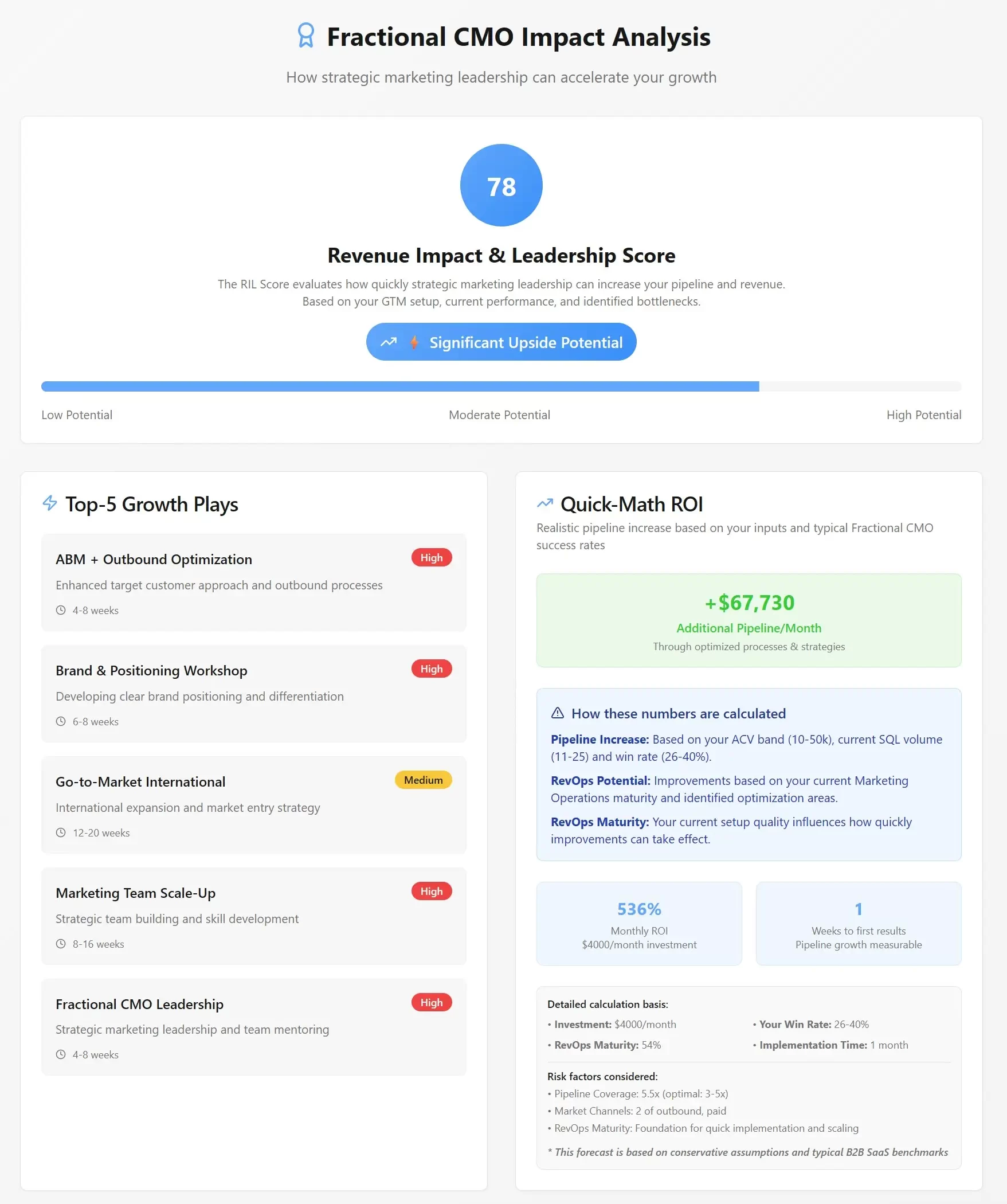
That’s exactly where our ROI Calculator for Fractional CMO engagements comes in, a tool that makes your growth potential, marketing ROI, and RevOps maturity visible in minutes.
Why an ROI Calculator?
Marketing teams measure a lot of things, but not always what truly matters: the direct impact on revenue growth, lead generation, and customer retention. Many decisions are based on gut feeling or vanity metrics like clicks and impressions.
An ROI calculator brings structure to this uncertainty. In just a few steps, it shows how mature your Revenue Operations (RevOps) really are and what kind of impact a Fractional Chief Marketing Officer (CMO) could have. The result: clarity on where you stand today, where the biggest levers are, and how you could improve marketing efficiency and return on investment.
→ More information: Fractional CMO – definition, responsibilites & cost.
The Dimensions at a Glance
The calculator walks you through eight core areas every B2B leader should understand:
- Strategy & Market Positioning
A clear marketing strategy, strong value proposition, and well-defined target audiences. - Demand & Growth
Effective lead generation, stable pipeline conversion rates, and plans for scaling into new markets. - Data & Infrastructure
Clean CRM data, a single source of truth across teams, and an integrated, GDPR-compliant tech stack. - Attribution & Reporting
ROI tracking per channel, multi-touch attribution, and KPI frameworks covering CAC, LTV, CLV. - Processes & Alignment
SLAs between marketing and sales, a shared sales funnel with forecasting, and real collaboration. - Automation & Enablement
Marketing automation, lead scoring, nurturing sequences, and sales enablement playbooks. - Content Generation
A consistent content engine, clear content strategy, performance measurement, and distribution. - Customer Lifecycle & Retention
Structured onboarding, churn tracking and reduction, plus systematic cross-sell and upsell.
At the end, you get a comprehensive score that highlights whether your organization is just getting started, on solid ground, or already operating at a best-in-class level.
What the Calculator Delivers
- Clarity: A fact-based snapshot instead of endless discussions.
- Prioritization: Clear visibility into which areas have the biggest ROI potential.
- Actionability: Within 5 to 10 minutes, you get a score and a starting point for a roadmap a Fractional CMO could execute.
An Illustrative Example
An illustrative example, not a real client case: a SaaS company with about 50 employees uses the calculator and scores 48% overall RevOps maturity. The values are assumptions chosen for illustration.
- CRM data: clean
- Attribution & reporting: missing
- Content strategy: underdeveloped
- Pipeline conversion: weak
The calculator reveals the gaps. Based on this, a Fractional CMO could design a 90-day roadmap that first builds attribution and reporting. The impact depends on execution; this example deliberately states no results in numbers.
Vibe Coding: the Gamechanger Behind It
Here’s another interesting part: the ROI calculator itself was built with Vibe Coding.
Vibe Coding, a term coined by Andrej Karpathy in February 2025, means building software by describing it in natural language while an AI model generates the code (Wikipedia). You get into flow quickly, experiment, and build faster than with traditional coding.
For us, it was the key to getting a functional, user-friendly tool live in no time, one that immediately delivers value. Put simply: without Vibe Coding, this ROI calculator wouldn’t exist in its current form.
Why a Fractional CMO is Worth It
This calculator is more than a nice-to-have tool. It shows the tangible impact a Fractional CMO can bring:
- Growth: More leads, better conversion, stronger pipeline.
- Efficiency: Less friction, more automation, cleaner data.
- Transparency: A single source of truth instead of siloed metrics.
- Strategic clarity: A clear market position that convinces customers and outpaces competitors.
For startups and mid-sized companies that aren’t ready to hire a full-time CMO, a Fractional CMO is often the perfect solution.
Conclusion: Your Personal Growth Check
If you’ve felt for a while that marketing and sales should work more seamlessly together, this calculator is for you.
In just a few minutes, you’ll see:
- Where you stand today
- Where you’re leaving growth potential on the table
- How a Fractional CMO could unlock that potential
Try the calculator here: https://www.jollymarketer.com/en/roi-rechner-for-fractional-cmo-engagements/
Frequently Asked Questions
What is a Fractional CMO and how does it differ from hiring a full-time Chief Marketing Officer?
A Fractional CMO is a senior marketing leader who works part-time or on a project basis. Unlike full-time CMOs, fractional arrangements offer flexibility and lower costs, making them ideal for startups and mid-sized companies that need strategic marketing expertise without the overhead of a permanent salary.
What are the eight core dimensions measured in a Fractional CMO ROI calculator?
The calculator evaluates: Strategy & Market Positioning, Demand & Growth, Data & Infrastructure, Attribution & Reporting, Processes & Alignment, Automation & Enablement, Content Generation, and Customer Lifecycle & Retention. Each dimension shows how mature your operations are and where growth potential lies.
How long does it take to complete the ROI calculator?
The calculator takes you through all relevant questions in just 5 to 10 minutes. At the end you receive an overall score that shows your marketing and sales maturity and identifies concrete areas for improvement.
What is Revenue Operations (RevOps) and why does it matter?
Revenue Operations (RevOps) aligns sales, marketing, customer success and sometimes finance to optimize revenue growth (according to DealHub). RevOps maturity describes how well processes, data and KPIs are aligned. Unlike clicks and impressions, it links marketing activities to business outcomes such as qualified leads, conversion rates and customer retention.
How does multi-touch attribution help with ROI measurement in B2B marketing?
Multi-touch attribution distributes conversion credit across all touchpoints in the customer journey, not just the last click. This shows which channels and content contribute to revenue and helps allocate the marketing budget. Google Analytics, for example, distinguishes data-driven attribution, which calculates the contribution of several interactions, from last-click models, which assign the value to a single interaction (Google Analytics Help).
→ More about the fractional CMO model in Germany.
Which KPIs should every B2B company use for ROI tracking?
Core B2B KPIs are CAC (customer acquisition cost), LTV (lifetime value), CLV (customer lifetime value), conversion rate per funnel stage and churn rate. These metrics connect marketing directly to business results and enable data-driven optimization.
What results can a company expect after working with a Fractional CMO?
Results depend on the starting point, on how well the strategist’s roadmap is implemented, and on organizational alignment around the priorities identified in the ROI assessment. No fixed figures can be promised, and the example above is illustrative, not a real client case.
How does data quality and CRM infrastructure impact marketing ROI?
Clean CRM data and integrated tech stacks enable accurate attribution tracking, multi-touch reporting, and predictive analytics. Poor data infrastructure creates silos, limits accountability, and wastes ad spend on ineffective channels. Strong data foundations allow precise CAC, LTV, and CLV calculations for informed budget allocation.
What is Vibe Coding and how does it speed up the development of marketing tools?
With Vibe Coding, you describe the software you want in natural language and an AI model generates the code (Wikipedia). It can shorten build time and speed up testing and iteration of functional tools, such as ROI calculators. The generated code should be reviewed.
How should companies prioritize improvements after receiving their RevOps maturity score?
Focus first on high-impact, low-effort improvements, typically in data infrastructure, attribution tracking, and sales-marketing alignment. These foundational areas unlock clarity on other gaps. Then tackle content strategy and automation, which compound benefits. A Fractional CMO typically designs 90-day roadmaps addressing these priorities sequentially.