

As of June 2026, go-to-market strategy in DACH centers on revenue predictability rather than lead volume. B2B organizations across Germany, Austria, and Switzerland now align marketing, sales, and customer success around shared pipeline quality metrics instead of siloed MQL targets. This guide shows how experienced GTM teams structure their DACH market entry tactics, build ICPs for Mittelstand and enterprise segments, and integrate digital marketing trends with cultural expectations to close the execution gap between strategy and performance.
TL;DR
High-performing B2B go-to-market strategy DACH teams run unified revenue operations with shared KPIs across marketing and sales, focusing on pipeline quality and predictability. Organizations entering Germany, Austria, and Switzerland succeed by localizing content in German, combining LinkedIn and XING outreach with trade-show presence, and adapting brand positioning to DACH buyers’ demand for proof, compliance, and long-term relationships.
– Revenue predictability and pipeline quality now rank as the top GTM outcomes for 2026, replacing raw lead-volume targets. – High-performing teams operating a single revenue engine with shared KPIs are 2.5 times more likely to succeed than siloed organizations. – German-language content outperforms English by 2-3 times in engagement and conversion across DACH markets.
Revenue Predictability Beats Lead Volume: The New DACH GTM Imperative
Quick Answer: B2B marketing leaders entering 2026 prioritize revenue predictability and pipeline quality over lead volume. High-performing DACH teams align marketing and sales around shared revenue metrics instead of MQL targets, closing the execution gap that affects most organizations.
Revenue predictability and pipeline quality now rank as the top GTM outcomes for 2026, marking a shift in how organizations approach customer acquisition strategies and market entry tactics in the DACH region. This evolution stems from a stark reality: 72% of B2B organizations report an execution gap between GTM strategy and in-market performance, driven primarily by siloed data and misaligned KPIs across teams.
The stakes are particularly high in DACH markets. B2B buyers typically involve 6-10 stakeholders in complex purchases, demanding orchestrated GTM across marketing, sales, and customer success. High-performing GTM teams are 2.5 times more likely to run a single revenue engine with shared KPIs than underperformers. Winners measure success on shared pipeline and net revenue retention targets rather than marketing-qualified leads alone.
Traditional GTM models split marketing and sales accountability. Marketing celebrates MQL targets while sales struggles with conversion quality. Modern revenue operations frameworks eliminate this divide by establishing shared definitions, unified funnel stages, and joint pipeline responsibility across both functions.
A DACH-focused SaaS vendor restructures its entire GTM around a single revenue operations function. The team standardizes funnel definitions across Germany, Austria, and Switzerland. Instead of marketing owning MQLs and sales owning opportunities, both functions share accountability for pipeline quality and net revenue retention. Weekly sync meetings focus on the healthiest opportunities moving through each stage, with agreed handoff criteria and mutual close plans replacing blame-driven retrospectives.
Execution Discipline Becomes the Differentiator
Strategy documents gather dust when teams lack the discipline to execute them. The execution gap stems from unclear ownership, inconsistent data, and conflicting incentives between marketing and sales. Organizations closing this gap invest in RevOps infrastructure, shared dashboards, and joint planning cycles that force alignment before campaigns launch.
Revenue growth strategies now emphasize fewer initiatives with deeper execution. Top performers pause or narrow at least one motion to free capacity for higher-impact plays. DACH expansion teams that try to run simultaneous LinkedIn campaigns, trade shows, webinars, and content programs without sufficient resources see diluted results across all channels. Selecting 2-3 primary channels and going deep outperforms spreading thin.
Understanding DACH Market Structure: Where Growth Lives and How Buyers Think
Quick Answer: Germany dominates DACH B2B IT spend at roughly 70%, shaping where most GTM investment flows. Buyers across Germany, Austria, and Switzerland demand local-language content, higher proof, and compliance assurances, with German-language assets outperforming English by 2-3 times in engagement and conversion.
Germany accounts for approximately 70% of DACH B2B IT spend, with Switzerland and Austria contributing the remaining 30%. This distribution shapes where GTM investment should flow and which regional offices deserve priority. Yet market entry tactics must account for profound behavioral differences beyond simple budget allocation.
DACH B2B buyers show a strong preference for local-language content, with German-language assets outperforming English by 2-3 times in engagement and conversion metrics. The platform strategy reveals nuanced requirements. LinkedIn dominates international-facing and tech verticals, offering global reach and precise targeting. XING maintains strong penetration among German-speaking professional segments, particularly in traditional industries. Both platforms prove critical for comprehensive DACH reach.
Regional Buying Behavior and Cultural Nuance
DACH buyers demand higher proof and references than most European markets. They favor local case studies, compliance certifications, and evidence of regional success before committing to vendor relationships. German business culture values professionalism, punctuality, and thoroughness, with buyers demonstrating healthy skepticism toward marketing hype.
Austrian buyers particularly emphasize personal connections and in-person meetings. Switzerland prioritizes trust, reliability, and demonstrated track records. These cultural nuances directly impact customer acquisition strategies and brand positioning. A cybersecurity vendor entering DACH focuses initial resources on Germany’s manufacturing and automotive clusters. The team rolls out German-language case studies featuring early lighthouse customers from recognizable German brands. They launch targeted campaigns on both XING for traditional OT security leaders and LinkedIn for IT security buyers, scheduling in-person roundtables in Stuttgart and Munich before expecting meaningful pipeline development.
Platform Selection and Digital Marketing Trends
Platform decisions hinge on ICP location and industry vertical. Technology companies targeting international buyers concentrate LinkedIn investment. Industrial firms selling to German-speaking Mittelstand add XING to capture decision-makers who maintain regional professional networks. Combining both platforms ensures comprehensive coverage across buyer segments.
Localized SEO with German-language thought leadership forms the third pillar. Prospects researching solutions in German expect content addressing regional compliance frameworks, local references, and DACH-specific implementation approaches. Brands publishing only English content miss organic discovery opportunities and signal insufficient regional commitment to cautious DACH buyers.
Building Your DACH ICP: Mittelstand, Enterprise, and the Buying-Group Reality
Quick Answer: Market segmentation in DACH requires precision beyond firmographics. Leading GTM teams use ICP decision grids to categorize segments and define buying-group coverage as a qualification criterion, adapting positioning to DACH cultural norms for higher win rates.
Market segmentation in DACH requires precision beyond traditional firmographic filters. Leading GTM teams use ICP decision grids to categorize segments into priority, deprioritized, and “not yet” buckets. Sales and marketing review these grids quarterly to eliminate random prospecting and focus resources on winnable accounts.
High-performers define buying-group coverage as a core qualification criterion. Rather than relying only on budget, authority, need, and timing frameworks, teams specify required roles and engagement sequences. A qualified opportunity in manufacturing might demand Plant Manager, CFO, and IT Director engagement before advancing to proposal stage. Without all three roles active, the deal remains unqualified regardless of expressed interest.
| Segment | Key Characteristics | Primary Decision Drivers | Engagement Model |
|---|---|---|---|
| German Mittelstand | 500-2,000 employees, family-owned, EUR 50M-500M revenue | Long-term ROI, service reliability, local references | Relationship-first, trade shows, XING, phone outreach |
| Swiss Financial Services | Regional banks, insurance, fintech infrastructure | Risk management, compliance, data residency | Multi-stakeholder, in-person, regulatory proof |
| Austrian Manufacturing | Industrial SMEs, 200-1,000 employees, export-focused | Quality, tradition, personal trust | Local presence, partner introductions, events |
| German Enterprise Tech | DAX/MDAX companies, 5,000+ employees, digital transformation | Innovation, scalability, vendor stability | ABM, LinkedIn, executive engagement, proof-of-concept |
Mittelstand: The DACH Revenue Engine Core
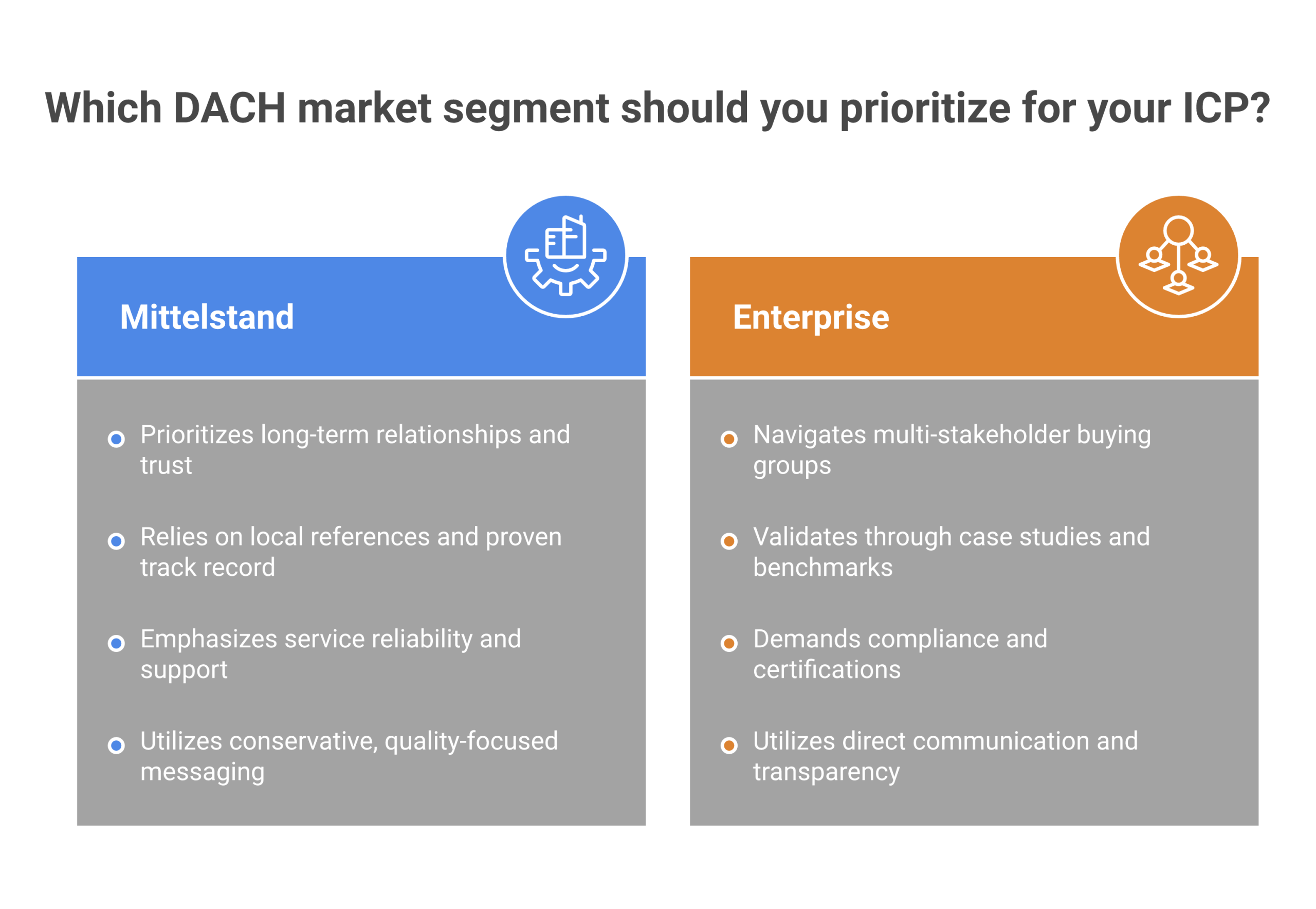
The DACH Mittelstand represents mid-sized, often family-owned companies placing outsized importance on long-term relationships, service reliability, and proven references over product novelty or aggressive growth promises. These organizations control significant purchasing power but resist aggressive sales tactics and unproven vendors.
B2B sales strategy for Mittelstand demands patience and proof. A data analytics provider builds separate ICPs for German industrial Mittelstand versus Swiss financial institutions. The Mittelstand ICP specifies Plant Manager, CFO, and IT Director as the core buying group, with proof points emphasizing production efficiency and long-term ROI. The Swiss financial ICP targets Risk Officer, CTO, and Compliance Lead, with positioning shifted from “move fast and break things” to “risk-managed efficiency and audit-proof insights,” complete with documentation on data residency and financial regulatory alignment.
Brand Positioning and Competitive Landscape Assessment
B2B brands adapting their positioning to DACH cultural norms achieve significantly higher win rates than those deploying only global messaging. Direct communication, conservative claims, and emphasis on quality and compliance resonate with DACH buyers skeptical of marketing hype. Sustainability metrics, transparent terms, and measurable claims replace vague promises and aspirational language.
Small and medium businesses across DACH expect vendors to demonstrate regional understanding. A logistics tech firm deploys German-language webinar series on supply chain resilience for Germany and Austria, while creating separate French-language content for Swiss Romandy. Each features region-specific case studies and regulatory nuances, signaling the vendor’s commitment to local market knowledge rather than generic European approaches.
Channel Strategy and Phygital Integration: Where DACH Buyers Actually Engage
The most effective modern GTM motions select 2-3 primary channels where the ICP is most reachable and invest deeply rather than spreading resources thin. In DACH, phygital strategies blending digital journeys with physical touchpoints and events emerge as a defining trend for 2026, especially in complex B2B categories.
Phygital strategies combine the efficiency and reach of digital channels with the relationship depth of in-person engagement. Local trade shows and industry events remain central to DACH lead generation, providing trust-building opportunities difficult to replicate purely online. Hannover Messe, SWISS-IT, and industry-specific conferences deliver concentrated access to decision-makers expecting face-to-face vendor engagement.
Digital Pillar: LinkedIn, XING, and Localized SEO
Digital marketing trends point to a three-pillar approach for DACH. First, localized SEO with German-language thought leadership targets organic discovery. Prospects researching “Industrie 4.0,” manufacturing digitalization, or compliance frameworks in German expect vendor content addressing regional concerns with local references and proof points.
Second, targeted outbound on LinkedIn and XING reaches decision-makers where they consume professional content. LinkedIn campaigns target international manufacturers and tech-forward enterprises. XING campaigns focus on traditional Mittelstand and German-speaking professional segments less active on LinkedIn. Messages reference German-language content and regional case studies rather than generic global value propositions.
Physical Pillar: Trade Shows, Roundtables, and Community Building
Events and communities are resurging as primary B2B growth engines. Brands designing strong buyer environments gain structural advantage in customer acquisition strategies. A cloud infrastructure company structures its DACH GTM around three synchronized pillars. They build a German-language SEO hub on industrial cloud migration, targeting “Industrie 4.0” and manufacturing keywords.
They run account-based outbound sequences on LinkedIn for international manufacturers and XING for traditional Mittelstand, with messages referencing the SEO content. They sponsor and present at Hannover Messe and SWISS-IT with the same messaging framework, capturing leads into a unified CRM flow that references the event conversation in follow-up sequences. Prospects moving through digital touchpoints receive invitations to in-person roundtables, creating phygital journeys that honor DACH buyers’ preference for relationship-based vendor selection.
Takeaway: Channel selection in DACH requires aligning digital efficiency with physical relationship depth, not choosing one over the other.
Data Quality, Compliance, and the Trust Foundation: Operating in GDPR-First DACH
The shift from lead volume to data quality at scale defines 2026 GTM priorities. Organizations now prioritize clean, consented data over raw MQL counts, recognizing that pipeline efficiency depends on information integrity. DACH marketers must implement transparent data layers and minimal-question forms, clearly explaining data usage to align with heightened privacy expectations and strict regulatory frameworks.
Robust consent management is non-negotiable. Teams obtain explicit permissions, respect user choices, and tailor email flows and offers based on allowed data. CRM, marketing automation, and analytics tools form the core technology stack for organizing leads, tracking interactions, and measuring ROI in a compliant manner. DACH buyers expect clear local compliance assurances, including data hosting locality, certifications, and alignment with EU and national regulations as standard components of late-stage GTM content and sales processes.
Value Exchange Replaces Aggressive Gating
Competitive landscape assessment shows that revenue growth strategies now emphasize value exchange for data. Useful tools, deep content, or community access replace aggressive gating or generic lead capture. Prospects voluntarily share information when they receive immediate, tangible value in return.
A martech vendor rebuilding its DACH GTM replaces 15 gated content pieces with five high-value, ungated guides on marketing compliance and efficiency. They add a single high-value tool, a German-language marketing audit calculator, behind explicit consent with clear data-use explanation. Using intent data from website behavior and CRM integration, they identify which accounts are researching specific topics and trigger targeted, lower-volume but higher-conversion sequences. The result: 40% fewer “leads” but 3 times higher opportunity conversion rate.
Intent Data and Behavioral Signals
Intent data combines firmographic filters with website behavioral signals, enabling teams to identify in-region accounts showing active buying signals and prioritize outreach without compromising compliance. Tracking page views, content downloads, pricing page visits, and repeat sessions reveals which prospects are in active evaluation mode versus casual research.
A fintech infrastructure player targeting German and Swiss banks uses firmographic and intent tools to identify in-market accounts. They offer German-language regulatory checklists and invite-only CFO and CTO roundtables as the value exchange. Multi-touch sequences highlight EU, BaFin, and FINMA-aligned compliance and regional data centers, addressing Swiss and German buyers’ regulatory concerns before sales conversations begin.
Localized Content, Language, and Cultural Authenticity
“Localisation + authenticity = trust” serves as the core principle for DACH digital marketing. German-language storytelling, cultural references, and local voices materially improve performance. High-quality localized content including blogs, white papers, and webinars in German attracts ideal prospects organically and establishes thought leadership.
German-speaking audiences expect directness, clarity, and detail. Transparent terms, measurable claims, and visible proof points like local case studies and sustainability metrics replace vague marketing language. DACH buyers value substance over style, rewarding vendors who demonstrate regional knowledge and cultural respect through content choices.
Multilingual Nuance Within DACH
Switzerland’s multilingual environment demands tailored content strategies by language region rather than a single German-only approach. Swiss Romandy expects French-language content. Ticino requires Italian. Treating Switzerland as monolingual German risks alienating significant buyer segments and signals insufficient market understanding.
Austrian B2B buyers respond particularly well to content emphasizing tradition, quality, and personal business relationships. German buyers prioritize efficiency, engineering excellence, and process optimization. Swiss buyers value discretion, reliability, and risk mitigation. Content strategies acknowledging these nuances outperform generic DACH approaches treating Germany, Austria, and Switzerland as interchangeable markets.
Platform-Specific Content Adaptation
LinkedIn content for DACH audiences requires localization beyond translation. German-language posts perform better than English, but tone and style matter equally. Direct, factual communication without hyperbole resonates. Case studies featuring recognizable German, Austrian, or Swiss brands build credibility faster than global references.
XING audiences expect professional yet approachable content rooted in regional business culture. Thought leadership addressing German regulatory frameworks, Mittelstand challenges, or DACH market trends performs well. Sharing insights from German industry events or referencing local business news signals regional engagement and cultural fluency.
Building Your DACH GTM Operating Model: AI, Buyer Enablement, and Continuous Iteration
A strong B2B sales strategy can be built in 4-8 weeks using a structured process: research, ICP definition, value proposition, channel and pricing decisions, team enablement, launch, and iteration. Modern frameworks emphasize six core GTM steps: define TAM, segment, position versus competitors, craft messaging, design acquisition and expansion motions, and continuously collect and act on performance data.
High-performing GTM teams identify and remediate their two weakest pipeline stages, measured by longest time-in-stage or highest drop-off, as a priority optimization lever. Top performers focus on fewer initiatives with explicit “stop” decisions, pausing or narrowing at least one motion to free capacity for higher-impact plays. This discipline becomes critical when entering new markets like DACH, where resource efficiency determines success.
AI Integration and Buyer Journey Optimization
B2B companies moving beyond AI experimentation and embedding AI into measurable workflows gain higher output at flat budgets. Content generation, lead routing, and opportunity scoring benefit from AI automation when properly implemented. Buyer journeys increasingly flow through chatbots and AI search engines, requiring brands to increase their “Share of Voice” in AI environments.
Modern market entry tactics recommend mapping target audiences’ journeys as prompts, then closing content gaps so AI systems can easily extract accurate, structured answers about solutions. A DACH-focused HR tech provider structures its German knowledge base, blog, and product documentation to be easily consumed by AI search. FAQ-style content aligned with common prompts from HR leaders ensures visibility when prospects ask ChatGPT or Perplexity for vendor comparisons. Sales receives AI-assisted insight packs before every buying-group meeting, arming them with relevant context and conversation starters.
Marketing as Buyer Enablement
Marketing’s role evolves toward buyer enablement, synchronizing with sales to provide assets and context that make purchasing easier in hybrid self-service plus sales-assisted journeys. For DACH markets specifically, the most effective outbound sequences mix local-language email, XING and LinkedIn touchpoints, and phone outreach with cultural sensitivity and clear value communication.
A DACH expansion team runs a 60-day GTM sprint. Week 1-2: They define a tight ICP around German manufacturing companies with 500-2,000 employees, EUR 50M-plus revenue, and active digitalization initiatives. Week 3-4: They select two channels, industry events targeting three specific 2026 trade shows and LinkedIn ABM, and pause a planned webinar series to focus resources. Week 5-6: They set a single shared KPI: “qualified DACH pipeline” defined as opportunities with three buying-group members engaged and mutual close plan.
Pipeline Stage Optimization and Continuous Improvement
Week 7-8: Pipeline analysis reveals “proposal to close” as the main leak, with average 87 days and 35% drop-off. They design new proof-of-concept and reference playbooks specifically for that stage, featuring German-language ROI calculators, recorded customer testimonials from similar manufacturers, and a rapid-implementation guarantee. The team structures knowledge base content to answer common AI search queries about their category, ensuring visibility when prospects ask for vendor comparisons.
By day 60, they have a running system with clear metrics, identified bottlenecks, and a 90-day optimization roadmap focused on the two weakest stages. This operating model prioritizes execution discipline and continuous iteration over elaborate planning documents. Teams review pipeline velocity, stage conversion rates, and win/loss patterns weekly, adjusting messaging, outreach cadence, and qualification criteria based on real market feedback rather than assumptions.
Organizations entering DACH benefit from a free Revenue Operations workshop to align their GTM strategy with regional best practices and avoid common execution pitfalls.
A note from practice: this interplay of strategy and execution is exactly what we build at Jolly Marketer as a Revenue Engine. Positioning, ICP, outbound, inbound, lifecycle and CRM work together as one system. AI-driven personalization plus sales and marketing automation keep the pipeline predictable. For many B2B companies across the DACH region this is the foundation for steady, profitable growth. Teams that would rather not build it in-house can have the Revenue Engine set up turnkey.
FAQ
What makes a DACH B2B go-to-market strategy unique?
The DACH region emphasizes trust, proof, and compliance. Buyers prefer local-language content, verified case studies, and strong in-person relationships. Companies succeed by aligning marketing and sales through shared KPIs and localized execution across Germany, Austria, and Switzerland, focusing on quality interactions instead of volume-driven approaches.
How is GTM strategy in DACH different from other European markets?
DACH markets tend to be conservative and detail-oriented, valuing documentation and references. Unlike some European regions that accept English-first materials, DACH buyers expect localized content and compliance assurances. Building credibility through regional proof points and German-language communication is key for winning enterprise trust and long-term partnerships.
What are the top GTM priorities for 2026 in DACH?
For 2026, marketers in DACH prioritize revenue predictability, pipeline quality, and cross-team alignment. Instead of chasing lead volume, successful firms unify marketing and sales metrics using shared revenue goals. Execution discipline and integrated RevOps models help reduce misalignment and close the strategy-to-performance gap.
Why is localized German content more effective than English campaigns?
German-language content performs two to three times better in engagement and conversion. It signals cultural respect, supports comprehension among non-fluent English buyers, and reflects professionalism valued in DACH markets. Localization also helps marketing teams meet compliance expectations and resonate with region-specific buyer motivations.
Which performs better for B2B in DACH: LinkedIn or XING?
LinkedIn dominates internationally and for technology sectors, offering global reach and targeting precision. XING, however, remains vital for German-speaking audiences in traditional industries. Combining both ensures comprehensive coverage: LinkedIn amplifies brand visibility beyond borders, while XING reinforces local credibility and relationship-based buyer engagement.
How does a unified revenue model compare to siloed GTM teams?
Unified revenue models align sales, marketing, and customer success around shared KPIs, improving forecast accuracy and pipeline quality. Siloed teams often duplicate efforts and misinterpret metrics. In DACH organizations, integrated RevOps systems help eliminate execution gaps and support consistent customer experiences across all deal stages.
Sources
- Outcomes Rocket – The 2026 State of B2B Go-to-Market (GTM) Strategy
- LeanData – HBR Research Reveals Execution Gap in B2B Go-to-Market Strategy
- Convertr – 6 B2B Marketing and Revenue Trends for 2026
- Callbox – B2B Lead Generation Strategies in DACH Region
- Heinz Marketing – B2B GTM Strategy 2026: 7 Decisions to Finalize Before Year-End
- eCommerce Germany – Time to rethink your online marketing in DACH? 9 trends for 2026
- Evergreen Media – B2B Marketing Trends & Priorities 2025/2026
Once the strategy is set, you can have us build your Revenue Engine, with inbound, outbound and CRM in one system.