

At What ARR Should a DACH SaaS Hire Its First GTM Engineer Instead of a Second SDR?
As of April 2026, more than half of the fastest-growing private B2B software companies already employ at least one GTM engineer. The DACH region’s intense competitive pressure and sophisticated buyer expectations make this decision especially acute. This post explains when a DACH SaaS should hire its first GTM engineer instead of adding a second sales development representative, the preconditions that must be in place, and how to measure success.TL;DR
A DACH B2B SaaS company should strongly consider hiring its first GTM engineer instead of a second SDR when approaching 1.8–2.5 million euros in ARR, provided it has a repeatable sales motion, at least one functioning SDR-AE pairing, and clear signs that bottlenecks are systems-driven rather than top-of-funnel constrained. Below this threshold, marginal pipeline is usually the limiting factor. Beyond it, the compounding impact of automation and sales efficiency means a GTM engineer can unlock more incremental ARR per euro of cost. – DACH SaaS market: now the world’s second-largest SaaS market by revenue, attracting approximately five billion euros in investment in recent first-half periods. – Revenue per employee: median for private SaaS companies reached 129,724 dollars in 2025, with the most efficient private B2B SaaS startups achieving 250,000 dollars or more per employee. – Hiring shift: entry-level tech positions saw a 73 percent decrease in hiring rates, while AI and machine learning roles grew 88 percent year-over-year in 2025.The €1.8–2.5M ARR Decision Point for DACH SaaS Companies
Quick Answer: DACH SaaS companies approaching 1.8–2.5 million euros in ARR with a repeatable sales motion should consider their first GTM engineer instead of a second SDR, provided funnel bottlenecks are systems-driven rather than purely top-of-funnel constrained. Below this ARR threshold, marginal pipeline is typically the limiting factor.
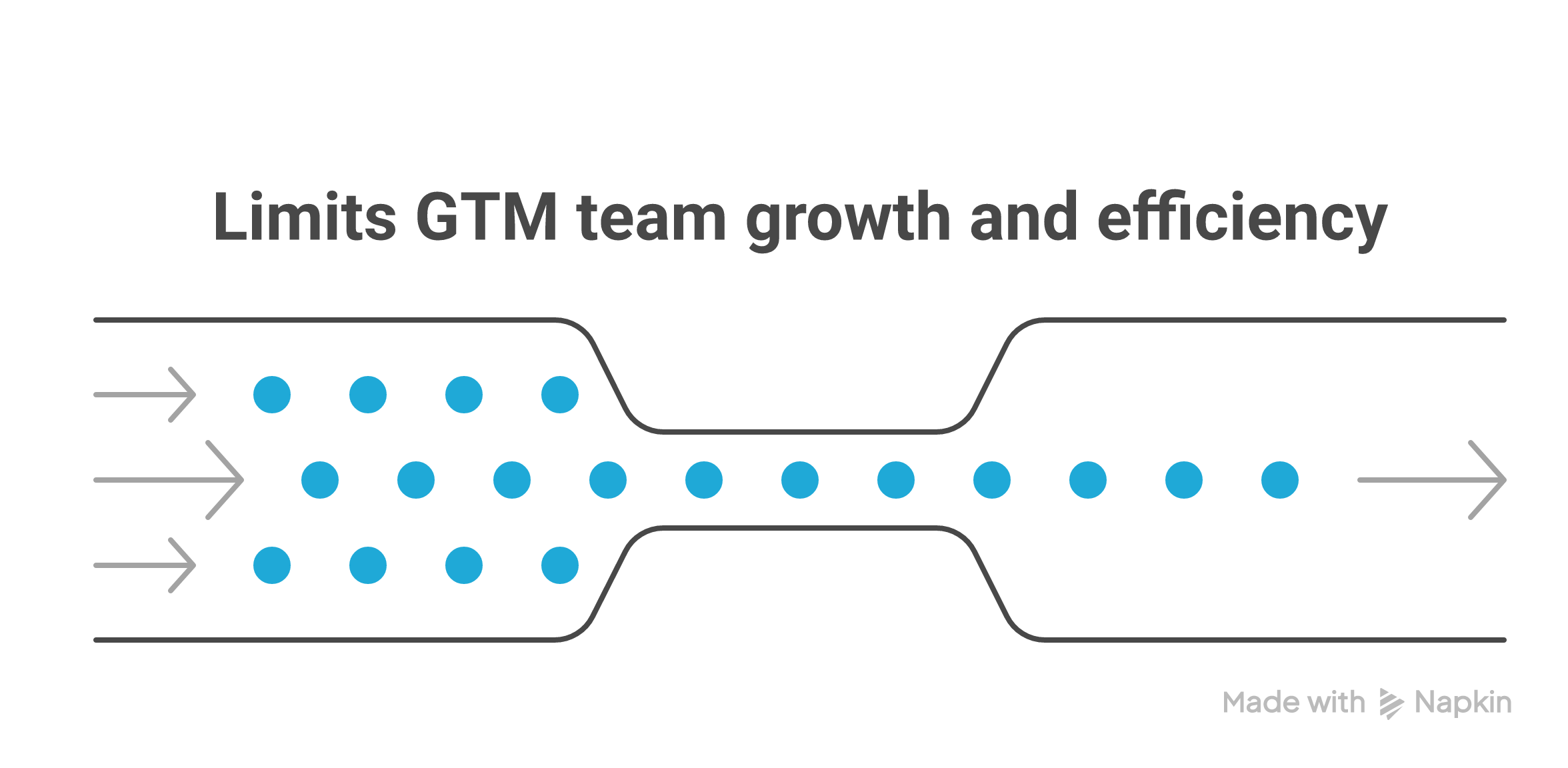
I have watched dozens of DACH SaaS founders struggle with this exact decision. The intuitive move is to hire another SDR when pipeline feels tight. More outreach equals more meetings, or so the thinking goes. But once you cross roughly 1.8 million euros in annual recurring revenue, the math changes. At this scale, you likely already have one SDR generating meetings and at least one AE converting them. Your product-market fit is proven. The bottleneck shifts from “not enough at-bats” to “poor conversion and operational friction in the at-bats we already have.” Lead routing is manual. CRM data quality is inconsistent. Follow-up sequences are built in spreadsheets. You lose deals to slow response times, not weak messaging. GTM engineers build and maintain the technical systems that power your entire go-to-market motion: marketing automation, CRM workflows, lead routing, data enrichment, integration between sales and product tools, analytics dashboards, and AI-driven experimentation. Their impact compounds. One SDR might generate 15-20 qualified meetings per month. One GTM engineer might increase conversion rates by 15 percent across the entire funnel, build lead scoring that improves SDR efficiency by 30 percent, and automate follow-up sequences that recover 20 percent more stalled deals. That multiplies the output of your entire team.Takeaway: The decision hinges on diagnosis – is your growth limited by not enough pipeline, or by poor conversion and operational friction in the pipeline you already have?
Preconditions Before Hiring a GTM Engineer
Before you consider a GTM engineer over a second SDR, these preconditions must be in place: – Proven repeatable sales motion: You have closed enough deals to know what works. The playbook is written. – At least one functioning SDR-AE pairing: You have sufficient lead volume to make automation worthwhile. – Systems-driven bottlenecks: Poor data quality, manual processes, integration gaps, or reporting blind spots constrain growth more than pure top-of-funnel volume. If your current SDR generates only 12 meetings per month and your AEs are asking for more pipeline, you need a second SDR. If your SDR generates 40 meetings but only 15 percent convert to opportunities because of slow follow-up, poor lead scoring, and manual data entry, you need the GTM engineer.Why the ARR Threshold Matters
Below approximately 1.8 million euros in ARR, most DACH SaaS companies are still pipeline-constrained rather than efficiency-constrained. The immediate ROI of a second SDR is higher than systems-level improvements. Beyond 2.5 million euros, the question is not whether to hire a GTM engineer but when to hire your second and third. The sweet spot is the middle. You have enough volume for automation to matter. You have proven what works. But you have not yet scaled the team so large that systems improvements feel urgent. Founders who wait until 5 million euros in ARR often regret it. By then, technical debt in your CRM and marketing stack has accumulated. Manual workarounds are baked into team habits. Fixing them takes longer and costs more.Why the DACH Market Demands Earlier GTM Engineering Investment
Quick Answer: The DACH region is now the world’s second-largest SaaS market by revenue, with sophisticated enterprise-heavy customer bases that demand high-touch, outbound-heavy sales motions and complex IT integrations. This raises the marginal value of technical GTM operators compared to less complex markets.
DACH is not just another European market. Germany, Austria, and Switzerland together represent the world’s second-largest SaaS market in terms of revenues and attracted approximately five billion euros of investment in just the first half of recent years. This sheer scale means that even relatively small DACH SaaS vendors face sophisticated buyers, intense competition, and high expectations around integration into complex corporate IT and data environments. Because so much of the addressable market consists of mid-market and enterprise customers with multi-stakeholder buying committees, go-to-market motions are often high-touch and outbound-heavy. This amplifies the importance of SDR productivity, sales process design, and technical integration between marketing, sales, and product systems. In simpler markets, you can get away with spreadsheets and manual handoffs. In DACH, buyers expect you to integrate with their existing workflows from day one.Valuation Multiples and Efficiency Pressure
European SaaS companies typically trade at valuation multiples that are about 15 to 25 percent lower than comparable US peers. This puts a premium on efficiency metrics: ARR growth, net revenue retention, and sales efficiency. Investors and acquirers scrutinize revenue per employee closely. Recent benchmarks show that the median revenue per employee for private SaaS companies reached 129,724 dollars in 2025. The most efficient private B2B SaaS startups with ARR between 200,000 and 20 million euros achieve 250,000 dollars or more per employee. DACH SaaS firms that simply add more SDR headcount without improving the underlying GTM system risk falling into the “early-stage or inefficient” bucket with revenue per employee below 150,000 dollars. That dampens valuations and constrains future fundraising.Takeaway: DACH SaaS companies face structural pressure to improve revenue per employee earlier than US peers, making the GTM engineer hire strategically critical around two million euros ARR.
Talent Market Dynamics in DACH
The broader European tech hiring environment has shifted in ways that directly affect the economics of GTM hiring in DACH. While the overall hiring rate in European tech has stabilized at around 29 percent, entry-level positions have seen a dramatic 73 percent decrease in hiring rates compared with the prior year. This collapse in junior hiring reflects a move away from large cohorts of inexperienced SDRs and toward fewer, more skilled GTM hires, often with stronger technical or analytical capabilities. In parallel, the proportion of new hires going into AI and machine learning roles grew by 88 percent in 2025 versus the previous year. This signals intense competition for technical talent that can work at the intersection of data, automation, and revenue. In DACH, these trends layer on top of a well-documented structural talent shortage. Successful hiring increasingly depends not only on salary but on offering compelling roles, career development, and a modern stack. A DACH SaaS founder competing for talent must recognize that hiring a second junior SDR may be harder and less effective than hiring a GTM engineer who sees the role as a technical career path.| Metric | Value | Implication for GTM Hiring |
|---|---|---|
| DACH SaaS investment (recent H1) | ~€5 billion | Intense competition; buyer sophistication high |
| European SaaS valuation discount vs. US | 15–25% | Premium on efficiency metrics |
| Revenue per employee (median, private SaaS) | $129,724 | Headcount expansion alone reduces multiples |
| Entry-level tech hiring decrease | -73% | Junior SDR roles harder to fill |
| AI/ML hiring growth | +88% | Technical GTM talent in high demand |
SDRs vs. GTM Engineers: Roles, Value Creation, and Cost Structures
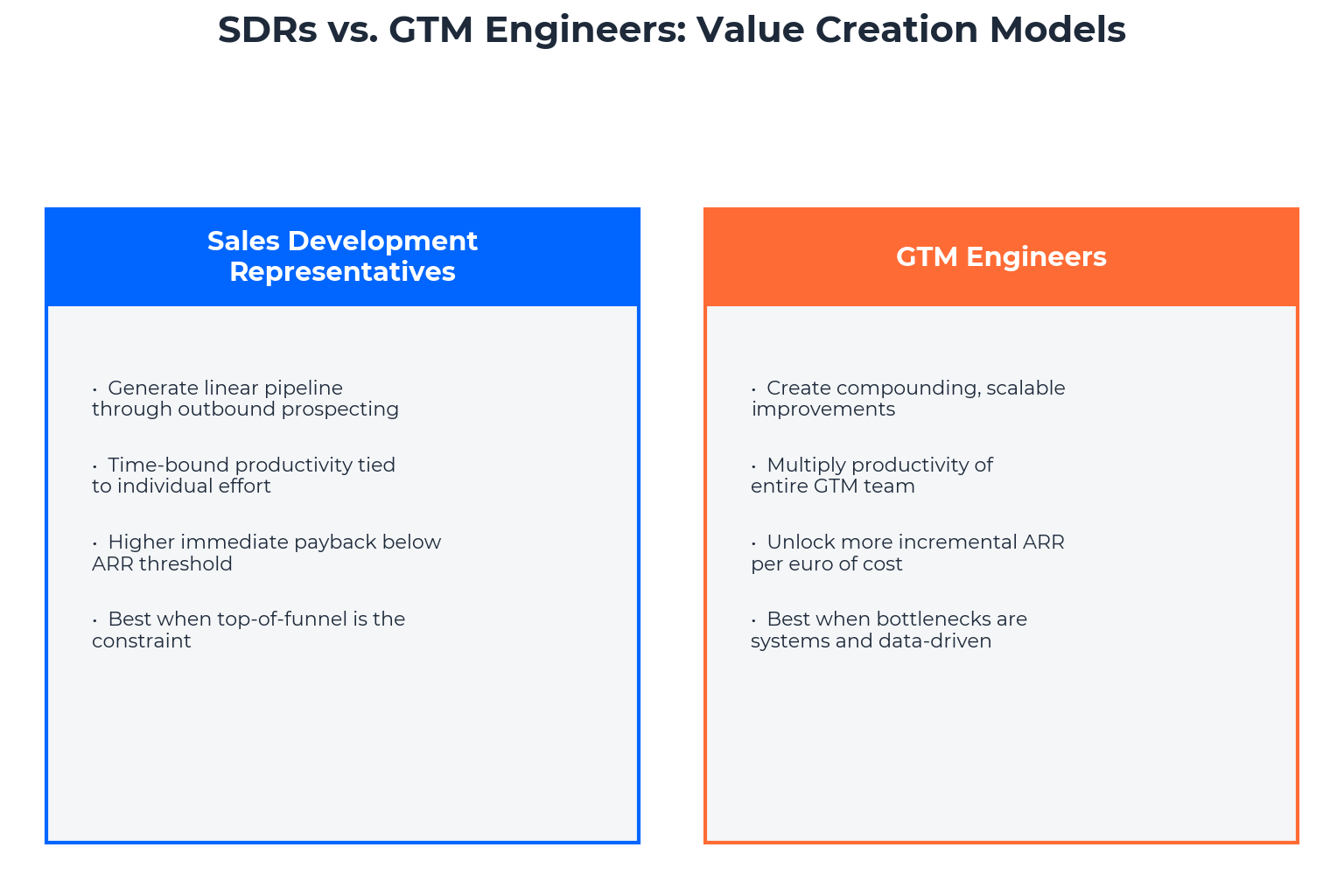
Quick Answer: Sales Development Representatives generate linear, time-bound pipeline through outbound prospecting. GTM Engineers create compounding, scalable improvements that multiply the productivity of all existing GTM team members. Cost structures differ, but the GTM engineer’s leverage increases with team size.
In most B2B SaaS organizations, Sales Development Representatives are responsible for generating pipeline via outbound prospecting, following up on inbound leads, and booking qualified meetings for Account Executives. Performance is measured primarily on meetings set, opportunities created, and pipeline volume. Typical SDR job descriptions emphasize high-volume outbound outreach across email, phone, and LinkedIn, qualification of prospects, and the hand-off to AEs. GTM Engineers build and maintain the technical systems that power the entire go-to-market motion. They work on marketing automation, CRM workflows, lead routing, data enrichment, integration between sales and product tools, analytics dashboards, and AI-driven experimentation. Their output is not a number of meetings per month. It is an increase in conversion rates, a reduction in manual tasks, and better data quality across the entire funnel.Value Creation Models
The fundamental difference is in how value compounds. SDRs generate linear, time-bound pipeline. More hours equals more outreach. If you want to double SDR output, you hire a second SDR. If your first SDR leaves, you lose their pipeline generation until you replace them. GTM Engineers create compounding, scalable improvements. One engineer might build a lead scoring model that improves SDR efficiency by 30 percent. That 30 percent gain applies to every SDR you hire in the future. The engineer might automate follow-up sequences that recover 20 percent more stalled deals. That 20 percent gain applies to every AE. The next GTM engineer you hire can build on those systems, not start from scratch. I have seen this play out at multiple DACH SaaS clients. A company at 2.5 million euros ARR with two SDRs and two AEs hired a GTM engineer. Within six months, the engineer had automated lead routing, built a data enrichment pipeline, and integrated product usage signals into the CRM. SDR efficiency improved by 25 percent. AE win rates increased by 12 percent. The company did not hire a third SDR until 4 million euros ARR, because the existing team was more productive.Cost Structure Comparison
Cost is not just base salary. It is total cost to the business, including ramp time, tools, and opportunity cost. SDRs typically command lower base salaries but require significant investment in training, enablement, and tooling. In DACH, a typical SaaS SDR base salary ranges from 40,000 to 60,000 euros, with on-target earnings (OTE) including commission reaching 55,000 to 75,000 euros for experienced hires. GTM Engineers command higher base salaries, reflecting their technical skill set. In DACH, the ideal first GTM engineer often has three to five years of experience combining sales operations, marketing operations, or product analytics with hands-on technical skills. Base salary typically ranges from 70,000 to 90,000 euros. Total compensation can reach 100,000 euros or more for senior profiles. The additional cost is often offset by efficiency gains, automation leverage, and increased scalability. Many DACH SaaS leaders find overall payback stronger once pipeline volume supports a system-level investment. The GTM engineer’s impact also scales with team size. In a team of one SDR and one AE, the marginal value is lower. In a team of three SDRs and three AEs, a 15 percent efficiency gain from better systems translates to meaningful ARR impact.Takeaway: SDRs create linear pipeline; GTM Engineers create compounding leverage. The GTM engineer’s ROI increases with team size and system complexity.
Preconditions and Red Flags: When NOT to Hire a GTM Engineer First
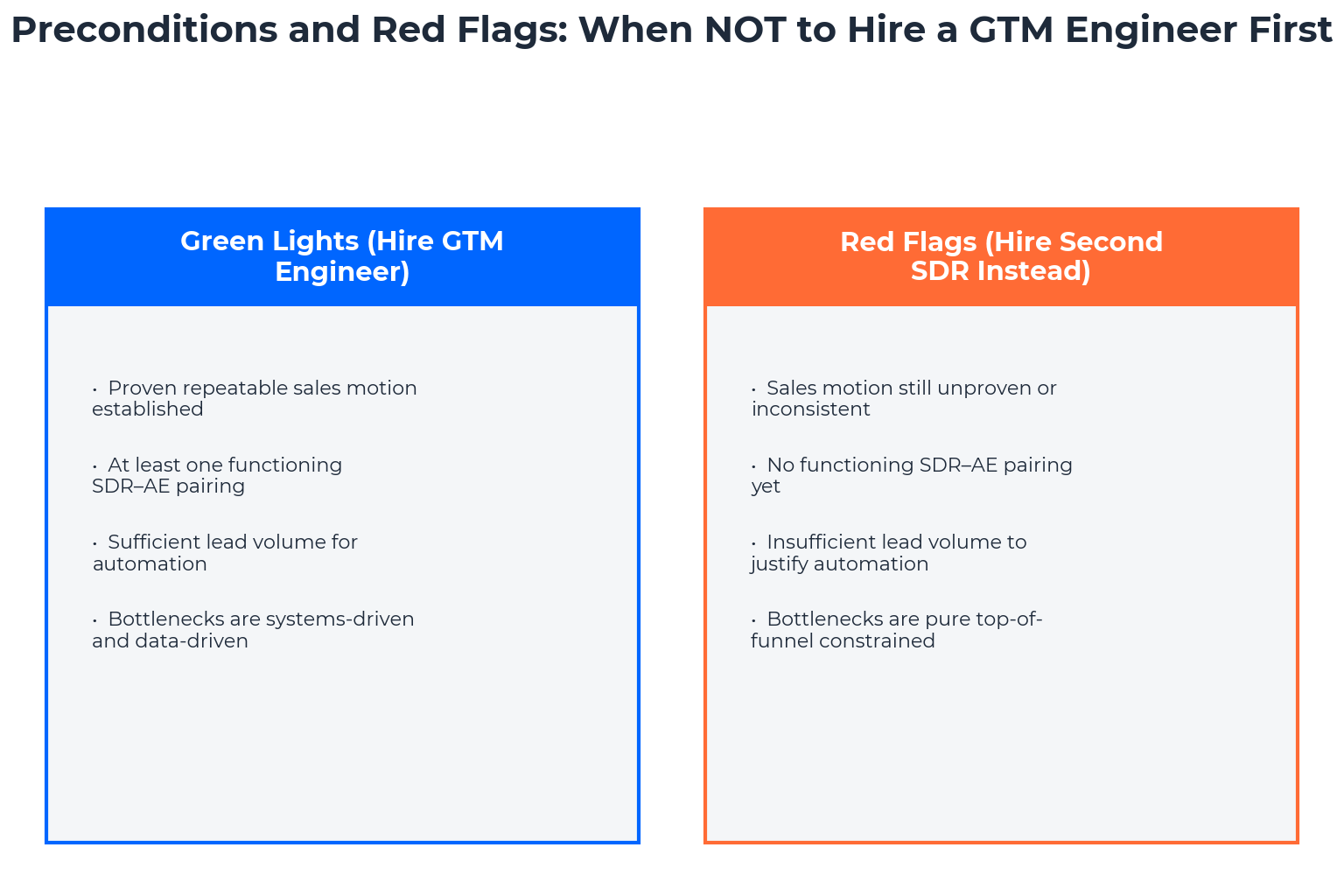
Quick Answer: Essential preconditions before hiring a GTM engineer instead of a second SDR include a proven repeatable sales motion, at least one functioning SDR-AE pairing, sufficient lead volume to make automation worthwhile, and clear evidence that bottlenecks are systems-driven rather than pure top-of-funnel volume constraints.
Not every DACH SaaS at 2 million euros ARR should hire a GTM engineer. The decision depends on diagnosis. If your growth is limited by not enough pipeline, hire the SDR. If your growth is limited by poor conversion and operational friction in the pipeline you already have, hire the GTM engineer.Red Flags Indicating You Still Need SDR Capacity
Hire a second SDR instead of a GTM engineer if you see any of these red flags: – Insufficient pipeline to meet sales targets: Your current SDR is not generating enough meetings to keep AEs busy. – AEs sitting idle waiting for meetings: You have sales capacity but no pipeline to fill it. – Inability to cover your total addressable market: You have identified target accounts but lack the outbound capacity to reach them. – Unproven product-market fit: You still need hands-on learning from prospect conversations to refine messaging and positioning. I worked with a DACH SaaS company at 1.5 million euros ARR with one SDR generating only 12 meetings per month. Their AEs were asking for more pipeline. The founder wanted to hire a GTM engineer to “fix the funnel.” I recommended a second SDR instead. The bottleneck was not systems. It was volume. Six months later, with two SDRs generating 25 meetings per month combined, we revisited the GTM engineer conversation. At that point, it made sense.Preconditions That Must Be in Place
Before hiring a GTM engineer instead of a second SDR, these preconditions must be in place: – Proven repeatable sales motion: You have closed enough deals to know what works. The playbook is written. – At least one functioning SDR-AE pairing: You have sufficient lead volume to make automation worthwhile. – Systems-driven bottlenecks: Poor data quality, manual processes, integration gaps, or reporting blind spots constrain growth more than pure top-of-funnel volume. A company at 2 million euros ARR with one SDR generating 40 qualified meetings per month but only 15 percent converting to opportunities due to slow follow-up, poor lead scoring, and manual data entry should hire the GTM engineer. The pipeline is there. The systems are not.Takeaway: The GTM engineer hire makes sense only when systems and data are the constraint, not top-of-funnel volume.
Implementation: Making the GTM Engineer Hire Work in Practice
Quick Answer: The first GTM engineer role should combine technical skills with commercial understanding. Scope the initial focus areas before hiring, expect a three-to-six-month ramp, and measure success through GTM efficiency metrics rather than traditional engineering KPIs.
Hiring a GTM engineer is not like hiring an SDR. The role is newer. The talent pool is smaller. The ramp time is longer. But when done well, the impact compounds for years.Role Definition and Profile
The first GTM engineer role definition should combine technical skills – APIs, automation platforms, CRM and marketing stack – with commercial understanding of funnel metrics, sales processes, and revenue impact. Avoid purely IT-focused profiles that lack GTM context. They will build technically elegant solutions that do not move the revenue needle. The ideal first GTM engineer in DACH often has three to five years of experience combining sales operations, marketing operations, or product analytics with hands-on technical skills. They have worked in a SaaS environment. They understand how sales teams work. They can write code or configure automation platforms like Zapier, Make, or HubSpot workflows. They can query databases and build dashboards. They report directly to the founder or Chief Revenue Officer to ensure strategic alignment. If they report to IT or product, they will optimize for technical elegance instead of revenue impact.Scope the Initial Focus Areas
Before you hire, identify the two to three highest-impact systems problems. Examples include: – Lead routing latency: Inbound leads wait hours or days for follow-up because routing is manual. – Poor CRM data quality: Fields are inconsistent or missing, making reporting and segmentation unreliable. – Lack of attribution reporting: You cannot trace which marketing channels drive pipeline and closed-won revenue. Ensure the candidate can address these problems within 90 days. This gives you a clear success metric and avoids the trap of hiring a generalist who spends six months learning your stack before delivering value.Ramp Time and Measurement
Expect three to six months before significant productivity gains materialize. This is longer than the four to six weeks it takes an SDR to begin generating pipeline. Plan cash flow and board communications around this timing. The GTM engineer will spend the first month understanding your systems, the second month building foundational integrations, and the third month delivering measurable improvements. Measure success through GTM efficiency metrics, not traditional engineering KPIs. Focus on: – Improvement in lead-to-opportunity conversion rate: Did the percentage of leads that convert to opportunities increase? – Reduction in sales cycle length: Did deals close faster due to better data or automation? – Increase in revenue per SDR or AE: Did each salesperson become more productive? – Net impact on CAC payback period: Did customer acquisition cost payback improve? As the company scales beyond three to five million euros ARR, the GTM engineer becomes the foundation for a revenue operations function that continues to compound efficiency gains across the entire go-to-market organization. The second GTM engineer you hire will build on the systems the first one created. By the time you reach 10 million euros ARR, you may have a small RevOps team that treats go-to-market as a technical discipline, not a headcount problem.Takeaway: The GTM engineer hire is a medium-term investment with long-term compounding returns. Plan for a longer ramp and measure success through efficiency gains, not immediate pipeline.