
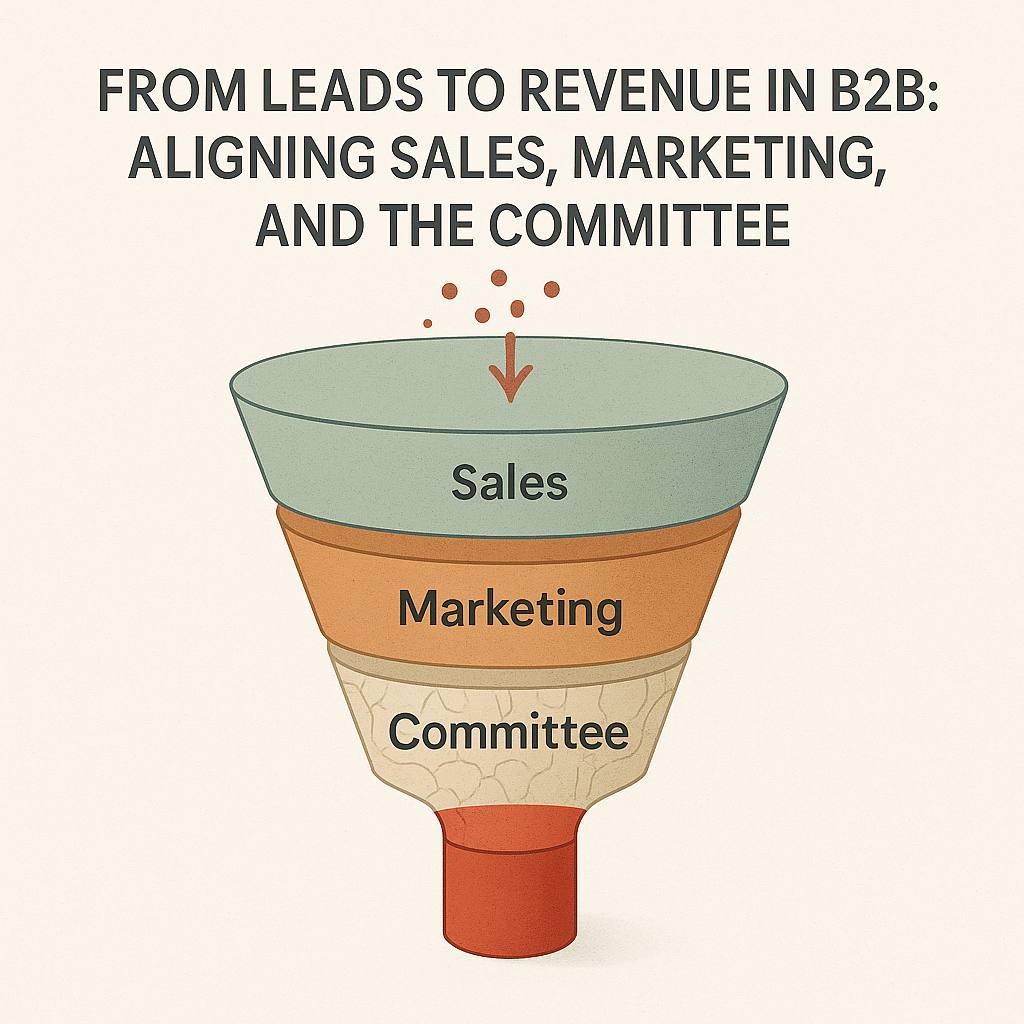
Misalignment between sales and marketing teams costs B2B companies revenue. According to a Pipeline360 survey of 500 B2B marketers in the US and UK, reported by MarTech, at least 50% of B2B marketers expected to miss their 2024 goals, and 44% named problems with marketing and sales alignment as a barrier, on top of the growing complexity of sales marketing alignment buying committee dynamics.
I’ll show you exactly how to build a unified revenue engine that transforms leads into predictable revenue by aligning your sales and marketing teams with modern buying committee behaviors.
Key Takeaways
- Revenue impact: According to Gartner, organizations whose marketing and sales teams share buyer journey insights are 1.6 times as likely to exceed revenue growth expectations
- Committee complexity: According to Forrester, an average of 13 people within an organization are involved in a buying decision, requiring sophisticated multi-stakeholder engagement
- Lead optimization: Organizations excelling at lead nurturing generate more sales-ready leads at lower cost
- RevOps transformation: According to Deloitte Digital, B2B organizations using RevOps were 1.4 times as likely to exceed their 2023 revenue goals by 10% or more
- Technology integration: Unified CRM and revenue intelligence platforms give both teams one shared data foundation
The Alignment Problem: Why Half of B2B Marketers Expect to Miss Their Targets
The Alignment Crisis
The disconnect between sales and marketing teams creates a massive revenue leak that most organizations fail to recognize until it’s too late. While 44% of B2B marketers cite alignment problems as a barrier to their goals (Pipeline360 via MarTech), a Gartner survey of 412 senior marketing and sales leaders (November and December 2023) found that 90% report conflicting functional priorities. This gap translates directly into missed opportunities and lost revenue.
I’ve witnessed firsthand how misalignment destroys pipeline velocity. Marketing generates leads it considers qualified, yet sales teams often reject many of them as not ready. Meanwhile, high-value prospects slip through the cracks because neither team owns the full customer journey. The same Gartner survey found that marketing and sales typically collaborate on only three out of 15 commercial activities, and that organizations whose teams share buyer journey insights are 2.3 times as likely to see higher sales conversion rates.

Economic Pressures Amplifying the Problem
In the Pipeline360 survey, budget and resource constraints were named by 48% of respondents and economic conditions by 46%, forcing teams to accomplish more with fewer resources and creating pressure to demonstrate immediate ROI on every marketing dollar spent. These pressures expose the inefficiencies of misaligned operations, where sales and marketing teams often define qualified leads differently.
The cost of misalignment extends beyond missed quotas. According to the Gartner survey, 80% of key commercial activities are missing contributions from marketing or sales. Every day of continued misalignment represents lost revenue that compounds over time.
Decoding the Modern B2B Buying Committee
The Evolution toward Larger Decision Groups
The traditional playbook for B2B sales assumed small buying committees, but that model is outdated. According to Forrester, an average of 13 people within an organization are involved in a buying decision. This expansion fundamentally changes how sales and marketing teams must approach prospect engagement.
The complexity multiplies because, according to Forrester, 89% of purchases involve two or more departments, each bringing distinct priorities and evaluation criteria. This cross-functional reality demands coordinated strategies that address diverse stakeholder needs while maintaining message consistency.
Authority Concentration at the Top
Final purchase decisions often involve C-suite executives or the CFO. This requires sales and marketing teams to develop executive-level messaging and value propositions.
The engagement patterns within these committees reveal another layer of complexity. Buying groups engage with seller content across many touchpoints. Each touchpoint represents an opportunity to influence the committee, but only if sales and marketing present unified, consistent messaging throughout the journey.
The Fear Factor Paralyzing Decisions
Economic uncertainty has fundamentally altered buying committee psychology. Committees have adopted defensive postures, driven by heightened spending scrutiny and pressure to demonstrate ROI. This shift from “fear of missing out” to “fear of messing up” matters: according to Forrester, 86% of B2B purchases stall during the buying process and 81% of buyers express dissatisfaction with their chosen provider.
Stakeholder turnover compounds these challenges, with deals stalling or getting lost when key contacts leave their positions. This volatility requires building consensus across multiple committee members simultaneously, creating redundant relationships that protect deal momentum when individual champions depart.

Lead Quality Revolution: Converting More at Lower Cost
The Economics of Lead Excellence
Organizations that master lead nurturing generate more sales-ready leads at lower cost, which shows that quality trumps quantity in modern B2B marketing. This efficiency gain stems from focusing resources on prospects who demonstrate genuine purchase intent rather than casting wide nets that capture unqualified contacts.
Lead scoring systems amplify these benefits by helping teams prioritize. The methodology ranks prospects numerically based on demographic fit, behavioral signals, and engagement patterns. Each interaction contributes to the overall score, creating a dynamic assessment that evolves as prospects move through their buying journey.
Behavioral Data as the Truth Signal
While demographic data provides initial qualification, behavioral signals reveal true purchase intent. B2B buyers require multiple touchpoints before making decisions, gradually engaging through content downloads, case study reviews, webinar attendance, demo requests, and trial activations. Each action provides insight into their readiness to buy and specific areas of interest.
The challenge lies in capturing and interpreting these signals accurately. Poor data quality affects many organizations, with information scattered across platforms, lacking standardization, and missing critical timestamps. Manual processes introduce errors and miss behavioral indicators like page views and form submissions, skewing quality assessments and creating disputes between teams about lead readiness.
Technology-Driven Quality Improvements
Lead enrichment tools transform raw contact data into actionable intelligence. These platforms aggregate data from multiple sources, creating comprehensive profiles that enable precise targeting and personalization.
The key metrics for measuring lead quality include lead-to-opportunity conversion rates, sales acceptance rates, and response times. Higher conversion rates indicate better targeting and qualification, while faster response times signal stronger engagement. Organizations tracking these metrics consistently outperform those relying on volume-based measurements.
Revenue Operations: The Productivity Game-Changer
The RevOps Revolution
Revenue Operations has evolved from experimental concept to essential business function, with dedicated RevOps teams becoming common. Companies recognize its impact on revenue generation and operational efficiency.
The benefits can be observed. According to Deloitte Digital, B2B organizations using RevOps were 1.4 times as likely to exceed their 2023 revenue goals by 10% or more, which supports the case for unified revenue strategies.
Strategic Advantages Beyond Revenue
RevOps delivers competitive advantages that extend beyond immediate revenue impact. When data from all customer-facing teams comes together, decisions about new channels, tools, and offers become easier. These capabilities create sustainable growth engines that adapt to market changes.
The revenue engine concept centralizes all customer-facing operations under unified leadership, eliminating silos that fragment customer experiences. When marketing, sales, and customer success align around shared revenue goals, organizations achieve faster growth while improving customer satisfaction and loyalty.
Implementation Timing and Maturity
The right timing for RevOps depends on company size and complexity. The implementation requires comprehensive approaches addressing technology integration, process standardization, and organizational alignment. Success depends on executive commitment to breaking down departmental barriers and establishing shared accountability for revenue outcomes.
Data-driven decision making becomes possible when RevOps consolidates information from all customer-facing departments. This integrated view enables accurate forecasting, strategic resource allocation, and rapid response to market changes.

MQL to SQL Conversion: The Bridge Metric
Marketing Qualified Lead to Sales Qualified Lead conversion rates represent the most critical metric for measuring alignment effectiveness. This metric reveals whether marketing targets the right audiences and whether handoff processes function smoothly. High conversion rates indicate strong alignment, while low rates expose disconnects in qualification criteria or nurturing processes.
Before tracking this metric, teams must agree on clear definitions for MQLs and SQLs. This shared understanding eliminates the frustration that occurs when sales perceives marketing leads as low quality. Organizations with aligned definitions report higher sales acceptance rates and more productive follow-up activities.
Customer Lifetime Value and Profitability Metrics
Customer Lifetime Value measures total expected revenue from individual customers throughout their relationship with your company. Growing CLTV indicates success in acquiring high-value customers and building lasting relationships. The LTV:CAC ratio provides crucial insight into profitability, balancing acquisition costs against long-term revenue potential.
Sales cycle length offers another vital indicator of alignment health. Shorter cycles suggest efficient processes and effective collaboration, while lengthy cycles often reveal friction points between teams. Well-aligned organizations demonstrate predictable sales cycles that enable accurate forecasting and resource planning.
Response Time and Engagement Metrics
Time-to-first-contact measures how quickly teams respond to qualified leads, with faster responses correlating strongly with higher conversion rates. This metric requires coordination between marketing’s lead routing and sales’ response protocols. Organizations optimizing this metric report significant improvements in both conversion rates and customer satisfaction.
Lead conversion rates track the percentage of qualified leads becoming customers, reflecting the entire funnel’s effectiveness. Average deal size provides insight into value creation capabilities, with aligned teams typically demonstrating growing deal sizes as they improve prospect identification and engagement strategies.
Technology Stack Integration for Unified Revenue
CRM as the Foundation
Customer Relationship Management systems provide the foundational infrastructure for alignment initiatives. Platforms like HubSpot consolidate sales activities, marketing campaigns, and customer interactions into unified repositories. Using single platforms ensures teams work from identical data, simplifying performance tracking and collaboration while eliminating the silos that fragment customer experiences.
The integration eliminates duplicate data entry, reduces errors, and provides real-time visibility into pipeline health. When both teams access the same customer information, they can coordinate activities more effectively and avoid conflicting communications that confuse prospects.
Revenue Intelligence and Automation
Revenue intelligence platforms represent the next evolution in alignment technology. Gong reports in a case study that Frontify increased lead conversion by 30% with Gong Engage and forecast accuracy by 20% with Gong Forecast. This is a vendor claim about a single customer. These systems analyze customer interactions, identify winning patterns, and provide actionable insights that improve both individual and team performance.
Marketing automation complements revenue intelligence by ensuring consistent lead nurturing across all touchpoints. Real-time lead grading, automated campaigns, and behavioral triggers maintain engagement momentum while reducing manual workload. The automation ensures no qualified leads fall through cracks due to resource constraints or human error.
Lead Enrichment and Data Quality
Lead enrichment tools have become essential for maintaining data quality and improving conversion rates. These tools aggregate data from multiple sources, creating comprehensive profiles that enable precise targeting and personalization.
The technology stack must integrate seamlessly to deliver value. Disconnected tools create new silos that undermine alignment efforts. Organizations should prioritize platforms offering native integrations or robust APIs that enable real-time data synchronization across all systems.
FAQ
How do you align sales and marketing teams when they have different goals and metrics?
Start by establishing shared revenue goals and KPIs that both teams own jointly. Create service level agreements defining lead quality criteria, response times, and handoff processes. Regular alignment meetings and unified dashboards ensure both teams track progress against common objectives rather than departmental metrics.
What’s the ideal size and composition of a B2B buying committee engagement strategy?
According to Forrester, an average of 13 people within an organization are involved in a buying decision, across multiple departments. Develop multi-threaded engagement strategies targeting different stakeholder personas simultaneously. Create content addressing specific concerns of executives, financial decision makers, technical evaluators, and end users while maintaining consistent core messaging.
How quickly should companies expect ROI from Revenue Operations implementation?
The timeline depends on your starting point, data quality, and executive commitment. Early improvements, such as clearer lead definitions and handoffs, usually show up before the cultural change that full alignment requires. According to Deloitte Digital, B2B organizations using RevOps were 1.4 times as likely to exceed their 2023 revenue goals by 10% or more.
Which technology investments provide the fastest alignment improvements?
Unified CRM platforms deliver immediate benefits by eliminating data silos. Revenue intelligence tools can bring quick wins: Frontify reports a 30% increase in lead conversion and a 20% increase in forecast accuracy in a Gong case study (vendor claim). Marketing automation and lead enrichment platforms support better lead quality and lower acquisition costs.
Sources
- MarTech: 50% of B2B marketers won’t reach 2024 goals
- Gartner: Survey Reveals Marketing and Sales Functions Collaborate on Only Three Out of 15 Commercial Activities
- Forrester: To Master B2B Buying Mayhem, Providers Must Prioritize Buyers’ Needs
- Deloitte Digital: Is RevOps the new driver for B2B growth?
- Gong: Alignment Across RevOps and Reps Brings Frontify a 30% Increase in Lead Conversion