
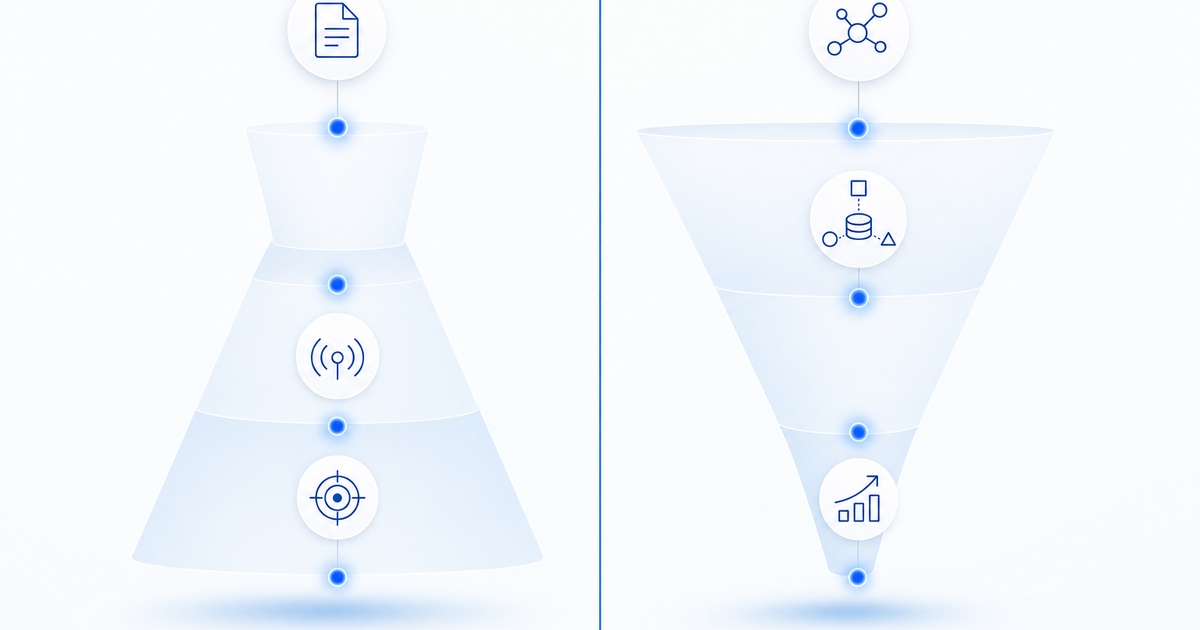
First-party intent signals reflect direct engagement with your brand, while third-party signals capture early research across external publishers. Clay workflows that combine both signal types consistently outperform single-source approaches in meeting volume and pipeline quality. This guide identifies the four intent signal types that drive the most B2B meetings in 2026 and shows how to stack them for conversion.
First-Party Web and Product Engagement
First-party signals – pricing page visits, repeat site sessions, and demo requests – deliver the highest conversion rates because they show direct buying interest. Clay ingests these signals from CRM and tracking pixels, scores accounts based on activity clusters, and routes hot prospects to sales in real time.
Pricing page views and comparison page visits are named the top first-party high-fidelity signals for sales-ready interest. Teams see the strongest results when they trigger outreach after three high-intent actions within seven days. A scoring rule like “two pricing page visits plus one demo request” creates a Tier-2 account that enters a personalized sequence immediately.
Clay offers native website tracking via pixel and accepts lead scoring inputs from tools like MadKudu. When an account crosses a score threshold, Clay sends a Slack alert and launches an email plus LinkedIn sequence. This automation removes manual sorting and ensures SDRs contact prospects at peak buying interest.
Takeaway: First-party web signals convert fastest when layered with routing rules that enforce minimum activity thresholds before outreach.

Company Activity and Trigger Signals
Company trigger signals – funding rounds, hiring spikes, and technology changes – reveal moments when businesses evaluate new tools. Clay monitors job postings, tech installs, and capital events, then routes multi-trigger accounts to AEs for immediate discovery calls.
Hiring surges and fresh funding within 90 days drive new solution evaluation cycles across B2B software. A Series B announcement combined with three RevOps hires in 30 days signals an imminent tech stack review. High-performing workflows treat these multi-trigger Tier-1 signals as priority for fast rep outreach.
Clay provides native job-change and job-posting signals plus company mentions online. Teams build tables that watch ICP accounts for funding plus hiring; when both fire within 30 days, Clay enriches contacts, scores the account, and alerts an AE. This timing advantage consistently creates net-new meetings that cold lists miss.
- Funding rounds open budget for new software evaluation.
- Rapid hiring in RevOps or IT roles indicates tech stack gaps.
- Technology install or removal events show active vendor switching.
Trigger signals work best when paired with at least one engagement indicator. A funding announcement alone may not convert; funding plus a pricing page visit within 21 days creates a qualified opportunity for go-to-market strategy execution.

Marketplace and Review-Site Research Signals
G2, TrustRadius, and Capterra signals – profile views, category research, and compare-page usage – indicate mid- to late-stage evaluation. Clay workflows that activate G2 Buyer Intent and stitch it with first-party data reliably generate meetings from accounts actively comparing vendors.
Research and comparison behaviors on review sites are classified as high-value because they show explicit vendor evaluation. Someone viewing your G2 profile and a competitor’s compare page within 14 days is a high-priority evaluation signal. Second-party review-site intent sits between first and third-party on accuracy, with explicit comparison behaviors rated stronger than generic content reading.
Growth teams connect Clay to G2 and TrustRadius; any account that views their profile and a competitor’s compare page enters a multi-channel outbound sequence. This approach reliably creates net-new meetings because the prospect has already shortlisted vendors.
Takeaway: Review-site signals perform best when combined with enrichment and fast routing, turning anonymous research into named opportunities within hours.
Third-Party Topic Surge and Content Consumption
Topic surge scores from Bombora and 6sense capture accounts consuming more content on a specific subject than their historical baseline. These early-stage signals widen discovery; teams pair them with first-party web visits to create meeting-ready lists.
Third-party topic surges are the strongest early-stage research indicator but convert slowly when used alone. Most GTM teams achieve best results by combining first-party engagement with third-party topic surges, using the surge for discovery and owned signals for conversion.
A marketing team filters 6sense surges to ICP accounts, pushes them into Clay, and waits for a matching web visit. Once both signals exist within 30 days, an SDR is alerted and books meetings off outreach that references the exact topics the account has been researching. AI-orchestrated Clay workflows stack Bombora and 6sense surges with web visits, social activity, and triggers, then auto-launch signal-aware sequences.
- Topic surges identify accounts entering a research phase.
- Content consumption spikes signal problem awareness.
- Pairing surge data with first-party touches creates timing advantage.
Expert guidance recommends aligning signal strength to funnel stage: use research-only surges for marketing nurture and save SDR time for mid- to late-stage signals like pricing visits or review comparison.
Composite Signal Scoring and Meeting Conversion
Multi-signal accounts – those showing topic surge, pricing page visit, and review research together – are 5–10 times more predictive of pipeline than isolated signals. Clay composite scoring prioritizes these accounts for immediate follow-up, ensuring reps invest time where conversion probability is highest.
Controlled pilots where one rep works intent-prioritized accounts while others work static lists have shown up to 3x more meetings booked from signal-based routing. Signal-based selling is associated with 82% faster lead conversion and up to 90% increased qualified lead volume across B2B teams deploying multi-signal stacks.
A team builds Clay scoring rules: Tier-1 equals at least one strong trigger (funding or hiring) plus one engagement signal (pricing page) plus one external intent signal (G2 or Bombora) within 21 days. Tier-1 accounts are pushed to SDRs and consistently become the largest source of booked meetings quarter over quarter.
Clay’s waterfall enrichment and AI research improve contact coverage to 70–85% valid emails versus 40–60% with single providers. This ensures signal-qualified accounts can be reached quickly, turning intent into conversation before interest fades.
Takeaway: Composite scoring transforms fragmented signals into a unified view, routing the hottest accounts to sales while nurturing early-stage prospects through marketing.
FAQ
What’s the main difference between 1st-party and 3rd-party intent data?
First-party intent data comes directly from owned properties like websites or CRMs, showing clear buyer interest. Third-party intent data comes from external publishers or aggregators, useful for broad discovery but less precise. Combining both creates a balanced pipeline of high-quality prospects.
Which intent signal types in Clay book the most meetings?
The four signal types that consistently drive meetings are first-party website engagement, company triggers like funding or hiring, marketplace evaluation via G2 or TrustRadius, and third-party topic surges paired with owned engagement. Together, these signals deliver strong buying indicators and predictable meeting outcomes.
Is first-party intent data more accurate than third-party signals?
Yes, first-party intent data is generally more accurate because it directly reflects how prospects interact with your brand. Third-party signals widen visibility but may include irrelevant accounts. Most high-performing Clay workflows mix both for optimal precision and reach in pipeline generation.
How does Clay combine 1st- and 3rd-party signals effectively?
Clay unifies multiple data sources – website activity, review-site research, job or funding triggers, and topic surges – into one view. It scores accounts based on signal combinations, routes hot accounts to SDRs, and automates follow-up sequences, significantly improving meeting and conversion rates.
Why are company trigger signals important for B2B outreach?
Trigger signals like funding rounds, rapid hiring, or tech stack changes reveal moments when companies are evaluating new tools. In Clay, these triggers help teams time outreach perfectly, focusing sales efforts on accounts most likely to engage and convert quickly.