

As of June 2026, successful B2B Positionierung Nische strategies in DACH markets outperform broad positioning by every meaningful metric. DACH buyers filter faster, research independently, and reward vendors who demonstrate clear, specific expertise over general-purpose platform promises. This post explains why narrow positioning wins more pipeline in 2026, how buyer behavior has shifted to favor focus, and what DACH vendors should change now.
Contents
Why Buyers Filter for Relevance Before Contacting Vendors
Quick Answer: In 2026, B2B buyers complete 60–70% of their decision journey before they reach out to a vendor. They compare options alone, consume content independently, and form strong preferences early. Narrow positioning makes that self-serve phase easier by offering clarity, proof points, and recognizable fit faster than broad messaging can deliver.
DACH buyers in particular value precision. A vendor that claims to solve “everything for all industries” forces buyers to do translation work. The buyer must figure out if the platform fits their compliance needs, tech stack, or budget constraints. Narrow positioning removes that friction by presenting a solution already tailored to their specific context.
Self-service evaluation also means vendors must optimize for discoverability. AI-driven search and chatbot-powered research sessions surface vendors that use precise, intent-matching language. A narrow positioning statement mirrors real search terms buyers type, improving visibility in both traditional SEO and semantic AI engines.
Takeaway: Buyers who research alone reward vendors who make relevance obvious at first glance.
Another dimension is trust. Three out of four B2B buyers now prefer a no-rep experience, and 86% of purchase processes stall before final decisions. A focused narrative that speaks directly to one segment builds credibility faster than a broad pitch that tries to appeal to everyone. Buyers can verify your claim by checking references in their industry, reviewing comparable case studies, and seeing proof that matches their operational reality.
Building a Narrow ICP That Drives Pipeline Quality
Quick Answer: A strong ICP in 2026 starts with the best 10 existing customers, defines firmographic and tech-stack traits tightly, and targets 100–500 high-fit accounts rather than casting a wide net. This focus improves message relevance, shortens sales cycles, and raises conversion rates because every marketing asset and sales conversation is built for one specific buyer profile.
Broad targeting dilutes everything. Marketing creates generic content that applies to nobody perfectly. Sales pitches a one-size-fits-all story that buyers ignore. A narrow ICP forces both teams to commit to one segment, then develop proof, language, and outreach tailored to that segment alone.
- Start with firmographics: company size, revenue band, location, regulatory environment.
- Add technographic filters: which CRM, ERP, or compliance tools the account already runs.
- Layer buying signals: which roles research solutions, which content they consume, and how they prefer to engage.
DACH markets reward this precision culturally. German, Austrian, and Swiss buyers expect vendors to understand local compliance frameworks, language nuances, and business norms. A vendor that demonstrates fluency in these details signals expertise. One that offers a pan-European or global pitch without localization appears inexperienced.
Narrow ICP definitions also improve alignment between marketing and sales. When both teams share the same target account list and the same success profile, lead quality rises and handoff friction drops. Marketing generates fewer but better leads. Sales spends time on accounts that match the ideal pattern. Pipeline velocity improves because both sides work from a unified playbook embedded in the broader go-to-market strategy.
Takeaway: A tight ICP backed by real customer data beats a broad TAM projection every time.
Proof Over Promises in DACH B2B Messaging
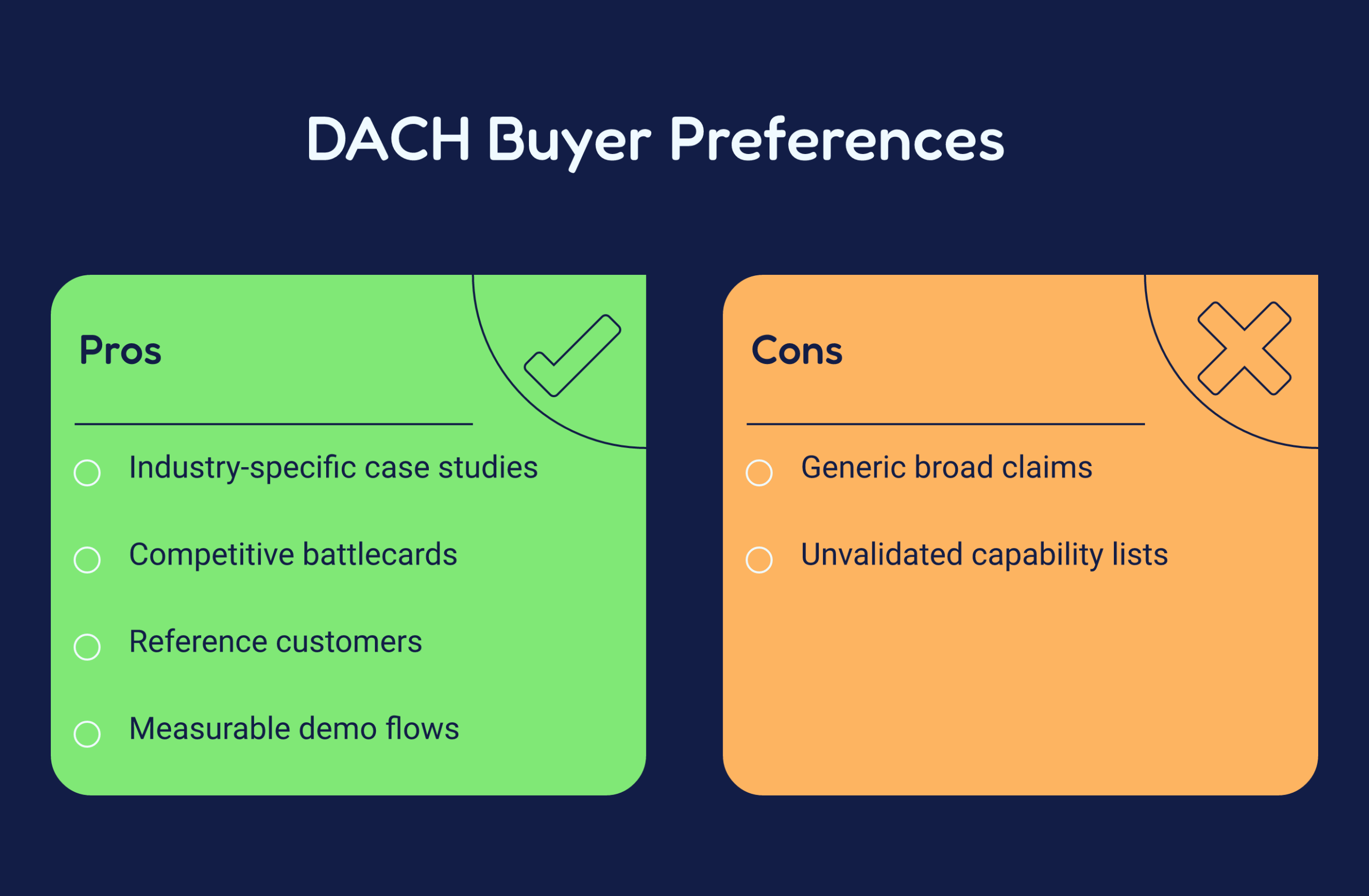
Quick Answer: DACH buyers prioritize documented evidence, measurable outcomes, and reference customers in their industry over innovation claims or category-wide promises. Narrow positioning makes it easier to produce relevant proof because every case study, demo, and competitive comparison can be customized for a single segment, raising trust and shortening the evaluation phase.
A cybersecurity vendor serving Swiss financial services firms will win faster by publishing one detailed case study with compliance evidence, cost savings, and a named reference than by promoting a broad “enterprise-grade platform” narrative. The narrow case speaks directly to the buyer’s context. The broad claim forces the buyer to extrapolate.
Buyer enablement content matters more in 2026 because so much evaluation happens before first contact. Marketing must provide decision-support assets that sales can share or that buyers find independently. Case studies, ROI calculators, competitive battlecards, and demo flows all work better when they reflect one focused segment. A general ROI model forces the buyer to guess their inputs. A model pre-populated with DACH manufacturing averages gives them a credible starting point immediately.
Sales and marketing alignment becomes simpler when both teams share one proof library. Marketing builds assets for a narrow segment. Sales uses those same assets in every conversation. The buyer hears a consistent story across web, email, LinkedIn, and live calls. That consistency accelerates trust and reduces the cognitive load buyers face when comparing vendors.
Takeaway: One industry-specific proof point outperforms ten generic feature lists in DACH markets.
Revenue teams looking to tighten this alignment and build narrow, proof-backed positioning often turn to fractional CMO support to coordinate messaging, ICP definition, and enablement production without expanding headcount.
AI Search and Semantic Discovery Favor Narrow Language
Quick Answer: In 2026, AI-powered search engines and chatbot interfaces surface vendors that use precise, intent-matching terminology. Narrow positioning naturally incorporates the language buyers actually search for, making it easier for AI systems to recommend your solution during the buyer’s independent research phase.
A vendor positioned as “B2B compliance automation for German medtech scale-ups” will rank higher in semantic search than one positioned as “digital transformation for life sciences.” The narrow phrase matches real buyer queries. The broad phrase matches noise.
LinkedIn profiles, company pages, and content hubs must now optimize for both human readers and AI reasoning engines. That means structured data, exact keywords, and clear segment definitions. Generic positioning fails here because AI filters interpret vague language as low relevance. Specific positioning signals high relevance to both the algorithm and the buyer it serves.
Takeaway: AI search rewards vendors who speak the buyer’s exact language, not category jargon.
FAQ
Why is narrow positioning better than broad in DACH B2B markets?
DACH B2B buyers in 2026 prefer clearly defined solutions because they research deeply before engaging vendors. Narrow positioning signals expertise, aligns with self-directed evaluation, and makes selection easier by demonstrating a perfect fit for specific industry or compliance needs, improving trust and conversion potential.
How does self-serve buying behavior affect B2B positioning?
Self-serve buying means DACH buyers complete most research independently, so positioning must deliver concise, high-value clarity. Buyers filter quickly for relevance. Vendors that present focused, context-rich solutions enable buyers to make confident progress without heavy sales involvement, reducing friction and raising the likelihood of final engagement.
What makes an ideal B2B ICP in the DACH region?
An ideal DACH ICP in 2026 is precise, data-validated, and narrow enough to reflect existing customer success patterns. It incorporates firmographic details, tech stacks, and regional compliance requirements. This focus strengthens marketing relevance, builds credibility, and reduces wasted sales efforts caused by diffuse targeting strategies.