

Cold outreach is still possible under the GDPR in 2026, but in Germany two laws apply at the same time. The GDPR governs whether you may process the contact data. The German Act against Unfair Competition (UWG) governs which channel you may advertise through. For processing, legitimate interest usually suffices in B2B. For advertising by email, however, Germany requires prior express consent even from business contacts.
If you would rather not set this up yourself: our cold email agency for B2B works with one-to-one outreach based on real signals instead of mass mailings.
Key Takeaways
- The GDPR usually allows processing business contact data for direct marketing on the basis of legitimate interest.
- In Germany, the UWG requires prior express consent for email advertising in B2B as well, and at least presumed consent for advertising calls to businesses.
- If you did not collect the data from the contact, you must inform them at the latest with your first message.
- An objection to direct marketing takes effect immediately, with no balancing test.
- Fines go up to 20 million euros or 4 percent of worldwide annual turnover.
Two laws, two questions
In cold outreach, the GDPR and the UWG answer different questions. The GDPR asks whether you may process a person’s data. The UWG asks whether advertising through a given channel is an unacceptable nuisance.
The two checks are independent. Processing can be lawful under the GDPR while the same email is unlawful under the UWG. Many guides mix the two and conclude from legitimate interest that cold emails are allowed as well. For Germany, that is not correct.
GDPR: legal basis, information, objection
For B2B cold outreach, processing usually relies on legitimate interest. Two duties are added that are often missing in practice: informing the contact and honouring an objection immediately.
Legitimate interest
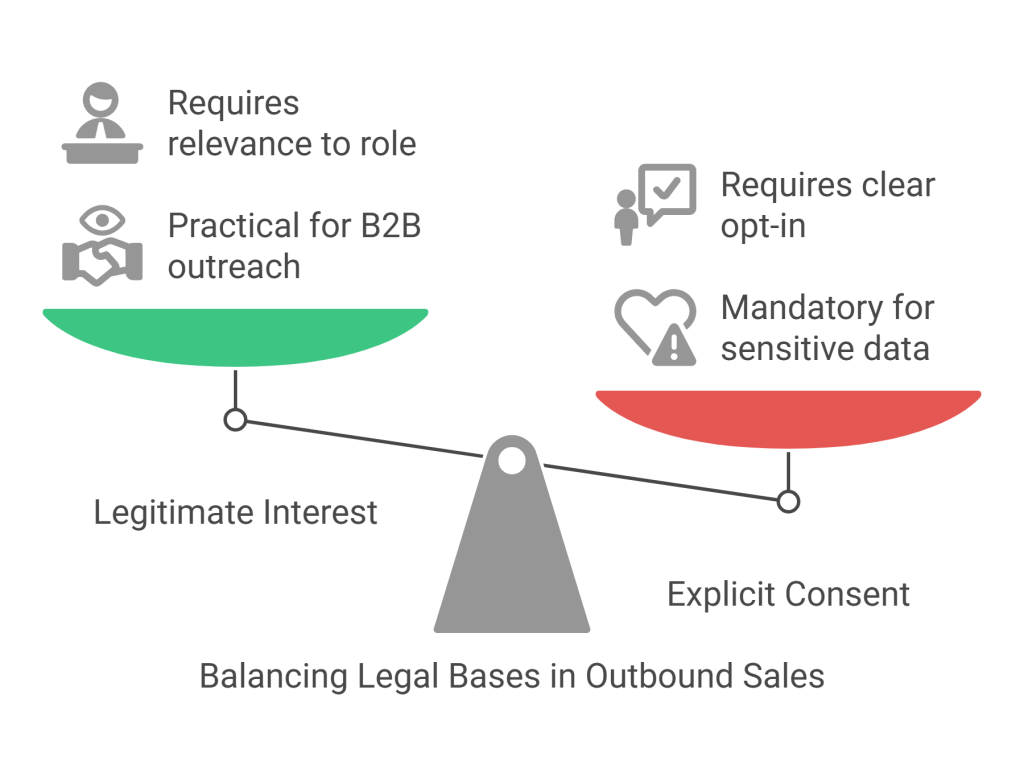
Under Art. 6 (1)(f) GDPR, processing is lawful if your interest is not overridden by the interests of the person concerned. Recital 47 explicitly names direct marketing as a possible legitimate interest. The balancing test decides: an offer that fits the professional role is more likely to be covered than broad outreach with no connection.
Duty to inform when data comes from third parties
If the data was not collected from the contact, for example from a data provider, Art. 14 GDPR applies. The contact must learn who processes the data, for what purpose and from which source. If the data is used to communicate with the person, this must happen at the latest with the first communication. In practice, the first message therefore needs a short privacy notice with a link.
Objection to direct marketing
Anyone can object to processing for direct marketing, as set out in Art. 21 (2) and (3) GDPR. Unlike other purposes, there is no balancing test here. After an objection, the data may no longer be used for marketing. An unsubscribe request therefore has to go onto a suppression list immediately, valid for all campaigns.
UWG: the channel decides
The UWG distinguishes by channel. Advertising calls to businesses need at least presumed consent, while advertising by email needs prior express consent in B2B as well.
- Phone: under Section 7 (2) no. 1 UWG, advertising calls to consumers need their express consent, calls to businesses at least their presumed consent. Courts interpret this narrowly. The IHK Munich (in German) cites prior contact as an example, such as a meeting at a trade fair.
- Email: under Section 7 (2) no. 2 UWG, advertising by email needs the recipient’s prior express consent. The IHK Munich puts it plainly: there is no B2B exception.
- Existing customers: Section 7 (3) UWG allows email advertising without consent only under narrow conditions, for example for similar products after a purchase and with a notice of the right to object.
In practice, a cold email strategy for Germany needs a legal review of your own approach. The GDPR balancing test alone is not enough.
Fines and duties after a data breach
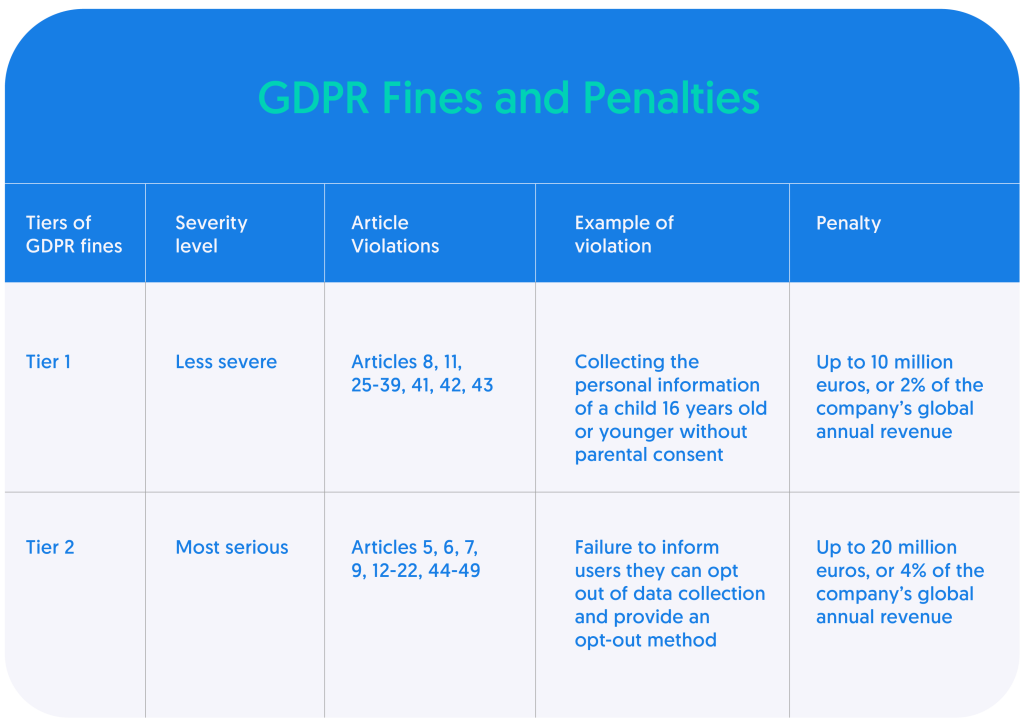
The GDPR has two tiers of fines. The higher tier covers violations of legal bases, information duties and data subject rights, which are exactly the points that matter in cold outreach.
The cap set by Art. 83 GDPR is 10 million euros or 2 percent of worldwide annual turnover for the lower tier and 20 million euros or 4 percent for the higher tier. These caps have applied since 2018 and are not new.
A case from the Netherlands shows how seriously authorities take transparency. In December 2024 the Dutch data protection authority imposed a fine of 4.75 million euros on Netflix because customers had not been informed clearly enough about the processing of their data. Netflix has objected.
If a data breach occurs, Art. 33 GDPR requires notifying the supervisory authority where feasible within 72 hours of becoming aware of it.
Practical setup in the CRM
Most duties can be covered with a few fields and rules in the CRM. What matters is that every campaign works from the same data.
- Source per contact: where does the data come from? You need this for the information under Art. 14.
- Legal basis and channel: is there consent for email, or only legitimate interest for other channels?
- Suppression list: unsubscribes and objections apply immediately to all campaigns and all tools.
- Deletion rules: delete contacts without a response after a set period and document that period.
- Record of processing activities: describe cold outreach as a processing activity of its own.

How to set up the technical side cleanly is covered in the post on technical requirements for cold email (in German). For deliverability, see the post on avoiding blacklisting during B2B prospecting.
Companies outside the EU
Companies based outside the EU are also subject to the GDPR when they target people in the EU. In many cases they must appoint a representative in the EU.
The duty follows from Art. 27 GDPR. Exceptions apply only to occasional, low-risk processing. A violation falls under the lower fine tier of Art. 83 (4) GDPR.
FAQ
Do B2B sales teams need consent for every cold email?
In Germany, yes. Processing the data can usually rely on legitimate interest under the GDPR, but the UWG requires prior express consent for advertising by email, in B2B as well. Other EU countries have their own rules, so check the law of the recipient’s country.
Do I have to tell contacts where I got their data?
Yes. If the data was not collected from the contact, Art. 14 GDPR requires information about the controller, the purpose and the source. When you contact the person, this must happen at the latest with the first message.
What applies if my company is based outside the EU?
The GDPR still applies if you target people in the EU. Under Art. 27 GDPR, you must appoint a representative in the EU in many cases.
What documentation do I need for GDPR-compliant outbound?
A record of processing activities, a documented balancing test for legitimate interest, the source per contact, a suppression list for objections and defined deletion periods. For email advertising, also proof of consent.
This post is not legal advice. Have your specific approach reviewed by a lawyer.
Sources
- GDPR Art. 6: Lawfulness of processing
- GDPR Recital 47: Legitimate interests
- GDPR Art. 14: Information where data was not obtained from the data subject
- GDPR Art. 21: Right to object
- GDPR Art. 27: Representatives of controllers not established in the Union
- GDPR Art. 33: Notification to the supervisory authority
- GDPR Art. 83: Administrative fines
- Gesetze im Internet: Act against Unfair Competition, Section 7
- IHK München: Marketing per E-Mail, Telefon, Brief (German)
- Stibbe: EUR 4.75 million fine for Netflix from Dutch GDPR watchdog