

SaaS pricing models are in motion: according to Growth Unhinged, 42% of the companies in its index adjusted their prices in the first three quarters of 2024 alone, with an average increase of 20%. Value based pricing saas approaches start exactly here: the price follows the value to the customer, not internal costs. We deliberately do not quote industry figures on the effect on retention or contract value, because we have no verified primary source for them.
Key Takeaways
- Market development: in the first three quarters of 2024, 42% of the companies in the Growth Unhinged index adjusted their prices, with an average increase of 20%
- Performance benefits: prices tied to customer value can improve retention and contract value because customers perceive the price as fair
- Metric evolution: usage-based models tie the price to consumption and lower the entry barrier, but need reliable measurement infrastructure
- Implementation: Van Westendorp analysis uses a customer survey to estimate the optimal price point and the acceptable price range
- Hybrid approaches: a base fee combined with usage-based billing reduces uncertainty for customers
Moving Away from Per-User Pricing: Why Value-Based Alternatives Deserve a Look
Definition and Distinction from Traditional Models
Value-based pricing for SaaS is a customer-centric approach in which pricing is based on the value actually delivered, not on production costs or competitor prices. In contrast to cost-based pricing, which orients itself on internal cost structures plus a desired margin, this approach puts measurable customer benefit at the center. The fundamental difference lies in the basis for the price: while cost-plus pricing stays rigidly tied to production costs, value-based pricing adapts dynamically to the value the customer realizes.
Sources report different market shares, but the picture is consistent: per-user pricing is still widespread, with usage-based and hybrid models added on top. Exact shares depend heavily on sample and survey, which is why we do not quote a single figure here. Companies recognize the limits of rigid subscription models and look for more flexible approaches that tie the price directly to customer success.
Competition-based pricing loses relevance when pure competitor orientation leads to price wars and margin erosion. Instead, successful SaaS companies focus on monetizing their unique value proposition.
→ More information: Fractional CMO – definition, responsibilites & cost.
Performance Metrics and Business Benefits
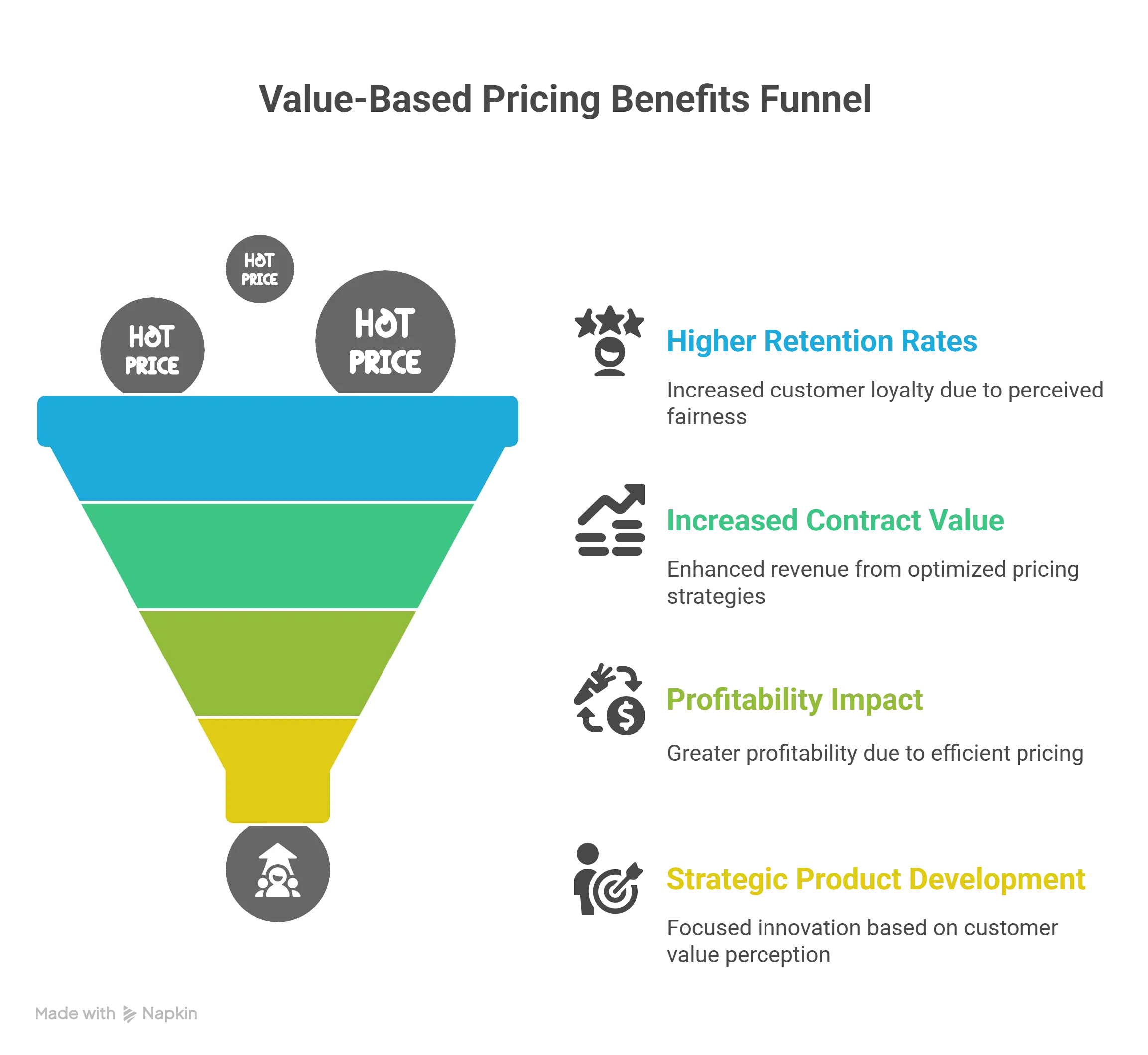
The possible benefits of value-based pricing lie in retention and contract value: when customers pay premium prices for demonstrable value, contract values rise, and customers who perceive the price as fair are more likely to stay. How strong this effect is depends on the product, the segment and how well the benefit can be measured.
The profitability impact goes beyond simple price increases. Strategic pricing captures additional value without raising customer acquisition or operating costs proportionally. When customers pay amounts that reflect their willingness to pay instead of arbitrary cost-plus calculations, companies can aim for higher margins at constant customer satisfaction.
The value-based pricing advantages and disadvantages show up especially in customer loyalty. When pricing matches perceived value, customers are happier with their purchase decisions. This can reduce churn and increase customer lifetime value. Fair pricing strengthens the bond between customers and vendors, an important factor in the subscription economy.
The Three Key Value Metrics: Per-User, Usage-Based and Outcome-Based Models
Per-User Pricing: Simplicity with Limits
Per-user pricing offers simplicity and predictability. Slack and Salesforce bill their paid plans per user and month according to their pricing pages (Slack, Salesforce). The clear structure lets customers calculate costs easily and plan budgets accordingly. However, this approach often creates adoption friction, because organizations may restrict user access to control costs.
The challenge is the decoupling of price and actual value. With a linear price per user, a company with 100 users pays ten times what a company with 10 users pays, regardless of whether it receives ten times the benefit. This gap often leads to dissatisfaction, especially when only a fraction of the licensed users actively use the product. Modern SaaS companies respond with hybrid approaches that combine per-user pricing with other metrics.
Usage-Based Pricing: Dynamics with Complexity
Usage-based models align costs directly with customer consumption and remove adoption barriers through pay-as-you-go structures. One example is New Relic, which according to its own announcement replaced host-based pricing with pricing by users and ingested data. The perceived value pricing component is particularly strong here, since customers only pay for the resources they actually use.
Implementation, however, requires sophisticated measurement infrastructure and can lead to unpredictable bills for customers. Companies have to balance flexibility and predictability. Successful implementations often offer caps, commitments or hybrid models that combine base fees with usage-based billing. These approaches reduce uncertainty for customers while offering the flexibility modern companies expect.
Outcome-Based Pricing: The Highest Form of Value Alignment
Outcome-based pricing is the most sophisticated approach and ties pricing directly to achieved business results. It creates close alignment between vendor and customer success and positions the vendor as a strategic partner instead of a mere tool supplier.
The challenge is measurability and attribution of results. Companies must define clear KPIs and implement robust measurement mechanisms. This requires deep industry knowledge and close collaboration with customers. Successful implementations focus on measurable metrics such as revenue growth, cost savings or efficiency gains that can be attributed directly to the SaaS product.
The Implementation Framework: From Customer Research to Execution
Market Research and Customer Segmentation
Successful implementation of a value-based pricing strategy begins with comprehensive market research. Companies must understand the needs, pain points and value perceptions of their target customers. This research should go beyond superficial surveys and include detailed customer interviews, focus groups and behavioral analysis. Identifying measurable benefits and their financial or operational impact on customer organizations is especially important.
Customer segmentation forms the foundation of effective pricing strategies. Organizations should divide their customer base into distinct segments based on shared characteristics such as company size, industry, usage patterns and value realization. Each segment typically has different value perceptions and willingness-to-pay thresholds. Enterprise customers, for example, often prioritize integration capabilities and security features, while small businesses focus on ease of use and cost efficiency.
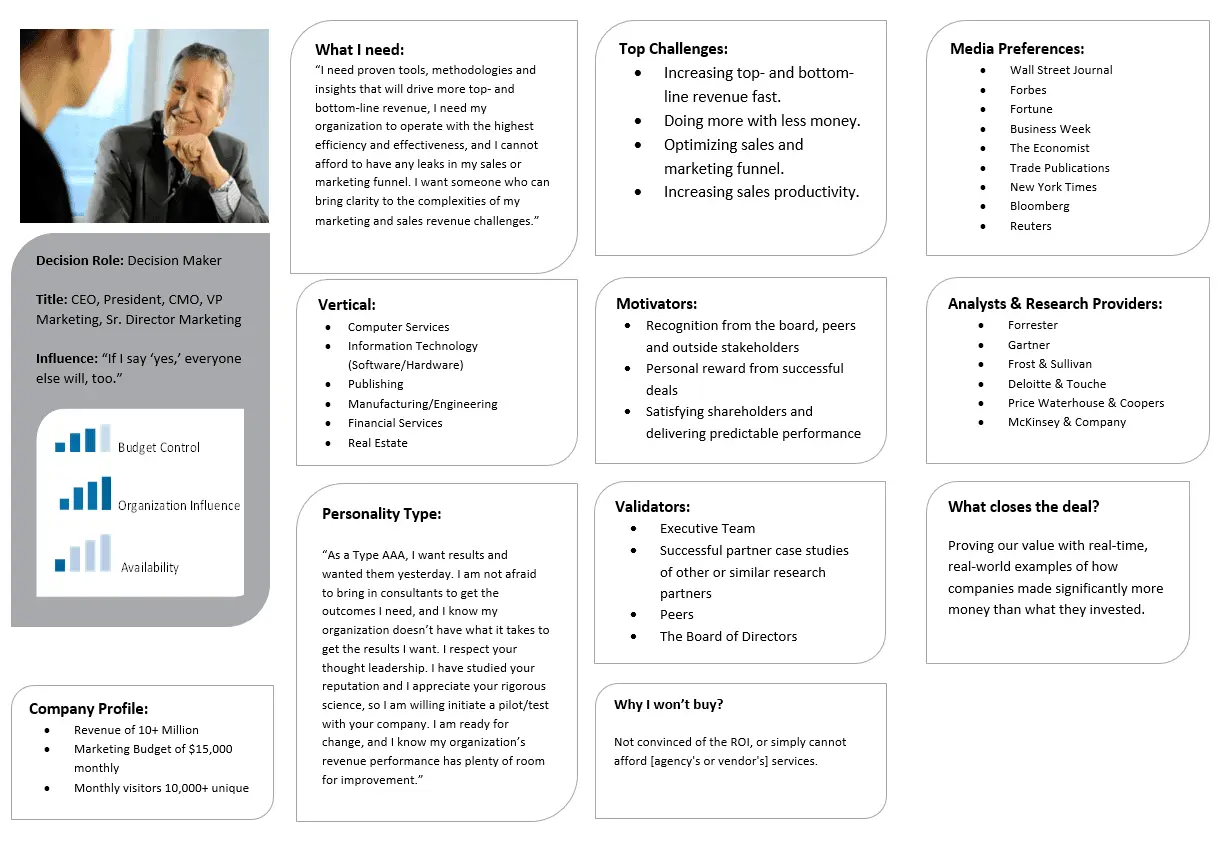
Developing precise buyer personas is essential for product-market fit refinement. B2B buyer personas should contain detailed information about the target buyer’s role and responsibilities, obstacles and challenges, key vendor selection criteria, budget constraints and success metrics. These personas guide pricing decisions and ensure that value propositions match specific customer needs.
Pricing Model Selection and Communication Strategy
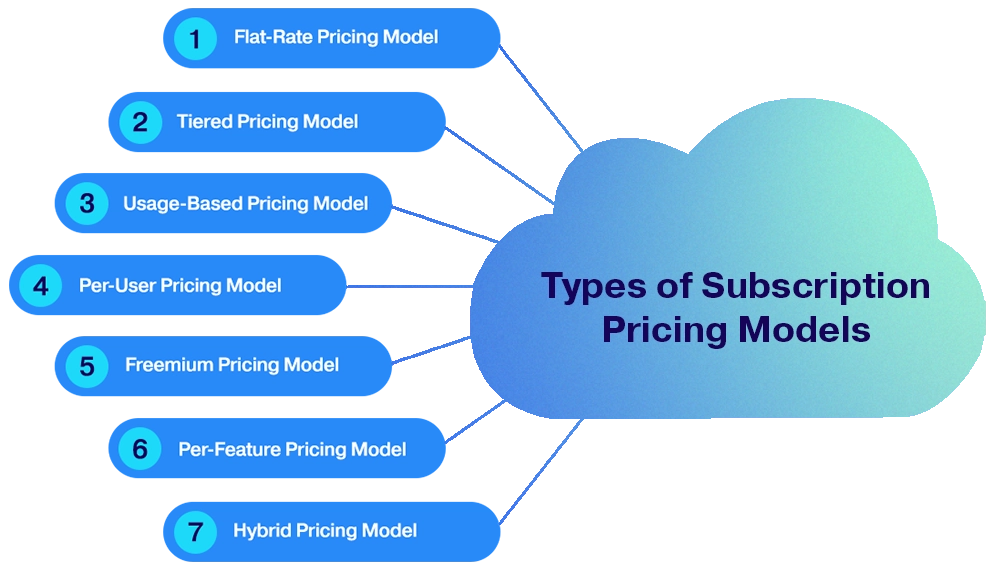
Choosing the right pricing model requires careful consideration of how different approaches match value delivery mechanisms. Companies must choose between tiered, usage-based, outcome-based or hybrid pricing. The chosen model should reflect how customers actually derive value from the product, whether through feature access, usage volume or achieved business results.
An effective communication strategy ensures that value propositions resonate with target audiences throughout the sales process. Early and frequent communication with customers becomes essential for the success of value-based pricing. It provides insight into what resonates with customers and what needs adjustment. Companies should introduce value-based pricing gradually, starting with small groups of existing customers or new clients, to test market response.
Measuring Willingness to Pay: Van Westendorp Analysis and Modern Methods
The Van Westendorp Price Sensitivity Method
The Van Westendorp price sensitivity analysis offers a structured method for assessing customer price sensitivity through four critical questions. Customers are asked to name the price points at which they would consider the product too expensive, expensive but still worth buying, a bargain, or too cheap. By analyzing the intersections of the response curves, companies can identify optimal price points and acceptable price ranges. The result should then be validated in real purchase situations.
The value-based pricing formula here rests on aggregating individual price perceptions into an overall picture of market demand. The method is especially valuable for new products or features where historical data is missing. The analysis delivers not only price points but also insight into the price elasticity of different customer segments.
Conjoint Analysis and Revealed Preference
Conjoint analysis offers a sophisticated approach to measuring willingness to pay by presenting customers with different product configurations and price points. The method reveals how customers trade off features against price, quantifies the value of individual features and identifies price elasticity across customer segments.
Revealed preference analysis examines actual customer behavior instead of hypothetical answers and provides more reliable insight into true willingness to pay. This approach includes A/B tests of different price levels with real prospects, analysis of conversion rates across promotional offers, and measurement of upgrade and downgrade patterns between tiers.
Value Based Pricing SaaS Examples: Successful Implementations in Practice
Salesforce and HubSpot: Masters of Tiered Value Creation
According to its own pricing page, Salesforce tiers Sales Cloud into several editions, from a free suite up to Max, billed per user and month. AI features and analytics are only included in higher editions. This is an example of tiers that rise with feature scope; how closely they track customer value is our interpretation. Customers can grow organically and scale their investment with their own company development.
→ More about the fractional CMO model in Germany.
HubSpot’s Marketing Hub pricing combines several value metrics: the price depends on the edition, the included seats and the number of marketing contacts. Additional contacts and seats can be purchased. HubSpot’s approach illustrates how companies can mix metrics to link customer growth and price.
New Relic and Slack: Transformation and Innovation
According to its own announcement, New Relic replaced host-based pricing with billing by users and ingested data. That is a shift from a price per infrastructure unit to a price tied to actual data consumption.
Slack combines per-seat pricing with tiered feature access. According to its pricing page, there is currently a free plan plus the paid plans Pro, Business+ and Enterprise+. The free plan limits message history to 90 days and integrations to up to 10 apps. This structure lets customers choose prices that fit their organizational needs and offers clear upgrade paths.
Avoiding the Five Fatal Pricing Mistakes That Hold Back SaaS Growth
Misunderstanding Customer Value and One-Size-Fits-All Approaches
One of the most significant mistakes is misunderstanding customer value drivers. Companies often assume they know what customers value without doing proper research. This assumption frequently leads to pricing strategies that emphasize features or capabilities customers do not actually prioritize. The result is price resistance and competitive disadvantages that can slow growth.
One-size-fits-all pricing is another common trap that limits the effectiveness of value-based pricing. Every customer segment has different value perceptions and price preferences, which makes uniform pricing strategies suboptimal for capturing maximum value across diverse customer bases. Companies should implement tiered, usage-based or customer-specific pricing approaches that fit different segments and their specific needs.
Underpricing and Communication Failures
Underpricing remains a persistent challenge, especially for early-stage SaaS companies that fear losing customers through premium pricing. Pricing below customers’ willingness to pay leaves revenue on the table. This restraint is often due to a lack of confidence in the product’s own value. Organizations should use A/B testing and data analysis to identify optimal price points that maximize revenue without sacrificing customer acquisition rates.
Communication failures can undermine even well-designed value-based pricing strategies. Companies must clearly demonstrate return on investment through case studies, testimonials and value-based selling approaches. The distinction between demand generation and demand capture becomes especially important here, since the two require different communication strategies. Without effective value communication, customers may not recognize the full benefits they receive, which leads to price sensitivity and vulnerability to competitors.
Implementation Complexity and New Challenges
The complexity and resource requirements of value-based pricing can create implementation barriers for many organizations. Done properly, it can be time-consuming and expensive and requires investment in market research, customer analysis and pricing infrastructure. Companies must weigh implementation costs against the potential benefits and make sure organizational capabilities match the demands of sophisticated pricing strategies.
The emergence of AI-driven services and high-cost infrastructure creates new challenges for traditional value-based pricing approaches. These technologies often require substantial upfront investment while customer value is realized over time. Companies must develop innovative pricing models that account for this dynamic, such as outcome-based contracts or tiered value realization models. Integrating product-market fit considerations into the pricing strategy is becoming increasingly critical for sustainable success.
Frequently Asked Questions
How do you calculate the optimal price with the value-based pricing formula?
The value-based pricing formula is not a single mathematical equation but the systematic capture of customer value perceptions. Companies combine Van Westendorp analyses, conjoint studies and actual behavioral data to find the optimal price point. It typically sits where maximum customer value and willingness to pay meet.
What value-based pricing advantages and disadvantages should I consider?
The main advantages are higher retention, better margins and stronger customer relationships. Disadvantages are the high implementation effort, the need for continuous market research and the complexity of measuring value. The initial investment in data infrastructure and in training sales and customer success teams on value-based communication is especially challenging.
How does perceived value pricing differ from other value-based approaches?
Perceived value pricing focuses on the customer’s subjective perception of value, not on objectively measurable results. While outcome-based pricing measures concrete KPIs such as revenue growth, perceived value pricing rests on emotional and psychological factors such as brand perception, ease of use and perceived innovation. This method suits products whose benefit is hard to quantify.
When should I use cost-plus pricing instead of value-based pricing?
Cost-plus pricing can make sense in highly standardized markets with little differentiation, where customers decide mainly on price. It can also be more practical at first for entirely new product categories without an established value perception, or in regulated industries with price transparency requirements. The move to value-based models should happen once clear differentiators and customer value data are available.