

As of June 2026, Revenue Operations has evolved from an experimental function into the dominant architecture for aligning sales, marketing, and customer success in B2B companies. Modern buyers complete most of their research independently, budgets face tighter scrutiny, and growth must be efficient rather than purely aggressive. This playbook delivers a complete implementation framework for RevOps, from mandate and governance to lifecycle design and AI readiness, based on patterns I see deployed across DACH mid-market companies.
For the current numbers on adoption, budgets and ROI across B2B teams, see our AI in B2B marketing statistics.
TL;DR
RevOps unifies sales, marketing, and customer success under shared data, processes, and metrics spanning the entire customer lifecycle. It eliminates silo conflicts, improves forecast accuracy, and turns disconnected tools into a coherent revenue engine. This playbook shows how to design the operating model, architect lifecycle processes, and implement a 90-day maturity program.
- End-to-end ownership across account selection, demand, closing, onboarding, renewal, and expansion reduces handoff friction and aligns teams around customer value.
- Single source of truth for revenue data eliminates interpretive conflicts when sales questions marketing pipeline or finance reviews forecast reliability.
- Cross-functional KPIs like pipeline conversion, net revenue retention, and sales efficiency replace departmental vanity metrics and drive collaborative behaviour.
What is Revenue Operations in B2B Companies
Quick Answer: Revenue Operations is a strategic framework that unifies sales, marketing, and customer success teams under common goals, data, and processes. It replaces siloed planning and overlapping tools with a single architecture spanning target account selection to multi-year renewal.
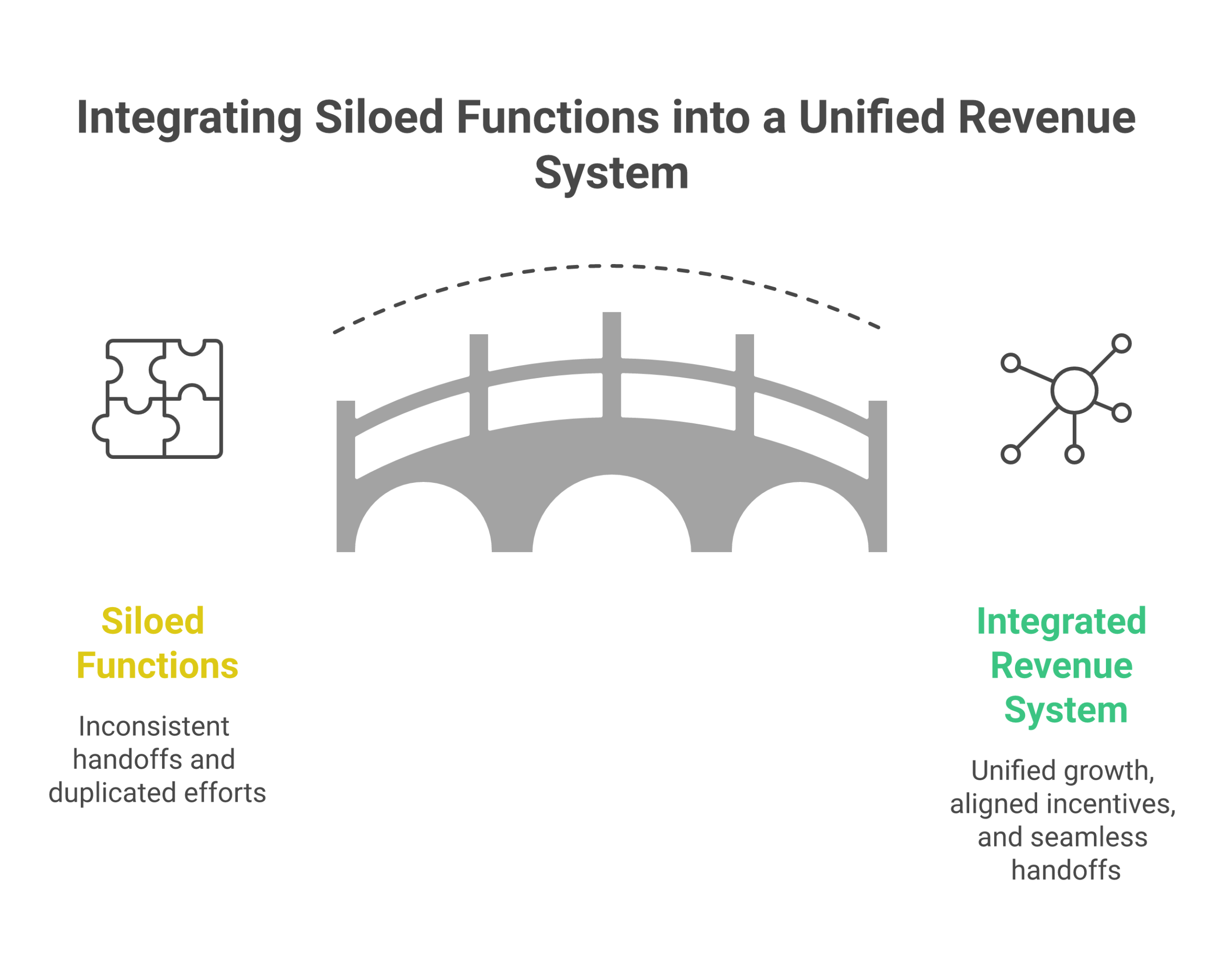
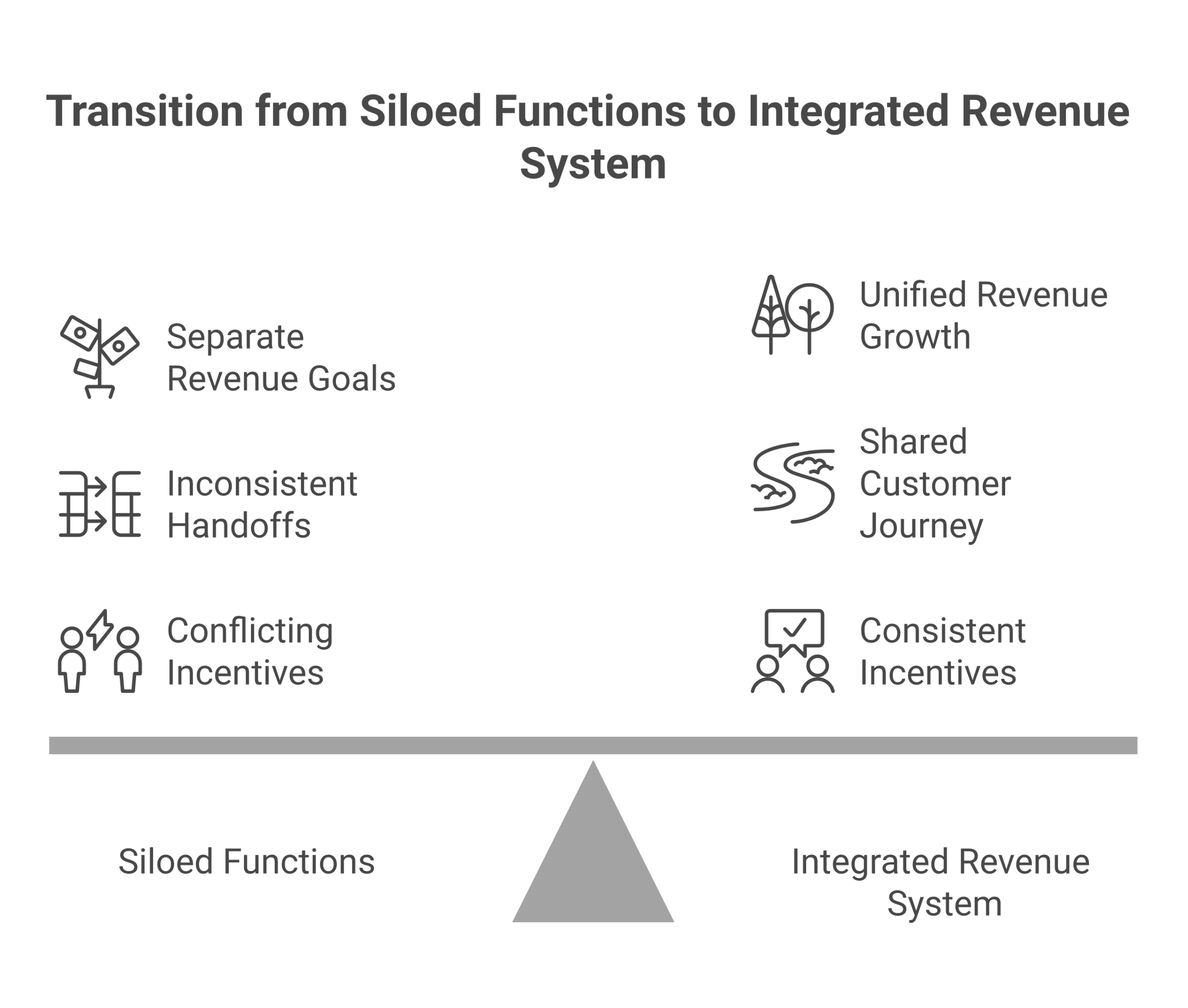
The fundamental problem RevOps solves is structural misalignment. Marketing measures leads, sales tracks bookings, customer success owns renewals. Each uses separate tools and interprets data differently. Handoffs break, incentives conflict, and growth suffers.
RevOps reframes this as a system design problem. It creates interconnected processes, shared definitions, and governance spanning all revenue activities. Instead of producing reports, RevOps curates the customer journey and aligns people, platforms, and metrics around it.
This shift has real consequences for decision-making. Which markets to prioritize, how to structure territories, how to balance new bookings against expansion – these questions get addressed with a holistic lens rather than departmental lobbying.
Takeaway: RevOps is custodian of the revenue engine, not an administrative support function.
RevOps vs Sales Operations
Sales Operations traditionally focuses on sales process, territory planning, quota management, and CRM administration. RevOps encompasses that scope but extends it across marketing and customer success.
The critical difference is lifecycle breadth. Sales Ops cares about opportunity stages and close rates. RevOps owns the connective tissue from demand generation through renewal, ensuring marketing’s qualified accounts meet sales’ acceptance criteria and that customer success data informs acquisition strategy.
When you centralize responsibility for the entire lifecycle, conflicts dissolve. Marketing no longer optimizes for volume that sales rejects. Customer success churn insights feed directly into ICP refinement.
RevOps vs Marketing Operations
Marketing Operations manages campaign execution, automation platforms, and lead workflows. RevOps integrates those efforts with sales and customer success for end-to-end performance.
Marketing Ops ensures emails deploy correctly and landing pages convert. RevOps ensures those conversions meet a shared definition of qualified, that handoffs to sales happen on time, and that pipeline metrics connect to business outcomes.
In practice, Marketing Ops often reports into or collaborates closely with RevOps to maintain alignment on data schemas, lifecycle stages, and shared KPIs.
The Business Case: How RevOps Drives EBITDA and Efficient Growth
Quick Answer: RevOps improves profitability by reducing redundant tool spend, improving sales efficiency, and increasing net revenue retention. It aligns acquisition cost with customer lifetime value and eliminates waste caused by poor handoffs and conflicting metrics.
Macroeconomic uncertainty in 2026 has shifted investor expectations toward rule-of-40 models. Companies must demonstrate efficient growth: revenue expansion paired with controlled cost and strong unit economics.
RevOps directly impacts three levers of profitability. First, it consolidates technology spend. When each function procures its own tools, overlapping subscriptions proliferate. RevOps evaluates the full stack and rationalizes platforms.
Second, RevOps improves sales efficiency. Clear qualification criteria mean sellers spend time on winnable deals. Forecasting accuracy improves, reducing the cost of missed quarters. Territory design balances coverage and quota attainability.
Third, RevOps lifts net revenue retention by closing the loop between customer success health scores and acquisition targeting. When churn patterns inform ICP updates, acquisition becomes more durable.
Takeaway: RevOps converts operational discipline into measurable margin improvement and capital efficiency.
Metrics That Matter to the CFO
Finance cares about customer acquisition cost payback, lifetime value to CAC ratio, and forecast variance. RevOps owns the systems that generate these numbers with integrity.
- CAC payback period shortens when lead quality improves and conversion rates rise.
- LTV expands when RevOps aligns retention and expansion motions with initial fit.
- Forecast accuracy increases when pipeline hygiene and stage criteria are enforced consistently.
I see CFOs treat RevOps as a strategic partner once it demonstrates reliable data governance and process discipline. The function earns budget authority and hiring priority when it proves it can de-risk revenue delivery.
Building the Data Foundation: CRM Hygiene and Documentation
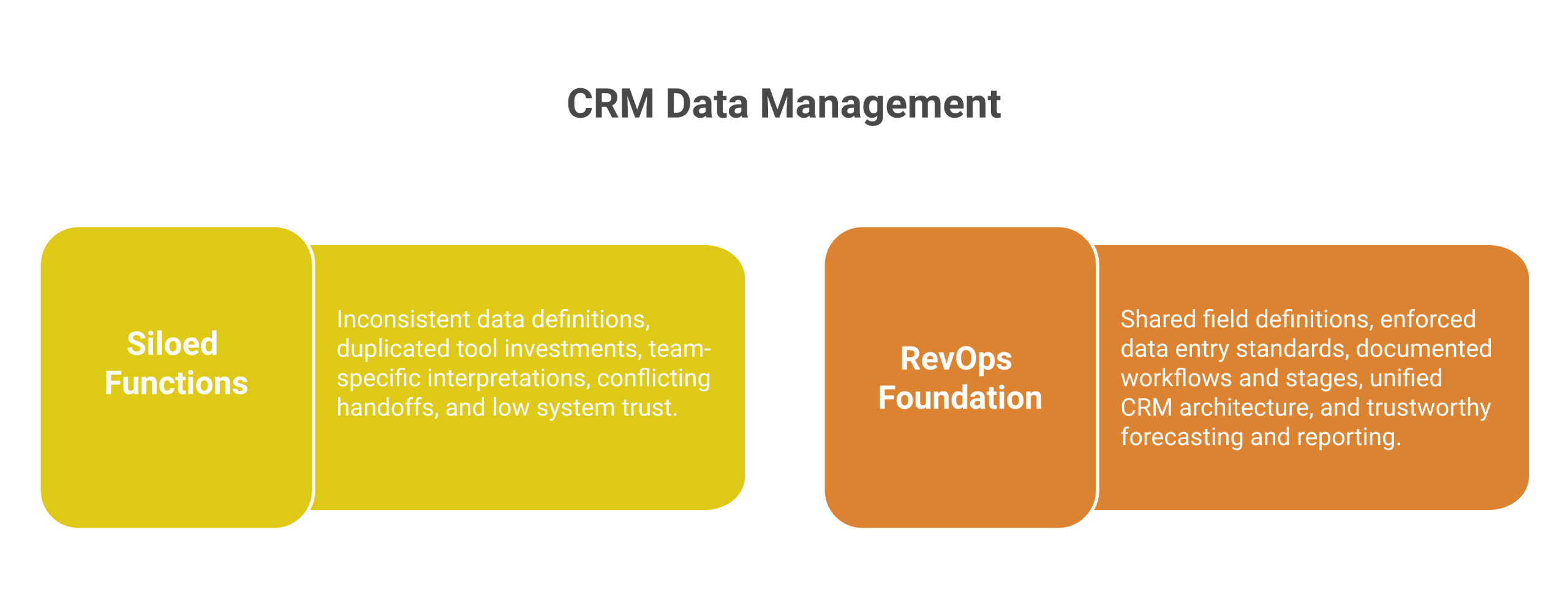
Quick Answer: Clean, well-structured CRM data is the foundation for forecasting, reporting, and AI deployment. RevOps enforces shared definitions, mandates data entry standards, and documents every field, stage, and workflow so teams trust the system.
Revenue systems are only as effective as the data inside them. Garbage in, garbage out applies brutally in B2B operations. Without shared definitions and entry discipline, reporting becomes interpretive art rather than reliable insight.
RevOps must define and document every core object: what constitutes an account, a lead, an opportunity, a qualified stage. Each lifecycle stage needs objective entry criteria. Subjective judgment invites inconsistency.
Field-level governance matters. Which fields are required at each stage? Who owns updates? What happens when sales disagrees with a marketing source attribution? RevOps writes these rules, trains teams, and audits compliance.
Takeaway: Documentation transforms the CRM from a black box into a shared operating manual.
Common Data Quality Pitfalls
The most common failure is orphaned records. Leads enter the system but never get qualified or disqualified. Opportunities linger in pipeline for months without activity. Accounts lack ownership or territory assignment.
Another trap is duplicate records. Without deduplication rules and merge workflows, the same company appears three times under variant names. Reporting breaks, and sellers waste time chasing the same contact.
A third issue is missing or inconsistent industry, region, or revenue data. Segmentation and territory logic depend on firmographic accuracy. RevOps must either enforce manual entry or integrate enrichment services.
| Metric | Target | Why It Matters |
|---|---|---|
| Required field completion rate | >95% | Enables reliable segmentation and reporting |
| Duplicate account rate | <2% | Prevents territory conflicts and skewed analytics |
| Stale opportunity ratio (no activity >30 days) | <10% | Ensures forecast reflects real pipeline health |
| Unassigned lead age (median days) | <1 day | Speeds response time and improves conversion |
Lead Management and MQL-to-SQL Handoff
Quick Answer: A formal Service Level Agreement between marketing and sales defines what qualifies as a marketing-qualified lead, how quickly sales must respond, and how rejected leads are routed back. This SLA eliminates blame and focuses both teams on conversion.
The handoff from marketing to sales is the highest-stakes process transition in the revenue lifecycle. When it works, pipeline fills with winnable opportunities. When it breaks, marketing burns budget on leads sales ignores, and sales complains about quality.
RevOps mediates this tension by codifying a lead management SLA. Marketing commits to delivering leads that meet agreed fit and engagement criteria. Sales commits to contacting those leads within a defined window and providing disposition feedback.
The SLA specifies objective qualification criteria: firmographic fit (industry, size, geography), engagement threshold (content downloads, demo requests, event attendance), and intent signals (pricing page visits, competitor searches). Leads meeting all criteria become MQLs.
Sales accepts or rejects each MQL within the SLA window, typically 24 hours. Accepted leads become Sales Accepted Leads (SALs) and enter active follow-up. Rejected leads return to marketing with a documented reason: wrong fit, not ready, duplicate, or other.
Takeaway: The SLA turns a blame cycle into a feedback loop that improves targeting and conversion over time.
Routing and Response Automation
Manual lead assignment introduces delay and error. RevOps automates routing based on territory, account ownership, product line, or round-robin logic.
- Named account leads route to the assigned account executive immediately.
- New territory leads distribute via round-robin with capacity weighting.
- Inbound demo requests trigger instant Slack or email alerts to the owner.
Automation also tracks SLA compliance. If a seller hasn’t touched a lead within 24 hours, escalation workflows notify the manager. Dashboards show acceptance rates, contact rates, and conversion by source.
Forecasting: From Forecast Call to Forecasting Process
Quick Answer: Reliable forecasting requires standardized opportunity stages, rigorous pipeline hygiene, and a repeatable submission process. RevOps builds the structure so forecast calls focus on strategy rather than data archaeology.
Most B2B organizations run weekly or biweekly forecast calls. Sales leaders present their pipeline, finance scrutinizes the numbers, and executives decide whether to adjust hiring or spending.
Without RevOps, these calls devolve into arguments about data quality. Which deals are real? Why did this opportunity appear overnight? Why hasn’t that stage moved in six weeks?
RevOps transforms forecasting from an interrogation into a decision process by enforcing pipeline discipline year-round. Each opportunity stage has entry criteria, required fields, and expected duration. Deals that violate these norms get flagged automatically.
RevOps also defines forecast categories: commit (high confidence, near-term close), best case (qualified but uncertain timing), and pipeline (early stage). Sellers submit categorized forecasts in the CRM, managers review and adjust, and RevOps aggregates into executive dashboards.
The forecast call itself becomes strategic. Instead of debating whether a deal is real, the team discusses win strategy, competitive threats, and resource allocation. Trust in the numbers allows faster, better decisions.
Takeaway: Forecasting is a process, not an event, and RevOps owns the infrastructure that makes it reliable.
Leading Indicators Beyond Pipeline Coverage
Pipeline coverage ratio (total pipeline divided by quota) is necessary but insufficient. RevOps tracks velocity and conversion metrics that predict future performance.
- Stage conversion rates (MQL to SQL, SQL to closed-won) identify where deals stall.
- Average sales cycle length by segment and product reveals capacity needs.
- New opportunity creation rate signals whether top-of-funnel is healthy.
When these indicators trend down, RevOps raises the alarm before the quarterly number misses. Early warning allows corrective action: accelerating campaigns, reallocating headcount, or adjusting targets.
Retention and Expansion as RevOps Metrics
Quick Answer: Net revenue retention, churn analysis, and expansion pipeline are core RevOps responsibilities. They connect customer success activities to overall revenue strategy and inform acquisition decisions by revealing which customers deliver durable value.
For many B2B SaaS and subscription businesses, retention and expansion contribute more to ARR growth than new bookings. RevOps must therefore treat the post-sale lifecycle with the same rigor as acquisition.
Net revenue retention (NRR) measures revenue from a cohort of customers over time, including upgrades, cross-sells, and churn. An NRR above 100 percent means existing customers are growing faster than they are leaving.
RevOps calculates NRR by segment, product, and cohort vintage. This granularity reveals which ICPs deliver sustainable growth and which require too much service cost relative to expansion potential.
Churn analysis goes deeper. RevOps categorizes churn by reason (product fit, competitor win, budget cut, usage decline) and by customer profile. Patterns emerge: certain industries churn faster, deals below a revenue threshold rarely expand, or customers acquired via one channel retain better than others.
These insights feed directly back into acquisition strategy. If enterprise customers in manufacturing retain at 95 percent while SMB e-commerce churn at 40 percent, RevOps adjusts ICP definitions and demand programs accordingly.
Takeaway: Treating retention as a RevOps metric closes the loop between what you sell and what actually drives long-term value.
Expansion Pipeline Management
Expansion opportunities (upsell, cross-sell, seat growth) require the same pipeline discipline as new business. RevOps defines expansion stages, qualification criteria, and ownership rules.
Customer success managers often identify expansion signals: increased usage, new stakeholder engagement, or feature requests that map to higher tiers. RevOps ensures these signals convert into formal opportunities with clear next steps and forecast categories.
AI in Go-to-Market: Foundation Before Automation
Quick Answer: AI tools for lead scoring, opportunity prediction, and content personalization require clean data, well-defined processes, and continuous monitoring. RevOps manages deployment, validation, and governance to ensure AI enhances rather than amplifies existing problems.
By 2026, machine learning and generative AI are embedded across revenue platforms. CRMs score leads automatically, predict close probability, and suggest next-best actions. Marketing automation personalizes email content and landing pages based on firmographic and behavioral signals.
These capabilities promise efficiency and insight, but they depend entirely on data quality and process integrity. An AI model trained on messy CRM data produces unreliable scores. A lead-scoring algorithm that reflects historical bias amplifies that bias at scale.
RevOps must therefore treat AI deployment as a governance and change management challenge, not merely a technology implementation. Before enabling AI features, RevOps audits data quality, validates training datasets, and defines success criteria.
Once deployed, AI models require ongoing monitoring. RevOps tracks model accuracy, reviews edge cases where predictions fail, and retrains models as buyer behaviour or market conditions shift. This discipline prevents AI from becoming a black box that erodes trust.
Takeaway: AI accelerates revenue operations only when RevOps manages the foundation of data, process, and accountability.
Practical AI Use Cases in 2026
Lead scoring models combine fit (industry, size, tech stack) and engagement (web visits, content downloads) to rank inbound leads. RevOps validates scores against actual conversion data and adjusts weighting.
Opportunity risk prediction flags deals likely to slip or close-lost based on activity patterns, stage duration, and stakeholder engagement. Sales managers use these alerts to intervene early.
Content and messaging personalization tailors email copy, landing pages, and ad creative to vertical, role, or buying stage. RevOps ensures personalization rules align with brand guidelines and compliance requirements.
Implementing RevOps: Maturity Assessment and 90-Day Plan
Quick Answer: Start with a maturity assessment across mandate, data, process, and technology. Prioritize the highest-impact gaps, then execute a 90-day plan focused on quick wins that build credibility and momentum for longer-term transformation.
Most B2B companies already have fragments of RevOps: a sales operations manager, a marketing automation specialist, scattered process documentation. The challenge is evolving these pieces into a cohesive, empowered function.
Begin with a structured maturity assessment. Evaluate five dimensions: mandate clarity, data quality, process documentation, technology integration, and cross-functional governance. For each, score current state (ad hoc, defined, managed, optimized) and identify the biggest gaps.
Common patterns emerge. Early-stage companies lack formal processes and documentation. Growth-stage firms have tools but inconsistent data. Mature organizations struggle with governance and change management as complexity grows.
Once you understand current state, define the target operating model: what RevOps will own, how it will engage with other functions, which metrics it will report, and what success looks like in 12 months.
Then build a 90-day implementation plan focused on three to five high-impact initiatives. Quick wins build credibility. Examples: standardize opportunity stages and run a pipeline audit, implement an MQL-to-SQL SLA with automated routing, or launch a monthly revenue review with cross-functional KPIs.
Takeaway: RevOps transformation is iterative; start with foundations that prove value, then expand scope and sophistication over time.
Executive sponsorship is the first hurdle. Without a senior leader who champions RevOps, the function lacks authority and budget. Secure a CRO, COO, or CEO sponsor by framing RevOps as risk mitigation and efficiency gain, not just process improvement.
Data migration and cleanup often consume more time than planned. Resist the temptation to fix everything at once. Prioritize the data required for your 90-day initiatives, clean that subset rigorously, and tackle the rest in phases.
Resistance from sales, marketing, or customer success is natural when new processes impose constraints. Involve team leads early, solicit feedback, pilot changes with a small group, and demonstrate results before rolling out broadly. Trust is earned through delivery.
FAQ
What is Revenue Operations in B2B companies?
Revenue Operations (RevOps) is a strategic framework that unifies sales, marketing, and customer success teams under common goals, data, and processes. It aligns tools, metrics, and governance across the revenue lifecycle, improving operational efficiency, data accuracy, and cross-functional collaboration to drive predictable growth and customer value.
How does RevOps differ from traditional sales operations?
RevOps encompasses the entire revenue engine, including marketing and customer success, while sales operations traditionally focus only on sales processes. RevOps centralizes data, tools, and accountability across functions, reducing silos and ensuring consistent strategy execution throughout the customer journey from demand generation to renewal.
What are the main benefits of adopting a RevOps model?
Adopting a RevOps model improves revenue predictability, operational efficiency, and customer experience alignment. It reduces redundant tool investments, enhances data integrity, and fosters collaboration between teams. Businesses gain better decision-making through unified metrics, consistent processes, and coordinated go-to-market execution across acquisition, retention, and expansion stages.
How does RevOps compare to Marketing Operations?
Marketing Operations focuses primarily on campaign execution, automation, and lead management, while RevOps integrates these efforts with sales and customer success for end-to-end revenue performance. RevOps ensures marketing metrics connect directly to business outcomes, creating a shared responsibility for pipeline and revenue growth across departments.
What role does AI play in RevOps by 2026?
By 2026, AI automates lead scoring, opportunity forecasting, and customer insights within RevOps systems. It enhances decision accuracy and efficiency but relies on high-quality data and governance. RevOps teams manage AI deployment, validation, and monitoring to ensure machine-learning models align with strategic objectives and ethical data practices.
How does RevOps improve collaboration between teams?
RevOps creates shared definitions, unified processes, and transparent data governance that reduce conflicts between sales, marketing, and customer success. It provides centralized tools and metrics, facilitating cross-functional planning and performance reviews that align departments around common goals like customer retention, pipeline efficiency, and sustainable revenue growth.
RevOps vs Sales Enablement: what’s the difference?
Sales Enablement focuses on training, content, and tools that help sellers close deals, while RevOps designs the underlying systems and data architecture supporting the entire customer lifecycle. RevOps ensures all functions operate cohesively, whereas Sales Enablement concentrates specifically on front-line sales productivity and readiness.
Is RevOps essential for AI-driven B2B growth?
Yes, RevOps is foundational for AI-driven growth because it manages data quality, process integrity, and technology integration. Without RevOps, AI insights risk inconsistency or bias. A mature RevOps function ensures AI models are effectively embedded into workflows while maintaining alignment with organizational goals and accountability.
How does RevOps differ from Customer Success Operations?
Customer Success Operations supports retention and expansion, while RevOps connects these efforts to marketing and sales for a unified lifecycle perspective. RevOps optimizes processes, metrics, and systems that span all revenue-impacting stages, ensuring customer health data directly informs acquisition and renewal strategies across the business.
What KPIs define a successful RevOps function?
Key performance indicators for a mature RevOps function include net revenue retention, sales efficiency, pipeline conversion rates, customer acquisition cost payback, and forecast accuracy. These metrics reflect operational integration and the organization’s ability to generate consistent, efficient revenue through cross-functional alignment and process optimization.
Sources
This article synthesizes established RevOps frameworks and operational best practices observed across mid-market B2B organizations in DACH through 2026. No external citations were included in the research brief provided.
If you would rather not build Revenue Operations in-house, our RevOps services build the system and hand it over to you.