

Founder-led sales works until it doesn’t. The model delivers deep market insight and validates messaging early, but it caps revenue once the founder’s calendar fills. This guide shows when to shift from personal selling to a scalable sales team and what readiness signals matter most.
Readiness signals that justify the first sales hire
Most B2B founders should wait until they’ve closed at least ten clients and documented a repeatable sales process before hiring a sales rep. The new hire needs a tested motion to replicate, not a blank slate to build from scratch.
Repeatability is the core test. If every deal still requires a different pitch or workaround, the founder lacks the pattern needed to onboard someone else. Solid signals include:
- Closed-won deals follow similar discovery-to-close steps.
- Buyer objections and pain points cluster around a few recurring themes.
- Win rates stabilize across quarters, not just one lucky month.
- A CRM holds stage criteria, exit conditions, and win-rate data.
EBQ names four milestones: at least ten clients, a known product-market fit, a developed sales process, and a lead generation strategy. Missing any one creates risk. The rep will spend time inventing process instead of executing it.
A founder who has passed the ten-client mark and sees consistent buying patterns can start interviewing. Demand for go-to-market strategy clarity rises the moment revenue depends on someone else closing deals.
Takeaway: Repeatability beats revenue volume as the trigger to hire.
A SaaS team often sells the first deals itself and records win rate, cycle length and typical objections along the way. Then a part-time or junior role is filled that builds on this knowledge. This creates a scalable go-to-market process that does not depend on the founder.
Signals for the right hiring time
The first sales hire pays off when the founder keeps running the same sales stages, the forecast becomes reasonably reliable, and selling time slows down product progress. Then a new rep multiplies an existing process instead of inventing one, and the founder can return to strategy and product.
Pipedrive lists three signals for moving from founder-led to team-led sales: the company has passed $1 million in annual recurring revenue, the founder is facing burnout and needs to focus on fundraising or other parts of the business, or the founder consistently closes similar types of customers and hears the same objections. The last one is the clearest sign that a process can be handed off.
It is too early when target group, value proposition and process are not yet clearly documented. Missing documentation and inconsistent sales routines are a recurring brake. New sales hires often take weeks or months to become productive. Whoever scales too early pays a salary without a measurable pipeline.
- Repeatable patterns: The founder regularly runs through the same sales stages.
- Stable metrics: Win rate and cycle length stay similar over several months.
- Documented playbook: Guides, scripts and follow-up protocols exist and can be reused.
- Founder bottleneck: The founder’s selling time blocks product development or delivery.
Volume and conversion thresholds that de-risk hiring
Dock’s startup sales guide ties the hiring decision to numbers: demo volume, win rate and average contract value should show that the market responds predictably and that messaging works beyond the founder’s personal brand.
Sales volume thresholds help filter noise from signal. Counting demos, tracking the win rate, and watching average contract value all show whether buyer behavior is predictable enough to train a rep on.
Quarter-over-quarter revenue growth, visible demand, and paying customers all signal the founder is ready to hand off execution. Without these, the first rep becomes a market-validation test rather than a scaling lever.
Takeaway: Conversion patterns matter more than raw demo counts.
Role design and candidate profile for the first hire
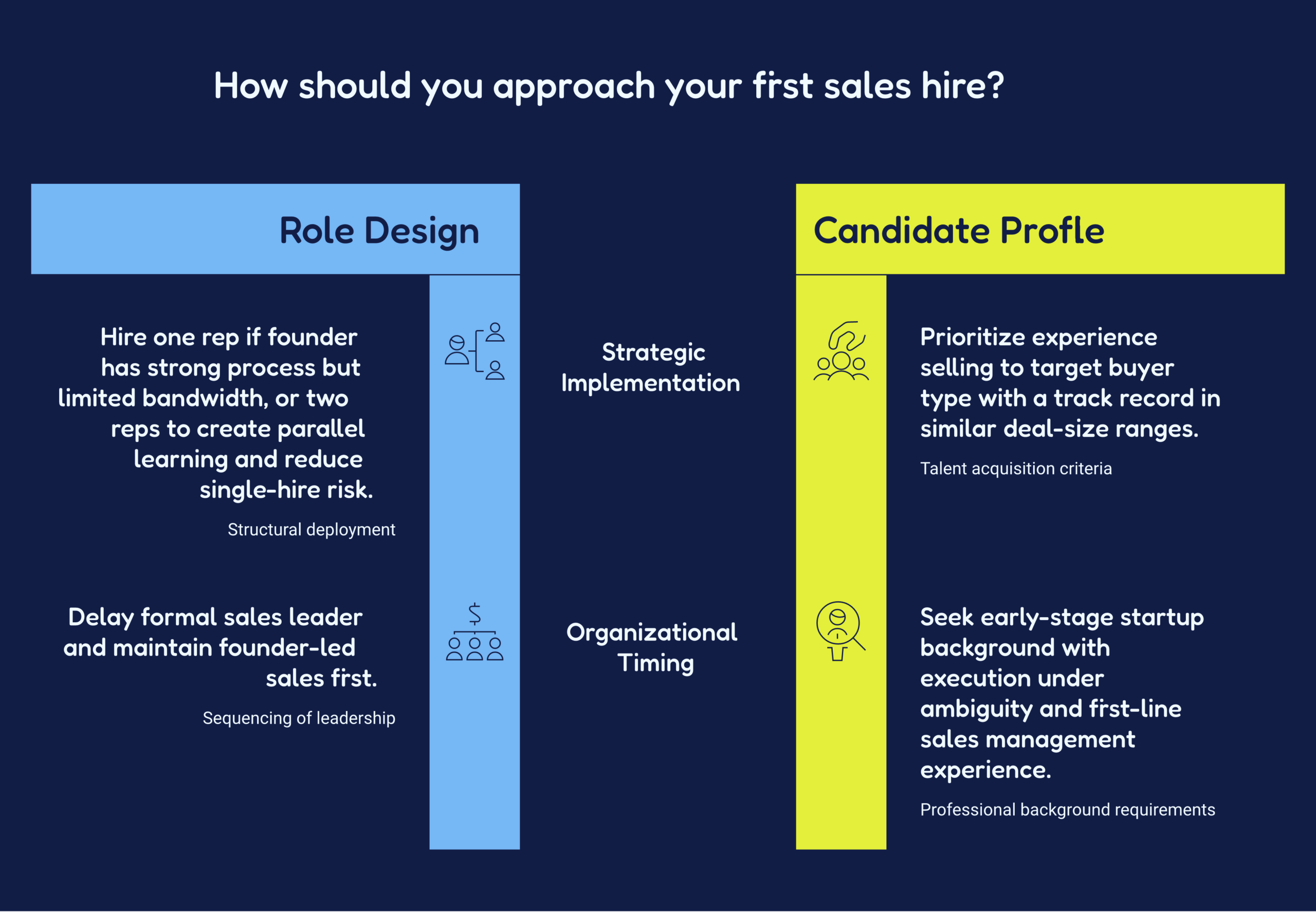
The first sales hire should have sold to the same buyer type and closed deals in a similar size range, as Kellblog argues. Execution under ambiguity is essential because the role demands building repeatable motion, not maintaining an established one.
Role design comes first. Some founders hire a sales assistant to document the existing motion before onboarding a quota-carrying rep. Others skip straight to a full rep once repeatability is clear. The right choice depends on whether the founder needs process support or immediate execution capacity. In the early phase a part-time or junior role is often the more flexible and cheaper option while the founder keeps closing deals.
Several roles should not just be delegated before the first sales hire but cleanly separated: lead generation, closer and account management can later be different functions. To start, a sales-adjacent working-student or junior role for prospecting and follow-up is practical, while the founder keeps running demos and closing. That keeps control with the founder, but routine tasks are taken off their plate.
Takeaway: Part-time relieves, full-time scales, but only once the process is in place.
Candidate profile priorities, following Kellblog:
- Has sold to the target buyer before
- Has closed deals in the company’s current deal-size range
- Is a committed seller with the executive presence to work a level above the target buyer
- Has significant first-line sales management experience
- Is willing to join early and work closely with the founder
Kellblog notes that you can save six to twelve months of onboarding time by hiring someone who has already sold to your target buyer.
Techstars (March 2026) calls hiring a salesperson in the earliest stage often a mistake and says founder-led sales should in many cases last one to two years. The right time comes when the founder has enough pattern recognition to teach someone else; the job of a sales leader is to scale an existing playbook, not to discover one. The first hire should carry quota and refine the playbook, not manage a nonexistent team.
Process documentation: the playbook a rep inherits
A complete sales playbook includes ideal customer profiles, messaging frameworks, call scripts, cadence schedules, objection responses, CRM workflows, and performance KPIs. Building it from the founder’s closed-won deals ensures the new hire can duplicate proven steps instead of reinventing them.
Founders who skip documentation extend ramp time. The rep shadows calls, absorbs tribal knowledge, and guesses at what works. A written playbook turns wins into training material.
Key components of an early-stage sales playbook:
- ICP definition with firmographics and pain points
- Messaging positioning tested across live calls
- Discovery scripts with objection-handling templates
- Stage-gate criteria for each pipeline step
- CRM process showing handoff and follow-up rules
- KPIs tying activity to revenue outcomes
Pipedrive recommends building the playbook from real conversations and objections and storing specific exit criteria for each stage in it. Without structured workflows, it notes, new sales hires struggle to replicate early success.
The first sales hire is not just hired but works out the call guide, CRM upkeep and reporting logic together with the founder. That turns individual knowledge into a team process. Onboarding and ongoing coaching are decisive so that new hires become productive quickly and process quality is kept.
Scaling sales needs stable responsibilities, onboarding and coaching alongside the product. Without this structure, founder-led selling slows growth. If the founder’s selling time blocks product progress or delivery, a first sales hire can make sense even though it costs money at first, because it shifts the founder’s focus back to product and strategy.
Founders should remain involved in deal reviews, shadowing, and KPI tracking after the hire. The early sales engine is still being codified, and monthly pipeline reviews reveal gaps in the playbook.
FAQ
When is the right time to hire the first sales rep?
Founders should hire their first sales rep once they’ve closed at least ten clients and have a repeatable, documented sales motion. Hiring too early risks wasting resources because the rep needs a tested process to replicate, not one they must build from scratch.
Founder-led sales vs hiring early: which is better for startups?
Founder-led sales is best early because it generates firsthand market insight and validates messaging. Hiring too early can fail without process clarity. Once revenue stabilizes and repeatability is proven, hiring a rep speeds expansion while letting founders focus on product and strategy.
When is it too early to hire a sales rep?
It is too early when target group, value proposition and process are not yet clearly documented. Without repeatable routines and KPI tracking, the first rep can hardly succeed. Founders should make the sales process consistent before they take on hiring responsibility.
Which metrics should be in place before hiring?
Dock’s startup sales guide names demo volume, win rate and average contract value as the yardsticks. If these show a stable pattern, it indicates predictable buyer behavior and validates messaging.
What signals show founder-led sales is ready to scale?
Key readiness signs include consistent win rates, repeatable discovery-to-close steps, steady growth in paying customers, and a clear sales process stored in a CRM. When founders can document what works and identify why deals convert, it means they’re ready to expand beyond personal selling.
Part-time or junior vs full-time: what is better for startups?
In the early phase a part-time or junior role is often the better fit because it stays flexible and keeps costs down. The founder keeps closing deals while the new person strengthens prospecting and follow-up. A full-time role makes sense once the process is stable.
Sales rep vs sales leader: who should come first?
A quota-carrying sales rep usually comes before a leader. Founders should first document and prove their own motion, then train a rep to replicate it. Once a small team achieves repeatable success, hiring a sales leader makes sense to formalize management and scaling.
What should a first sales hire’s background include?
Ideal candidates have experience selling to the same buyer type and within similar deal sizes. Execution under ambiguity is key. Kellblog notes that hiring someone who has already sold to your target buyer can save six to twelve months of onboarding time.