
Founder-led sales works until it doesn’t. The model delivers deep market insight and validates messaging early, but it caps revenue once the founder’s calendar fills. This guide shows when to shift from personal selling to a scalable sales team and what readiness signals matter most.
Contents
- 1 Readiness signals that justify the first sales hire
- 2 Volume and conversion thresholds that de-risk hiring
- 3 Process documentation: the playbook a rep inherits
- 4 Role design and candidate profile for the first hire
- 5 FAQ
- 5.1 When is the right time to hire the first sales rep?
- 5.2 How many sales demos should a founder complete before hiring?
- 5.3 What signals show founder-led sales is ready to scale?
- 5.4 Founder-led sales vs hiring early: which is better for startups?
- 5.5 Should I hire one sales rep or two first?
- 5.6 Sales rep vs sales leader: who should come first?
- 5.7 What should a first sales hire’s background include?
- 5.8 When should a founder step back from daily sales deals?
- 6 Sources
Readiness signals that justify the first sales hire
Most B2B founders should wait until they’ve closed at least ten clients and documented a repeatable sales process before hiring a sales rep. The new hire needs a tested motion to replicate, not a blank slate to build from scratch.
Repeatability is the core test. If every deal still requires a different pitch or workaround, the founder lacks the pattern needed to onboard someone else. Solid signals include:
- Closed-won deals follow similar discovery-to-close steps.
- Buyer objections and pain points cluster around a few recurring themes.
- Win rates stabilize across quarters, not just one lucky month.
- A CRM holds stage criteria, exit conditions, and win-rate data.
EBQ frames 2024 startup hiring around four milestones: product-market fit, paying customers, documented sales motion, and a CRM to track it. Missing any one creates risk. The rep will spend time inventing process instead of executing it.
A founder who has closed 12 customers and sees consistent buying patterns can start interviewing. Demand for go-to-market strategy clarity rises the moment revenue depends on someone else closing deals.
Takeaway: Repeatability beats revenue volume as the trigger to hire.
Volume and conversion thresholds that de-risk hiring
Founders should complete at least fifty sales demos and achieve a 15–25% win rate before hiring their first sales rep. This volume proves the market responds predictably and validates that messaging works beyond the founder’s personal brand.
Sales volume thresholds help filter noise from signal. Running 60 demos, closing one in five, and tracking average contract value growth all indicate buyer behavior is predictable enough to train a rep on.
Dock’s startup sales guide advises waiting for at least 50 demos and a 15–25% win rate. The same source notes some experts prefer an average contract value of at least $3,000 before expanding. Lower ACV can work if volume compensates, but thin margins make training expensive.
Quarter-over-quarter revenue growth, visible demand, and paying customers all signal the founder is ready to hand off execution. Without these, the first rep becomes a market-validation test rather than a scaling lever.
Takeaway: Conversion patterns matter more than raw demo counts.
Process documentation: the playbook a rep inherits
A complete sales playbook includes ideal customer profiles, messaging frameworks, call scripts, cadence schedules, objection responses, CRM workflows, and performance KPIs. Building it from the last ten to fifteen closed-won deals ensures the new hire can duplicate proven steps instead of reinventing them.
Founders who skip documentation extend ramp time. The rep shadows calls, absorbs tribal knowledge, and guesses at what works. A written playbook turns wins into training material.
Key components of an early-stage sales playbook:
- ICP definition with firmographics and pain points
- Messaging positioning tested across live calls
- Discovery scripts with objection-handling templates
- Stage-gate criteria for each pipeline step
- CRM process showing handoff and follow-up rules
- KPIs tying activity to revenue outcomes
HubSpot emphasizes that the playbook should be ready before recruiting, so the founder can train immediately. Recording top-performing calls and turning them into scripts accelerates this. Each shadowed deal adds refinement.
Founders should remain involved in deal reviews, shadowing, and KPI tracking after the hire. The early sales engine is still being codified, and monthly pipeline reviews reveal gaps in the playbook.
Role design and candidate profile for the first hire
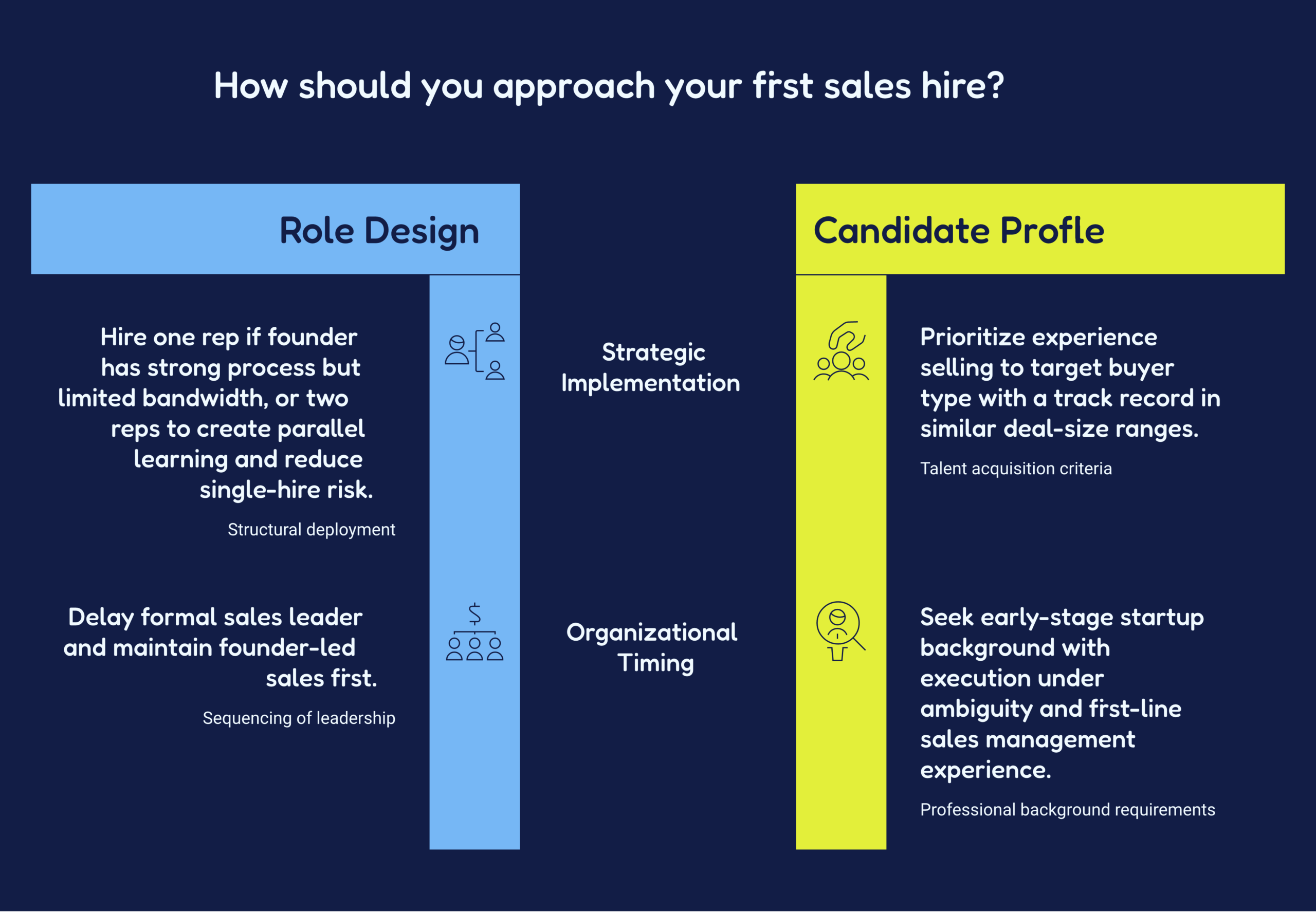
The first sales hire should have experience selling to the same buyer type, within similar deal sizes, and ideally in early-stage startups. Execution under ambiguity is essential because the role demands building repeatable motion, not maintaining an established one.
Role design comes first. Some founders hire a sales assistant to document the existing motion before onboarding a quota-carrying rep. Others skip straight to a full rep once repeatability is clear. The right choice depends on whether the founder needs process support or immediate execution capacity.
Hiring two reps instead of one can accelerate learning if resources allow. With one rep, success or failure is ambiguous. Two create parallel data, benchmark performance, and avoid over-reliance on a single person’s style.
Candidate profile priorities:
- 2+ years selling in startups with similar buyer personas
- Deal-size experience matching the company’s ACV range
- Track record of building process, not just following it
- First-line management interest or experience (optional but valuable)
Kellblog notes that candidates meeting these criteria can shorten onboarding by six to twelve months in 2024. A rep who has closed similar accounts in a startup setting can start producing faster than a large-company seller used to brand pull and established enablement.
Techstars warns that hiring the wrong role too early is a common failure mode. Its 2024 guidance suggests founder-led sales should often last one to two years before a formal sales leader is added. The first hire should carry quota and refine the playbook, not manage a nonexistent team.
FAQ
When is the right time to hire the first sales rep?
Founders should hire their first sales rep once they’ve closed around ten clients, have a repeatable and documented sales motion, and use a basic CRM. Hiring too early risks wasting resources because the rep needs a tested process to replicate, not one they must build from scratch.
How many sales demos should a founder complete before hiring?
Guides suggest completing at least fifty demos with a 15–25% win rate before hiring a rep. This volume indicates predictable buyer behavior and validates messaging. Once these patterns appear consistently, the founder can confidently hand off execution while continuing to refine playbook details.
What signals show founder-led sales is ready to scale?
Key readiness signs include consistent win rates, repeatable discovery-to-close steps, steady growth in paying customers, and a clear sales process stored in a CRM. When founders can document what works and identify why deals convert, it means they’re ready to expand beyond personal selling.
Founder-led sales vs hiring early: which is better for startups?
Founder-led sales is best early because it generates firsthand market insight and validates messaging. Hiring too early can fail without process clarity. Once revenue stabilizes and repeatability is proven, hiring a rep speeds expansion while letting founders focus on product and strategy.
Should I hire one sales rep or two first?
If resources allow, hiring two reps can accelerate learning and comparison testing. With one rep, success or failure is ambiguous. Two allow the founder to benchmark performance, refine scripts faster, and avoid dependence on one person’s style while developing scalable, data-informed processes.
Sales rep vs sales leader: who should come first?
A quota-carrying sales rep usually comes before a leader. Founders should first document and prove their own motion, then train a rep to replicate it. Once a small team achieves repeatable success, hiring a sales leader makes sense to formalize management and scaling.
What should a first sales hire’s background include?
Ideal candidates have experience selling to the same buyer type, within similar deal sizes, and in early-stage startups. Execution under ambiguity is key. Candidates who’ve built motions before and understand smaller-company dynamics can shorten onboarding time and start producing measurable results faster.
When should a founder step back from daily sales deals?
A founder should reduce direct selling once the rep can close predictable deals independently. They should remain involved in reviews, shadowing, and KPI analysis for several months to refine the process. This involvement ensures consistency and teaches the rep how to extend success.