
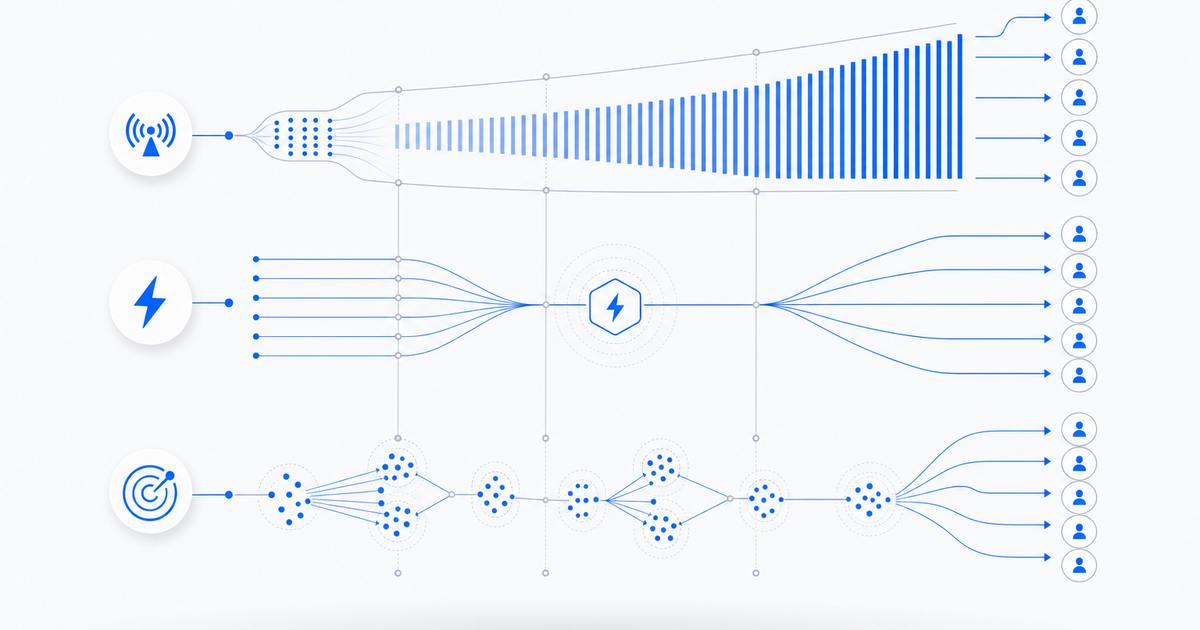
Most outbound teams run one play for every account. A 3-tier system splits your total addressable market (TAM) into volume, trigger, and signal campaigns, matching effort to intent. This guide shows how such a system raises SDR productivity without increasing outreach volume.
Why you need a 3-tier system
A 3-tier outbound system splits your total addressable market into volume, trigger, and signal campaigns. Volume campaigns cover breadth, trigger campaigns react to concrete events, and signal campaigns prioritize accounts that are ready to buy. The same SDR capacity then reaches more qualified conversations without increasing total contacts.
Volume campaigns deliver reach but little context. Trigger-based programs react to funding, leadership changes, or hiring spikes and therefore hit a real occasion more often. Signal campaigns additionally filter by buying signals such as website visits or tool adoption. Reply-rate benchmarks depend heavily on audience and offer, so we deliberately give no blanket figures here.
Illustrative scenario: A SaaS vendor replaces generic mass sequences with a system that prioritizes accounts by volume, concrete trigger events, and buying signals. The same SDR capacity is concentrated on the accounts most likely to buy.
Takeaway: The more concrete the occasion, the more effort per account pays off. The three tiers distribute SDR capacity along that logic.
Tier 1: volume campaigns for systematic TAM coverage
Volume campaigns target every ICP-matched account with standardized multi-channel sequences. A scalable system works with a fixed start rate and a cap on active accounts per SDR. That keeps visibility continuous without over-chasing individual accounts.
The sequences combine email, LinkedIn, and phone to reach different decision makers in the buying committee. Callbox recommends assigning each channel a role: email for volume, phone for warmth, LinkedIn for authority. For contacts in DACH, the rules in the legal section below apply.
Illustrative scenario: A manufacturer sets a volume motion for its full TAM. Each week a fixed number of new ICP accounts enters a standardized multi-channel sequence. That creates baseline awareness and first replies.
- Start rate: a fixed number of new accounts per SDR per day to keep the pipeline filling
- Active cap: a ceiling on simultaneously active accounts to protect quality
- Sequence design: set length and number of touchpoints per segment, longer in enterprise than in mid-market
- Channel mix: email, LinkedIn, and phone combined for broad decision-maker reach
Tier 2: trigger campaigns for event-driven outreach
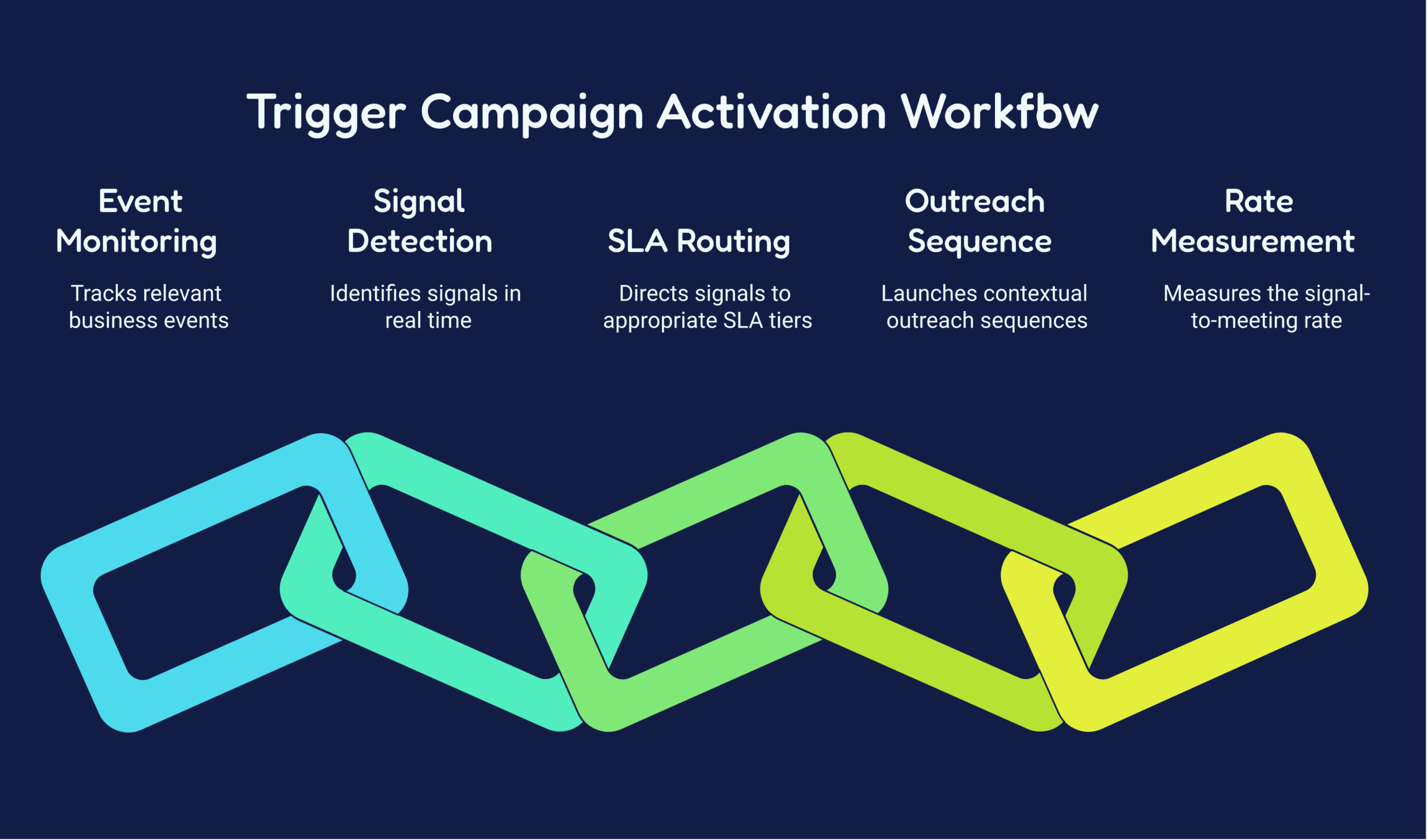
Trigger campaigns activate on relevant events like funding rounds, executive hires, or pricing-page visits. They capitalize on narrow timing windows to reach prospects while the event is still fresh. The framework follows identify, prioritize, automate: detect triggers, score accounts, launch fast-response sequences.
Illustrative scenario: A PLG company monitors senior hiring and product-page visits. When any Tier 1 trigger fires for a high-fit account, a hot sequence launches with a direct meeting ask and context referencing the event.
The skill lies in capturing triggers quickly and turning them into personalized sequences. Enrichment and monitoring tools surface events such as funding rounds, job changes, or technology switches. Automatic alerts allow an immediate reaction.
Best-practice playbooks define hot, warm, and cold triggers with clear response times. Vanderbuild gives an example: hot triggers within two hours, warm the same day, cold signals no trigger. For some intent signals a deliberate delay makes sense: according to Growleads, a seven-day pause improves meeting conversion for most intent signals.
Trigger discipline requires pruning. Weekly reviews remove underperforming events. Teams test a small set of core signals per ICP for a full quarter, measuring signal-to-meeting rate rather than activity volume.
Practical framework for trigger campaigns:
- Identify: capture funding, executive hires, technology changes, expansion signals
- Prioritize: score triggers by ICP fit and urgency
- Automate: start fast-response sequences according to the urgency of the trigger
- Personalize: reference the trigger explicitly in the first touch
Trigger campaigns work when an event indicates new budget, pain, or urgency. Funding announcements and leadership changes create natural entry points. The broader discussion of cold versus warm outreach becomes less relevant when timing matches a real business moment.
Tier 3: signal campaigns as a prioritization layer
Signal campaigns concentrate on accounts showing stacked behavioral, situational, or technographic data, such as website visits, G2 review engagement, or job ads for tools in your segment. Effective setups follow four steps: capture signals, resolve them to accounts, filter by ICP, route into the right sequence. They work primarily as a prioritization layer, not only a personalization layer.
Illustrative scenario: A RevOps team builds a handful of “reach out now” archetypes in an enrichment tool. Each archetype combines tiers of signals: hiring spikes plus tech install plus content consumption. Sequences trigger only when the archetype threshold is hit. The rule is simple: no archetype, no outreach.
Scoring matters. TAM/SAM/SOM segmentation, paired with account scoring, sets pipeline targets and allocates outreach waves. Best-practice signal workflows follow a loop: detect signals, score and prioritize, route owner, trigger play, measure and refine. Quarterly pruning removes signals that do not convert into meetings.
Takeaway: Signal campaigns focus effort where data shows buying intent, raising the odds of winning the deals that matter.
- Capture: track website visits, content downloads, G2 reviews, job postings
- Resolve: map signals to account and decision-maker level
- Filter: route only ICP-fit accounts into signal sequences
- Route: signal strength decides sequence intensity and personalization
Tiering, routing, and sequence governance
A tiering model gives full personalization to ICP accounts with strong signals, partial personalization to accounts with moderate signals, and light, templated outreach to all others. Governance rules such as a time-limited Now status stop signal accounts from blocking capacity indefinitely.
Illustrative scenario: A software vendor defines: Tier 1 plus strong signals gets a 1:1 personalized sequence. Tier 2 plus moderate signals gets a partly personalized sequence. Tier 3 plus no signals gets a low-touch volume sequence. Now accounts without progress are downgraded after a fixed period.
Typical tiering model:
- Tier 1 + strong signals: 1:1 personalization, intensive SDR work, time-limited Now status
- Tier 2 + moderate signals: partial personalization, standardized sequence, Later status
- Tier 3 + no signals: templated volume sequence, low-touch motion
Trigger-based programs should track reply quality. A rising HOT+WARM share at the same total reply rate counts as a success signal. For every trigger and signal setup, metrics such as signal-to-response rate, signal-to-meeting rate, and deal velocity are worth tracking.
Illustrative scenario: A B2B team compares volume, trigger, and signal campaigns monthly by HOT+WARM reply rate, meetings per 100 contacts, and pipeline per SDR hour. Budget shifts step by step from pure volume efforts to the most profitable signal streams.
Orchestration: automating the 3-tier system
Automation handles sequencing, routing, and follow-up, assigning accounts to the volume, trigger, or signal tier based on fit and behavior. When a key trigger appears, systems enroll contacts automatically and notify reps, ensuring consistent timing and cleaner data across your outbound motion.
Sales automation removes repetitive tasks like lead research and follow-ups. It keeps high-context conversations human while the system manages low-judgment work. Intent providers feed the CRM and sales engagement platform. When a signal threshold is crossed, the system enrolls contacts into the right sequence and creates tasks for reps.
Metrics vary by tier:
- Volume campaigns: reply rate and meeting rate across full TAM
- Trigger campaigns: meetings booked and speed to response by event
- Signal campaigns: win rate and deal size by archetype
Measuring separately helps refine each tier. One pointer to the shift from activity to pipeline outcomes: in HubSpot’s 2026 report, 39% of surveyed marketers named lead quality and MQLs and 34% named lead-to-customer conversion rate as top metrics.
Takeaway: Automation and tier-specific measurement turn the 3-tier system into a repeatable engine that scales without adding headcount.
Legal framework for outreach
A trigger is not a license for cold email. In Germany, advertising by email without the addressee’s prior express consent is not permitted, also in B2B (Section 7(2) no. 2 UWG). An exception applies only to existing customers under the narrow conditions of Section 7(3) UWG. For advertising calls to businesses, at least presumed consent is required (no. 1). Legitimate interest under Art. 6(1)(f) GDPR concerns data processing but does not replace the consent required under the UWG. This is not legal advice.
FAQ
What is a 3-tier outbound system in B2B sales?
A 3-tier outbound system combines volume, trigger, and signal campaigns to cover your total addressable market. It starts with broad reach, uses event triggers for relevance, and uses signals to prioritize the accounts closest to buying.
How do volume and trigger campaigns differ?
Volume campaigns aim for broad reach and awareness, while trigger campaigns react to concrete events such as funding or leadership changes. Relevance and reply quality rise because the message fits a real occasion.
How do signal campaigns differ from volume campaigns?
Signal campaigns concentrate on accounts showing stacked behavioral, situational, or technographic signals. They use deeper personalization and more touchpoints, while volume campaigns prioritize reach and consistency across the whole TAM.
What is the difference between trigger-based and signal-based outbound?
Trigger-based outbound rests on external events such as leadership changes or funding rounds. Signal-based outbound captures digital buying-intent signals such as website visits or job postings. Together they form a prioritization layer for outreach.
How should you automate a 3-tier outbound system?
Automation handles sequencing, routing, and follow-up and assigns accounts to a tier based on fit and behavior. When a relevant trigger appears, the system enrolls the contact in the right sequence and notifies the sales rep.
How do you measure success across volume, trigger, and signal tiers?
Metrics vary by tier: reply and meeting rate across the full TAM for volume campaigns, meetings booked and speed to response by event for trigger campaigns, and win rate and deal size by archetype for signal campaigns.
What legal rules apply to cold outreach in DACH?
Email advertising in Germany requires prior express consent, also in B2B (Section 7(2) no. 2 UWG). The only exception is existing customers under Section 7(3) UWG. Advertising calls to businesses require at least presumed consent (no. 1). This is not legal advice.