
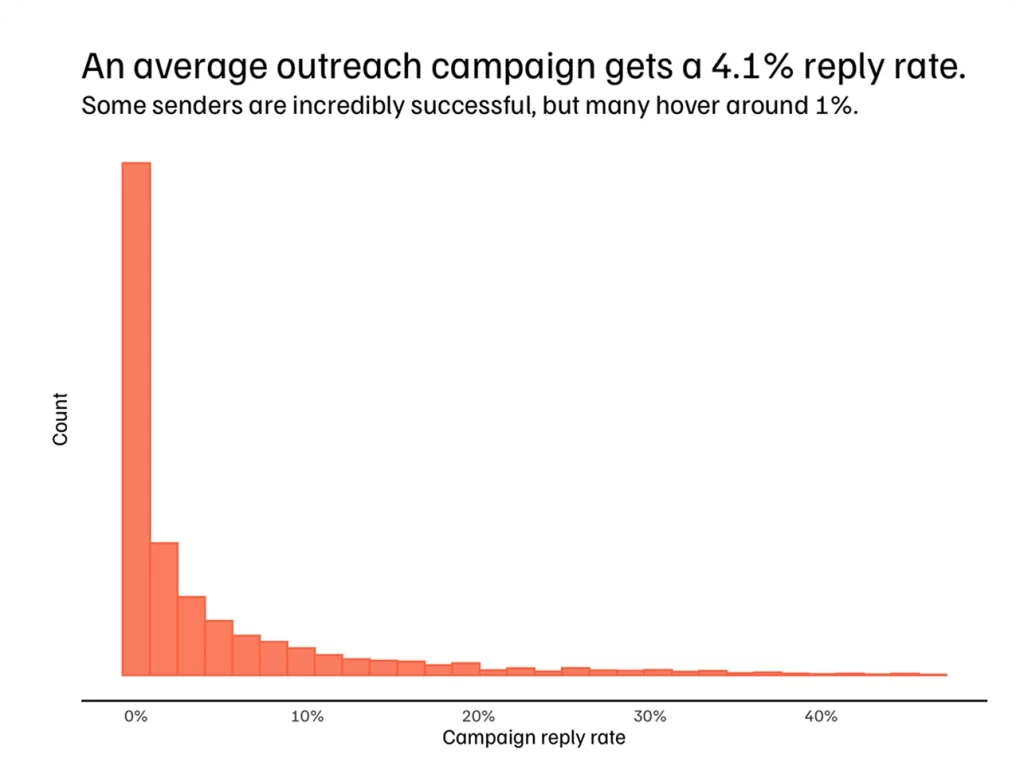
The 30 30 50 rule is a simple rule of thumb for structuring a cold email: a personal opening, a clear benefit and one unmistakable next step. As the explanation from Growleady shows, it describes shares of the email content. The provider cites no study for it. What a campaign delivers depends mainly on personalization and follow-ups, according to Hunter data: the average reply rate of a sequence there is 4.5%.
Key Takeaways
- The rule weights a single email in three parts: 30% personal opening, 30% value proposition and 50% clear call to action (Growleady); the numbers are a rule of thumb, not a measurement
- The average reply rate of a cold email sequence is 4.5%; three messages instead of one increase total replies by 106% (6.8% versus 3.3%) (Hunter, State of Cold Email 2025)
- Two custom attributes in the body give a 5.6% reply rate, without personalization it is 3.6% (Hunter)
- More than three follow-ups lower the average reply rate according to Hunter, so more follow-up is not automatically better
- In Germany, cold email requires prior express consent even in B2B (Section 7(2) no. 2 UWG)
Understanding the 30/30/50 Cold Email Rule
The rule splits the content of a cold email into three parts: 30% personal opening, 30% value proposition and 50% clear call to action. This definition comes from the explanation by Growleady. The percentages add up to 110, so they are a weighting rather than an exact split: the call to action gets the most weight because it decides whether someone replies.
One caveat matters: there is no published study behind the rule. It is neither a time budget nor scientifically grounded. What is supported are individual levers that match the three parts, which we classify below with Hunter data.
Why Following Up Matters
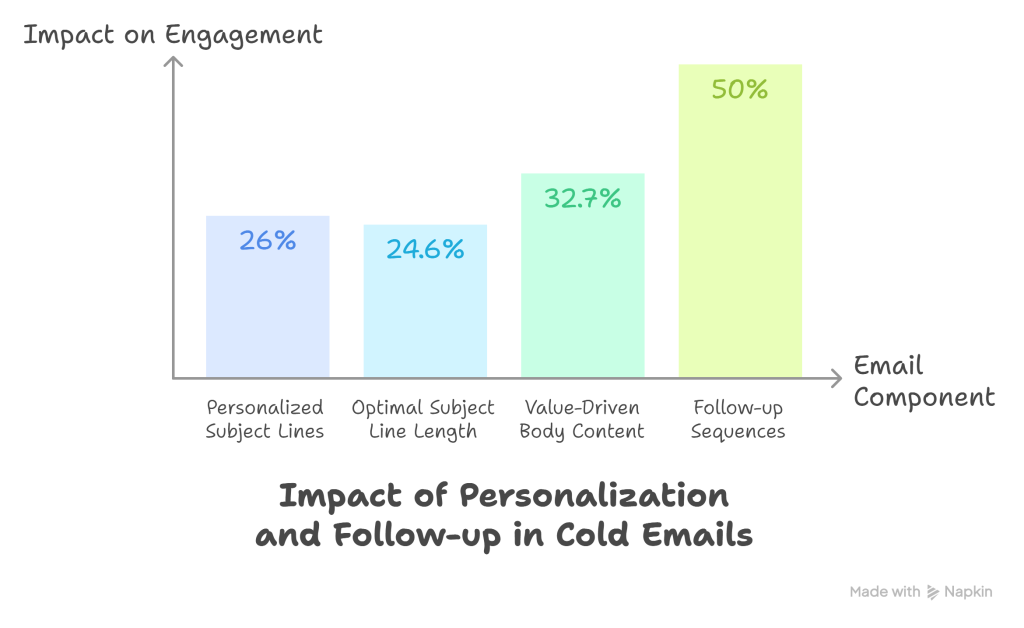
The evidence for follow-ups is much stronger than the evidence for the rule itself. Hunter found that three messages instead of one increase total replies by 106% (6.8% versus 3.3%). The first message alone earns a 2.9% reply rate, and two follow-ups roughly double that.
That does not mean you should send as many messages as possible. In the same analysis, sequences with three or more follow-ups have a lower average reply rate, and Hunter recommends three emails in total.
The Personal Opening: Subject Line and First Sentence
The opening decides whether your email gets read. According to Hunter, subject lines with two custom attributes have a 14% higher open rate than those with one (40.2% versus 35.4%). For length, Hunter names 5 to 6 words as the sweet spot for the average reply rate.
Effective openings go beyond “I hope this email finds you well”. The first sentence should address a concrete trigger or problem of the recipient, such as a funding round, a product launch or a job posting.
Technical Deliverability Requirements
Before you polish subject lines, the technology has to work. Google requires senders of more than 5,000 messages per day to Gmail addresses to set up SPF, DKIM and DMARC, offer one-click unsubscribe and keep the spam rate below 0.30% in Postmaster Tools (Google, bulk sender requirements). Even if you send less, these are sensible benchmarks.
New domains should be warmed up gradually instead of sending large volumes at once. This protects sender reputation and prevents blacklisting.
Personalization That Works
Personalization means more than inserting a company name. In the Hunter analysis, the reply rate is 5.6% for bodies with two custom attributes and 3.6% without personalization (Hunter). Behavioral triggers such as funding rounds or new executives provide authentic hooks.
For a successful B2B strategy, it pays to define industry-specific triggers. SaaS companies tend to respond to efficiency topics, financial services to compliance.
The Value Proposition: Brevity and Relevance
The body has to answer why the recipient should invest their time. An ideal word count cannot be derived from the data: according to Hunter, emails of 61 to 80 words get comparatively high reply rates, and so do those of 181 to 200 words. What matters is that every sentence contributes to the benefit for the recipient.
Avoid spam trigger words such as “free” or “guaranteed” and put the benefit for the recipient before your product.
Industry-Specific Adjustments
Different industries need different approaches. SaaS audiences care about problem and solution, financial services about compliance and risk, industrial companies about reliability and process safety. We cannot support specific conversion rates per industry and therefore do not quote them.
Behavior-Based Personalization
Triggers such as leadership changes, funding rounds or job postings can be monitored with data sources and alerts. The key is the balance between automation and a human touch: tools collect the data, but linking it into a relevant message remains a human task.
The Clear Call to Action and Follow-Ups
The call to action usually gets the most weight. A concrete, small next step such as “Would a 15-minute call on Thursday work?” lowers the barrier more than a vague request like “Learn more”. We cannot support a number for the difference. Limit yourself to exactly one call to action and put it at the end of the email.
Follow-Up Sequences That Work
Plan about three messages in total, as the analysis by Hunter suggests. Each follow-up should add new value, such as a case, an industry figure or a relevant insight. Simply repeating the first message backfires.
A comprehensive outreach strategy also covers further channels and touchpoints.
Timing and Frequency
We did not find reliable figures for the best weekday or time window, so we quote none. Test send times with your own audience and space the messages so the recipient does not feel pressured.
The Legal Framework in Germany
Cold email to businesses in Germany is an unreasonable nuisance without the addressee’s prior express consent (Section 7(2) no. 2 UWG). This applies in B2B as well. The exception in Section 7(3) UWG applies only under narrow conditions: you obtained the address in connection with a sale, you advertise your own similar goods or services, the customer has not objected and is told of the right to object with every use. For advertising calls to businesses, at least presumed consent is required (no. 1).
Legitimate interest under Art. 6(1)(f) GDPR only concerns whether you may process data. It does not replace the consent required under the UWG. If you do not collect data directly from the person, Art. 14 GDPR also requires you to inform them at the latest at the time of the first communication. This is not legal advice; clarify your approach with a lawyer if in doubt.
Measurement and Common Mistakes
Measurement and Optimization
Track open rate, reply rate, share of positive replies and bounce rate per sequence. For context: the average reply rate of a sequence is 4.5% according to Hunter. Derive your own targets from your own data, not from blanket promises.
Critical Mistakes
The most common mistake is neglecting follow-ups and putting all the energy into one perfect email. The second is poor list hygiene: outdated addresses and spam traps destroy sender reputation. Clean your list regularly and validate every address before sending.
Many companies also fail because they do not understand why cold emails fail and how real personalization works.
Content mistakes are common too: too many senders talk about their own product instead of the benefit for the recipient. The right tone varies by audience and industry; too formal feels distant, too casual feels unprofessional.
FAQ
How do I apply the 30/30/50 rule in practice?
You weight the content of your email: about 30% personal opening, 30% value proposition and the most weight on a single clear call to action. According to Growleady, the values are a rule of thumb without study evidence, not a time budget and not an exact split.
What tools do I need to implement it?
You need a sending tool with sequences, authenticated sender domains (SPF, DKIM, DMARC, see Google), address validation before sending and a CRM for reporting. Which vendors you pick matters less than clean technology and list quality.
How do I measure the success of my campaigns?
Track open rate, reply rate, positive replies and bounce rate per sequence. For context, Hunter reports 4.5% as the average reply rate of a sequence (Hunter). Review weekly and test one variable at a time.
What is the biggest mistake when implementing it?
Following up too little or too much. According to Hunter, three messages instead of one increase total replies by 106%, while more than three follow-ups lower the average reply rate.
May I send cold emails to companies in Germany?
Only with the addressee’s prior express consent (Section 7(2) no. 2 UWG), also in B2B. For calls to businesses, at least presumed consent is required. Legitimate interest under Art. 6(1)(f) GDPR only covers data processing.